

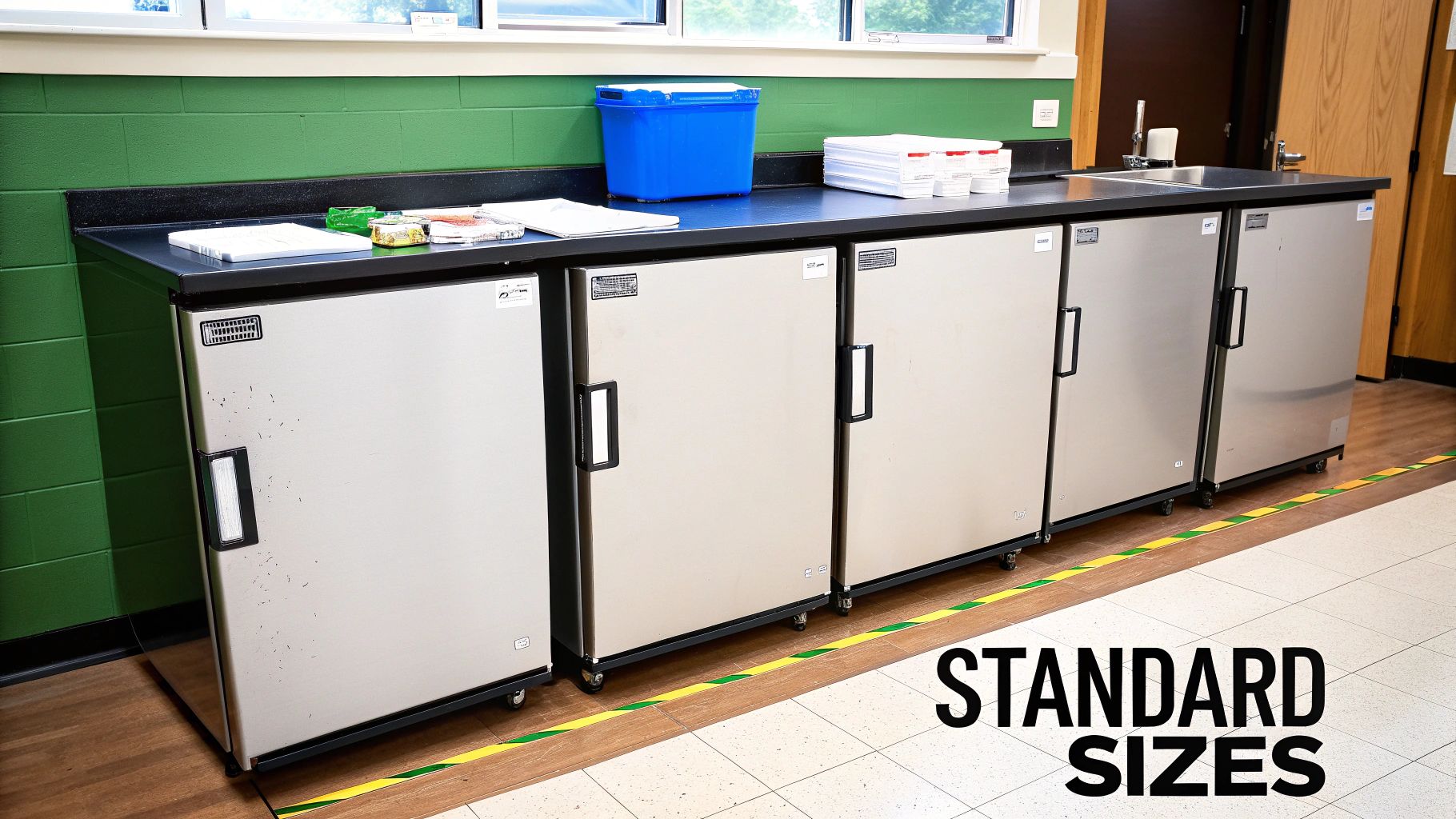
Picking the right undercounter refrigerator can feel like a puzzle, but it really boils down to a few key measurements. Most of the undercounter refrigerator sizes you’ll see on the market fall between 24 to 72 inches wide. They’re almost always around 30 inches deep and built to slide right under a standard 36-inch countertop. Think of these dimensions as the starting point for a smarter, more efficient kitchen.
Finding the Perfect Fit for Your Kitchen
Choosing an undercounter unit is more than just plugging a hole in your prep line; it's a strategic move that can make or break your kitchen’s flow. Whether you're setting up a busy Seattle coffee bar or a high-volume restaurant kitchen, the right size gives your crew instant access to what they need without wasting time or taking extra steps. A unit that’s too small will have you restocking constantly, but one that's too big is just eating up floor space you can't afford to lose.
Here at Seattle Restaurant Equipment, we see it all the time—how getting the dimensions right can completely change how a kitchen operates. From a small under counter freezer tucked away at the bar to a wide sandwich prep table that becomes the heart of your lunch rush, every piece has its place. The real goal is to create that seamless workflow where your commercial refrigerators, commercial freezers, and even deep fryers work together like a well-oiled machine.
Common Sizes and Applications
To get a better sense of what you need, let’s talk about real-world scenarios. That little 24-inch unit? It’s a perfect fit for a coffee shop’s milk and cream station. A much larger 60-inch model, on the other hand, can hold all the toppings for a bustling pizza prep line. Taking a look at the full range of commercial under counter refrigerators is the best way to match the gear to the job.
The most crucial step is matching the unit's footprint to its intended function. A well-chosen refrigerator becomes an extension of your prep line, not an obstacle within it.
To make things even clearer, we put together this quick-reference table. It lines up the common undercounter refrigerator widths with their typical applications here in the Seattle area.
Common Undercounter Refrigerator Sizes and Applications
| Standard Width | Typical Capacity (Cubic Ft.) | Best For (Seattle Use Case) |
|---|---|---|
| 24 inches | 5-7 cubic feet | A coffee shop's milk station or a bar's garnish storage. |
| 36 inches | 9-12 cubic feet | A small prep area or as supplementary cold holding. |
| 48 inches | 12-15 cubic feet | A standard bar back or a small sandwich prep station. |
| 60 inches | 15-18 cubic feet | A high-volume deli or a busy kitchen's main prep line. |
| 72 inches | 18-22 cubic feet | Large-scale food preparation or as a primary ingredient cooler. |
Use this as a starting point to figure out what footprint makes the most sense for your space and your menu. Getting this right from the start saves a lot of headaches down the road.
How to Decode Refrigerator Dimensions
Looking at a spec sheet for undercounter refrigerator sizes can feel like trying to crack a secret code. But once you get a handle on what width, height, and depth actually mean for your kitchen, you can start building a much smarter, more efficient workspace. These aren’t just random numbers; they’re the building blocks of your kitchen’s entire layout and flow.
Each measurement has a job to do. Width decides how much horizontal real estate the unit eats up, depth affects how far it juts into your precious aisle space, and height is the make-or-break factor for sliding it perfectly under your counters. Nail these three, and you're already on your way to a smooth, headache-free installation.
Width: The Key to Access and Capacity
The width of an undercounter refrigerator is probably its most important feature. It directly impacts how many doors you get and how your team will actually use the thing day in and day out. Standard widths like 24", 48", or 72" typically correspond to single, double, or triple-door units.
A slim 24-inch model is perfect for a tight spot, like a Seattle coffee shop refrigerator that just needs to hold milk and syrups. On the other hand, a sprawling 72-inch unit gives you massive storage for a busy prep line, letting multiple cooks grab what they need without bumping elbows. This one choice can seriously speed up your whole operation.
Height: Standard vs. ADA-Compliant Models
Height is all about the fit. Get it wrong, and you've got a big, expensive problem. Most commercial countertops are built to a standard height of 36 inches, so most undercounter units are designed to slide right in, usually measuring about 35.5 inches tall.
But it’s not just about fitting. Accessibility is a huge deal. For any business that needs to comply with the Americans with Disabilities Act (ADA), you can't just buy any model off the shelf.
ADA-compliant undercounter refrigerators are built with a maximum height of 34 inches. This lower profile guarantees they fit under accessible countertops, giving wheelchair users the right clearance and an easy reach.
Choosing the right height isn't just about making sure your equipment fits physically. It’s also about meeting crucial regulations and creating a kitchen that works for everyone on your team. At Seattle Restaurant Equipment, we stock models that cover both standard and ADA requirements.
Depth: Balancing Storage and Aisle Space
Depth determines how far your refrigerator sticks out from the wall, a critical measurement for keeping walkways clear and safe in a chaotic kitchen. The majority of units have a depth around 30 to 32 inches, which lines up nicely with standard commercial counters and other gear like sandwich prep tables.
Getting the depth right is essential for a smooth workflow. Picture a prep line with an under counter freezer, a sandwich station, and a deep fryer all side-by-side. If one unit sticks out a few inches further than the others, you’ve just created a bottleneck and a trip hazard. By picking units with matching depths, you create a flush, organized, and much safer line. That kind of smart planning keeps your kitchen humming along without a hitch.
How to Measure Your Space for a Flawless Installation
Getting the manufacturer's listed dimensions for an undercounter refrigerator is only half the battle. The other half is knowing the actual space you have to work with. A perfect fit—and a flawless installation—boils down to getting your measurements right from the start to avoid some seriously costly surprises.
Trust me on this one: the old saying "measure twice, order once" is your best friend here. Before you even think about ordering, grab a tape measure and check the width, height, and depth of your opening. And don't just measure one spot. Floors settle and walls aren't always perfectly plumb, so measure the width at the top, middle, and bottom. Do the same for the height. You’d be surprised how often a slight dip in the floor can create a tight spot you'd otherwise miss.
The Importance of Breathing Room
Even if your measurements are dead-on, you can't just cram a refrigerator into a perfectly sized hole and call it a day. Every single piece of commercial refrigeration needs "breathing room" to ventilate properly. If the compressor can't breathe, it will overheat. That leads to poor cooling, sky-high energy bills, and eventually, total equipment failure—a nightmare for any busy kitchen.
The clearance you need all depends on how the unit breathes:
- Front-Breathing Units: These are your go-to for any built-in setup. The vents are right on the front grille, pulling in and pushing out air from the same direction. This design means you can install them flush against back walls and right next to other cabinets without any issues.
- Rear-Breathing Units: These models are a different story. They need several inches of open space at the back and on the sides for air to circulate. They are absolutely not meant for tight, enclosed spaces and will burn out quickly if their ventilation is blocked.
This simple visual breaks down the three core measurements you'll need to lock down for a successful installation.
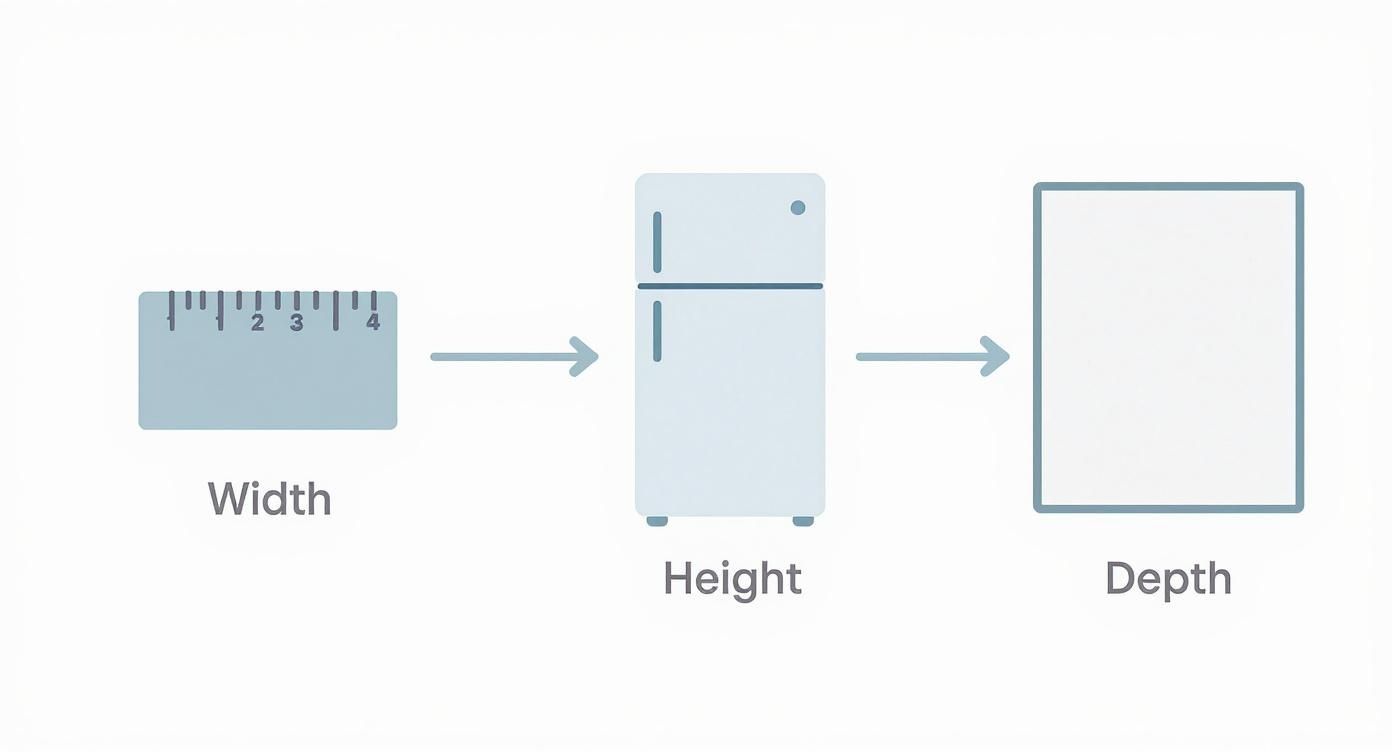
Getting the width, height, and depth right is the absolute foundation for a smart equipment purchase.
A rookie mistake is only measuring the front of the opening. Always, always check the back for things like pipes, electrical outlets, or chunky baseboards that can completely derail your installation plans.
For our Seattle-area customers setting up a bar, prep line, or coffee shop, a front-breathing model is almost always the right call. It ensures your under counter refrigerator, under counter freezer, or prep table runs like a champ without demanding extra wiggle room. Understanding this ventilation difference is key to protecting your investment and keeping your kitchen running smoothly.
Matching Refrigerator Size to Your Business
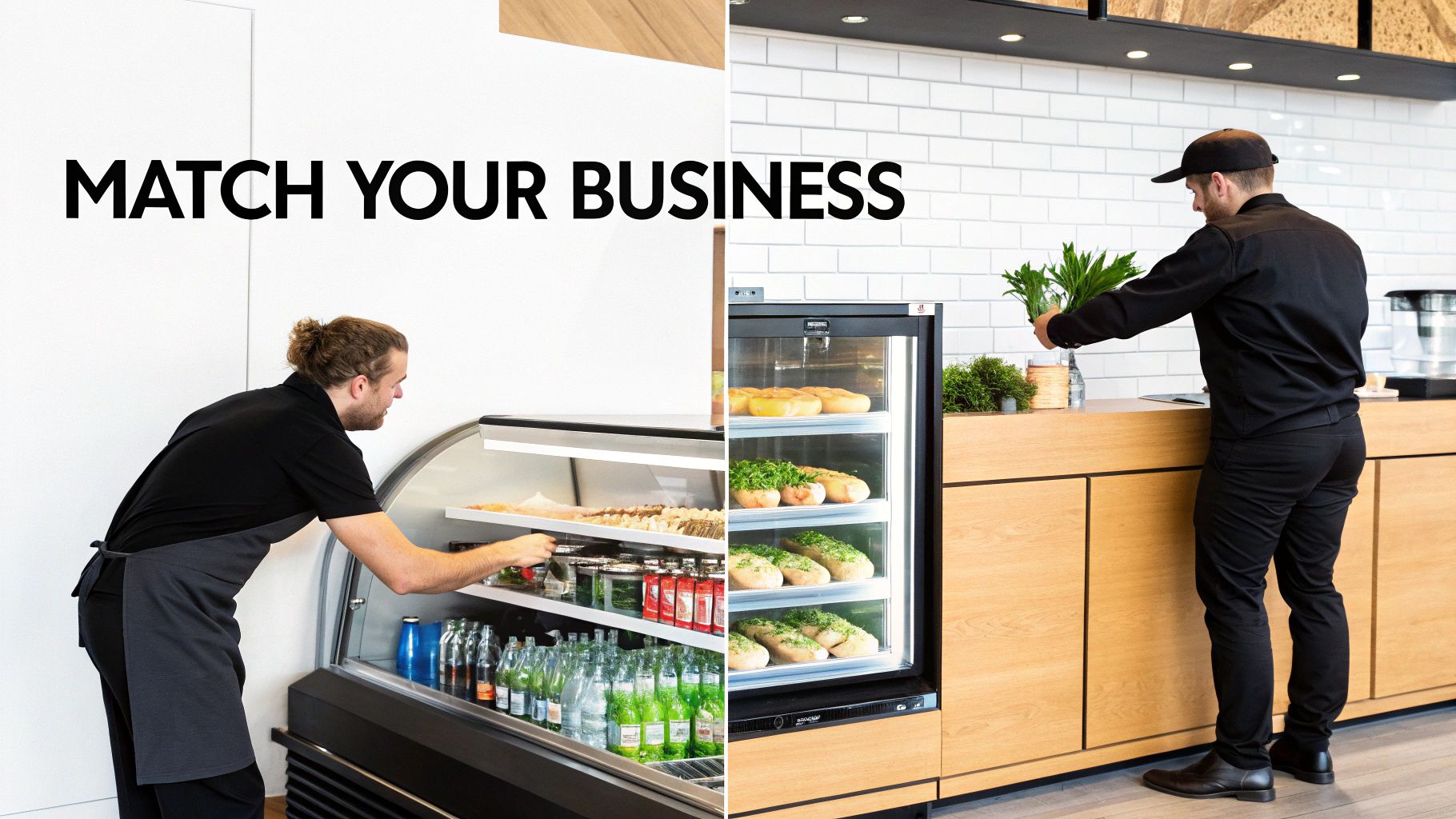
Choosing the right undercounter refrigerator isn't just about finding something that fits a hole in your counter. It's a strategic move that can make or break your kitchen's flow, your staff's sanity, and even how quickly you can serve a customer. The real goal is to build a seamless operation where every piece of equipment has a clear purpose and is exactly where it needs to be.
Picture a high-volume Seattle bar getting slammed during happy hour. A roomy 48-inch glass-door refrigerator is a game-changer. It gives bartenders an instant visual of their most popular bottles and garnishes, cutting down search time and getting drinks out faster.
Aligning Equipment with Your Workflow
Now, think about a busy sandwich shop. Their needs are completely different. For them, a 60-inch sandwich prep table is the heart of the entire line. These specialized units are brilliant—they combine refrigerated wells for toppings with a built-in cutting board, creating a self-contained workstation that slashes unnecessary steps and streamlines the whole assembly process.
This idea of matching the tool to the task applies to every kind of food business out there:
- Seattle coffee shop refrigerators: A compact 24-inch solid-door unit is perfect for stashing milk, creamers, and syrups right under the espresso machine, keeping the barista station clean and efficient.
- Pizza Prep Tables: A massive 72-inch pizza prep table gives your crew enough refrigerated space for a huge variety of toppings, all within arm's reach of the dough.
- Food Trucks: In a mobile kitchen where every inch is gold, a slim 36-inch undercounter freezer provides crucial frozen storage without hogging precious floor space.
The demand for this kind of purpose-built equipment is growing fast. The commercial refrigeration market was valued at $4.73 billion in 2024 and is expected to climb to $8.39 billion by 2035, all thanks to the needs of modern restaurants, cloud kitchens, and shops.
More Than Just Refrigerators
At Seattle Restaurant Equipment, we help businesses think bigger. We don't just sell you a box; we help you build out entire workstations. That could mean pairing an under counter freezer with a nearby deep fryer for a dedicated frying station or setting up a glass-door unit next to your other Seattle bar equipment for a perfectly organized back bar.
You can check out our huge collection of commercial refrigerators in Seattle to find the right piece for any setup you can imagine.
The ultimate goal is to reduce wasted steps. When your team can pivot instead of walk to get what they need, you save seconds on every single order. Over the course of a day, that adds up to a faster, more profitable operation.
By thinking carefully about your menu, your daily volume, and your kitchen layout, you can pick the perfect undercounter refrigerator sizes from our inventory. This ensures your equipment is actively helping you hit your goals, whether that’s faster service, more efficient prep, or a less chaotic food truck. It’s all about making your space work smarter, not harder.
Understanding Capacity Beyond External Size
It’s a classic trap: two undercounter refrigerators look identical on the outside, so they must hold the same amount of stuff, right? Not so fast. The real story is told by the cubic foot capacity—the true measure of usable space inside. Think of it like packing a suitcase. It’s not just the size of the luggage that matters, but how well the interior is designed.
The total volume on a spec sheet can be deceiving. Things like thick insulation, the location of the compressor, and the shelf layout all take a bite out of the raw internal space. A unit with a bulky, bottom-mounted compressor might steal precious floor space, while another with adjustable shelves gives you the freedom to store odd-sized bottles and containers.
How Usable Space Impacts Your Operations
You have to think about what you’re actually storing. A busy sandwich line that needs to hold full-size hotel pans has totally different needs than a Seattle bar stocking slender bottles and cans. A fridge with poorly spaced, fixed shelves can turn into a nightmare if you need to store tall items, even if its cubic foot rating looks impressive on paper.
This is exactly why you have to look beyond the numbers and picture your daily workflow.
- A Sandwich Prep Table: You'll want shallow, wide compartments for quick access to a bunch of different ingredient pans.
- An Undercounter Freezer: Deep, open space is your friend here, making it easy to stack boxed frozen goods.
- A Seattle Coffee Shop Fridge: This is all about flexibility. You need adjustable shelves to fit gallons of milk right next to smaller cartons of cream and alternative milks.
The Sweet Spot for Commercial Kitchens
For most kitchens, that perfect balance of storage and footprint falls right in the 5 to 10 cubic foot range. This size gives you plenty of room for daily prep without taking over your entire line, making it a go-to choice for everything from undercounter freezers to bar coolers.
The numbers back this up. The global market for undercounter refrigerators hit around $3.2 billion in 2024, and models between 5 and 10 cubic feet grabbed the biggest piece of the pie—nearly 50% of the revenue share. It’s clear this size is the workhorse of the industry.
It's not about the total volume, but how you can use it. A well-designed interior with efficient shelving and minimal mechanical intrusion will always outperform a unit with a higher cubic foot rating but a poorly planned layout.
At the end of the day, maximizing your storage is about smart design, not just raw space. And as a bonus, better insulation means the compressor runs less, which saves you real money on your energy bill. To learn more about how design impacts your bottom line, check out our guide on energy-efficient commercial refrigeration.
Picking the right undercounter refrigerator is a big deal, but it's not a decision you have to make on your own. If you remember anything, remember this: measure your space like your life depends on it, match the unit to how you actually work, and always, always plan for proper ventilation. Getting that right is where we come in.
The team at Seattle Restaurant Equipment does more than just sell boxes that get cold. We're here to talk you through the options and help you land on the perfect commercial refrigerator, under counter freezer, or sandwich prep table that fits what you're trying to do. Our whole goal is to make sure the equipment you buy becomes a workhorse for your business, not just another appliance taking up space.
A Complete Equipment Solution
We're set up to support Seattle-area businesses with everything they need to succeed. Our warehouse is stocked with everything from Seattle coffee shop refrigerators and pizza prep tables to heavy-duty deep fryers. Whatever the job, we have the commercial-grade unit for it.
It's funny how trends in commercial kitchens often follow what's happening in homes. Take the residential undercounter refrigerator market—it was valued at $4.5 billion in 2023. The most popular models are in that 5 to 10 cubic foot range, which happens to be the sweet spot for capacity and efficiency that we see in so many commercial kitchens, too. You can discover more insights about this growing market and see how it shapes equipment design.
At Seattle Restaurant Equipment, we mix deep product knowledge with a real desire to see your business do well. We’re here to help you build an efficient, reliable kitchen from the ground up.
We know a new unit is a big investment, which is why we offer flexible financing options built for foodservice businesses. Once you’ve picked your unit, we provide fast, reliable installation all over Washington to get your new commercial freezer or Seattle bar equipment humming along quickly. From the first conversation to the final setup, we’re here to help your business thrive.
Frequently Asked Questions
When you're diving into the world of commercial undercounter refrigeration, a few questions always seem to pop up. Let's tackle some of the most common ones we hear from restaurant and bar owners across Washington.
What Makes an Undercounter Refrigerator ADA-Compliant?
An ADA-compliant undercounter refrigerator is all about accessibility. The biggest requirement is height—it has to be 34 inches tall or less to slide neatly under accessible countertops. This leaves the right amount of clearance for wheelchair users to work comfortably.
But it's not just about height. The controls also need to be designed for easy use. That means no tight grasping, pinching, or twisting motions are required to operate them. Here at Seattle Restaurant Equipment, we stock a range of ADA-compliant commercial refrigerators and commercial freezers to help you keep your establishment accessible and up to code.
What Is the Difference Between Front-Breathing and Rear-Breathing Units?
This all comes down to where the unit pulls in and pushes out air, which is a huge deal for performance.
Front-breathing units have all their vents on the front grille. This design is a game-changer because it lets you install them completely flush within your cabinetry without worrying about overheating. They are the go-to choice for tight, built-in spots like under a bar or in a custom prep station.
Rear-breathing models, on the other hand, need room to breathe. They require several inches of clearance at the back and on the sides to keep the compressor from working itself to death. If you block that airflow, the unit will run inefficiently and eventually fail. For just about any commercial built-in application, front-breathing is the way to go.
Choosing a residential model for a commercial kitchen is a costly mistake. It will likely fail under the stress, void its warranty, and could result in health code violations, putting your business at risk.
Can I Use a Residential Refrigerator in a Commercial Kitchen?
We get this question a lot, and the answer is a hard no. A residential fridge in a professional kitchen is a recipe for disaster, and here's why.
Commercial-grade units—from under counter freezers to sandwich prep tables—are built like tanks. They have powerful compressors and tough materials made to handle the heat and non-stop pace of a busy kitchen. A home unit just can't keep up.
More importantly, commercial equipment is certified by organizations like NSF to meet strict health and safety codes, which is something residential models don't have. Your home fridge simply isn't designed to hold safe food temperatures in a demanding environment, and a health inspector will spot it immediately.
Find the right size and type of undercounter refrigerator for your business at Seattle Restaurant Equipment. Explore our full collection of commercial refrigeration solutions online today.