

Choosing the best commercial freezer for your business really comes down to one thing: balancing solid performance with long-term value. Get it right, and you'll save thousands in protected inventory and lower energy bills. A commercial freezer isn't just another appliance; it's the guardian of your products, the silent hero in your kitchen that works 24/7 to keep your quality and safety standards high.
Your Freezer: The Cornerstone of Kitchen Operations
Think of your commercial freezer as the foundation of your kitchen's entire inventory system. You wouldn't build a restaurant on a shaky foundation, right? The same logic applies here. The wrong freezer can lead to devastating product loss, a clunky workflow, and shockingly high utility bills.
A high-quality unit does so much more than just keep things cold. It creates a stable, reliable environment that protects the flavor, texture, and safety of everything you store—from your most expensive cuts of meat to delicate, house-made pastries.
For any Seattle foodservice business—a bustling restaurant, a cozy café, or a high-volume bar—your refrigeration system is the heart of your operation. It’s an entire ecosystem of cold storage working together.
- Commercial Refrigerators and Freezers: These are the daily workhorses for all your fresh and frozen ingredients.
- Sandwich and Pizza Prep Tables: This equipment brings cooling right into your prep line, which speeds up assembly and keeps everything at a safe temperature.
- Under Counter Freezers and Refrigerators: Absolutely essential for squeezing every bit of utility out of tight spaces, like under a Seattle coffee shop's milk station or a bar’s cocktail prep area.
- Deep Fryers and Other Cooking Equipment: While they're on the hot side of things, where you place them and how much heat they kick out has a huge impact on your kitchen’s cooling needs.
It's More Than Just a Box
When you pick the right equipment from Seattle Restaurant Equipment's extensive catalog, you’re making a smart investment in how smoothly your business runs. A well-chosen freezer, especially when paired with complementary gear like under counter refrigerators or specialized Seattle bar equipment, creates a seamless workflow. This synergy cuts down on extra steps for your staff, speeds up service, and makes for happier customers. It’s a strategic choice that directly impacts your bottom line.
A reliable commercial freezer is one of the biggest investments a foodservice business can make. This isn't the place to cut corners. A single equipment failure can wipe out thousands of dollars in inventory overnight—far more than the initial cost of a quality unit.
The demand for this essential equipment is booming. The global market for commercial refrigeration, which includes the freezers that are vital for restaurants and retail, flew past USD 85.6 billion in 2024. It’s projected to hit a staggering USD 161 billion by 2034. This explosion reflects just how much we all rely on frozen and processed foods, cementing the freezer's central role in any modern kitchen. You can learn more about these commercial refrigeration market trends here.
Finding the Right Freezer for Your Kitchen's Flow
Picking out a commercial freezer isn't a one-size-fits-all deal. It's really about matching the equipment to the unique rhythm of your kitchen. A chef wouldn’t use a cleaver for delicate slicing, and you shouldn’t grab just any freezer without thinking about how you’ll use it. The right model slides right into your workflow and makes everything smoother. The wrong one? It just creates traffic jams and eats up precious floor space.
The first step is to figure out its main job. Are you looking for a unit to support the daily hustle on a busy prep line, or do you need a deep-freeze vault for your bulk inventory? Answering that question will point you straight to the perfect fit.
This little decision tree can help you picture which freezer types make sense for different spots, whether you're running a full-service restaurant or a cozy café.
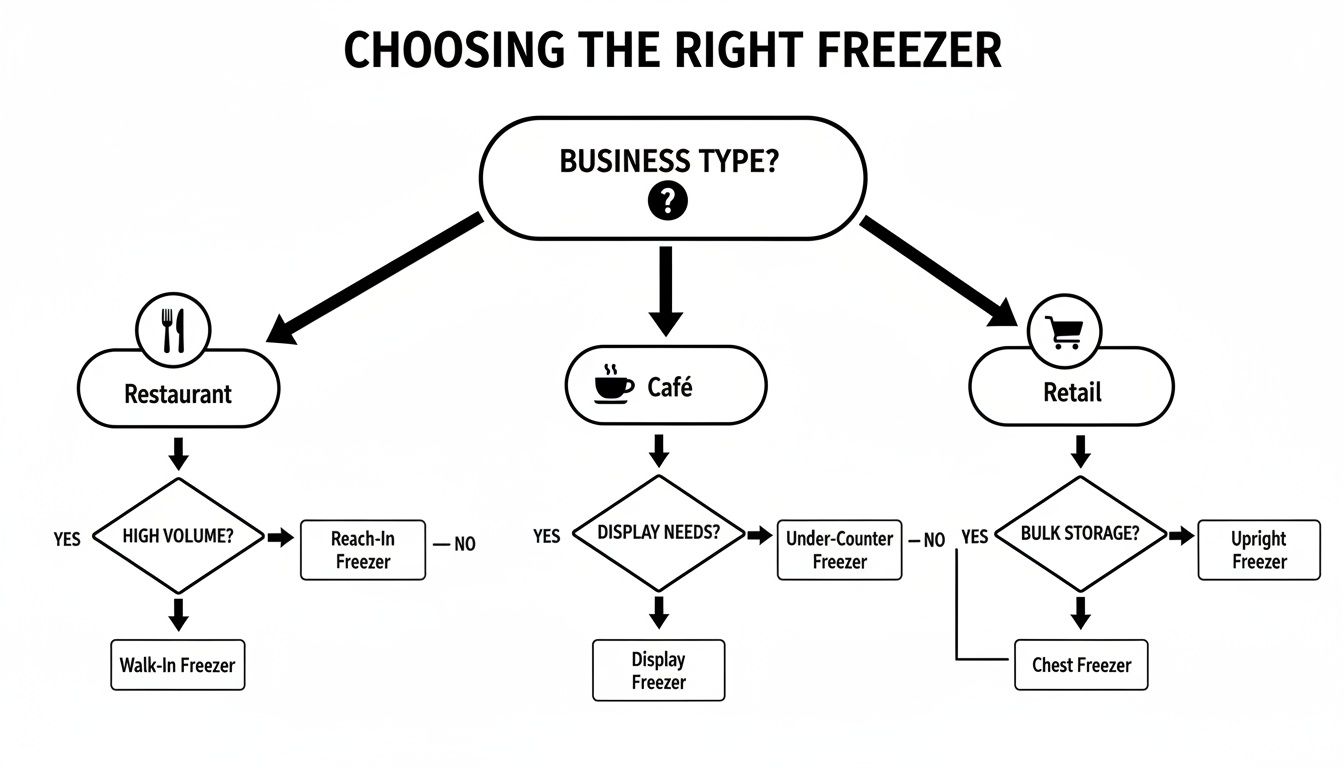
As you can see, a high-volume restaurant often needs a tag team of walk-in and reach-in freezers to keep up. On the flip side, a smaller café can get by just fine with a compact undercounter model.
To make it even easier, here's a quick rundown of the main players.
Commercial Freezer Types at a Glance
| Freezer Type | Best For | Typical Capacity Range (Cubic Feet) | Footprint Considerations |
|---|---|---|---|
| Reach-In | Daily access, line prep, high-turnover items | 20 - 70+ | Upright, moderate footprint |
| Undercounter | Tight spaces, point-of-use storage, bar backs | 2 - 12 | Compact, fits under standard counters |
| Chest | Long-term bulk storage, less-used items | 5 - 25+ | Low profile, requires significant floor space |
| Prep Table | Assembly lines (sandwiches, pizza, salads) | 5 - 20+ | All-in-one station, wide footprint |
| Walk-In | High-volume bulk storage, receiving inventory | 100+ | Large, often requires dedicated room/space |
This table gives you a starting point, but let's dig into what makes each one tick.
The Everyday Workhorse: Reach-In Freezers
The reach-in freezer is the workhorse you'll find in almost every commercial kitchen. These are the classic upright units, coming in one, two, or even three-door models, and they're built to give you easy access to your most-used ingredients. They are designed for the chaos of a professional kitchen, letting your staff grab what they need on the fly without breaking their stride.
Think of a reach-in as your kitchen's ready-access library. It doesn't hold the long-term archives; it holds the books you need to pull from all day long. That kind of immediate access is everything when you're in the weeds during a dinner rush.
The Space-Saver: Undercounter Freezers
When every square inch counts, the undercounter freezer is a lifesaver. These compact powerhouses are made to tuck neatly under your prep tables and countertops, putting frozen goods right where the chef needs them. For a Seattle coffee shop with a tiny footprint, an undercounter unit is perfect for stashing frozen pastries or smoothie packs.
They're also a game-changer for food trucks and packed prep lines. By building cold storage right into the workspace, you cut out all those extra steps to a bigger freezer, saving time and keeping the line moving. Both under counter refrigerators and freezers are vital for optimizing tight layouts.
Deep Storage and Specialized Prep
For your long-term, bulk storage needs, nothing beats the sheer volume of a chest freezer or a walk-in freezer. Chest freezers are fantastic for stashing big, less-frequently used items and are pretty energy-efficient. Walk-ins, on the other hand, are the ultimate solution for any high-volume spot that gets massive inventory drops.
The secret to a killer kitchen isn't one giant freezer. It's creating smart cold-storage zones with a mix of freezer types that support every task, from bulk storage in the back to quick grabs on the line.
Beyond just storage, you've got specialized gear like sandwich prep tables and pizza prep tables. These units are brilliant because they combine refrigerated rails and cutting boards into one station. They are built for maximum efficiency in an assembly-line setup, keeping all your ingredients perfectly chilled and right at your fingertips.
This kind of smart layout is a cornerstone of great kitchen design. If you want to go deeper on optimizing your space, check out our guide on restaurant kitchen layout design.
At the end of the day, choosing the right freezers comes down to a hard look at your menu, your customer volume, and your kitchen's layout. By placing different types of freezers strategically, you build a smarter, more productive kitchen for your whole crew.
Understanding the Features That Drive Performance
Once you’ve settled on the right type of freezer for your kitchen, it's time to look under the hood. The features are what separate a basic cold box from a high-performance machine that saves you money and headaches down the road. It's a lot like buying a delivery van; sure, the cargo space is important, but it's the engine, fuel efficiency, and suspension that determine if it's reliable day in and day out.
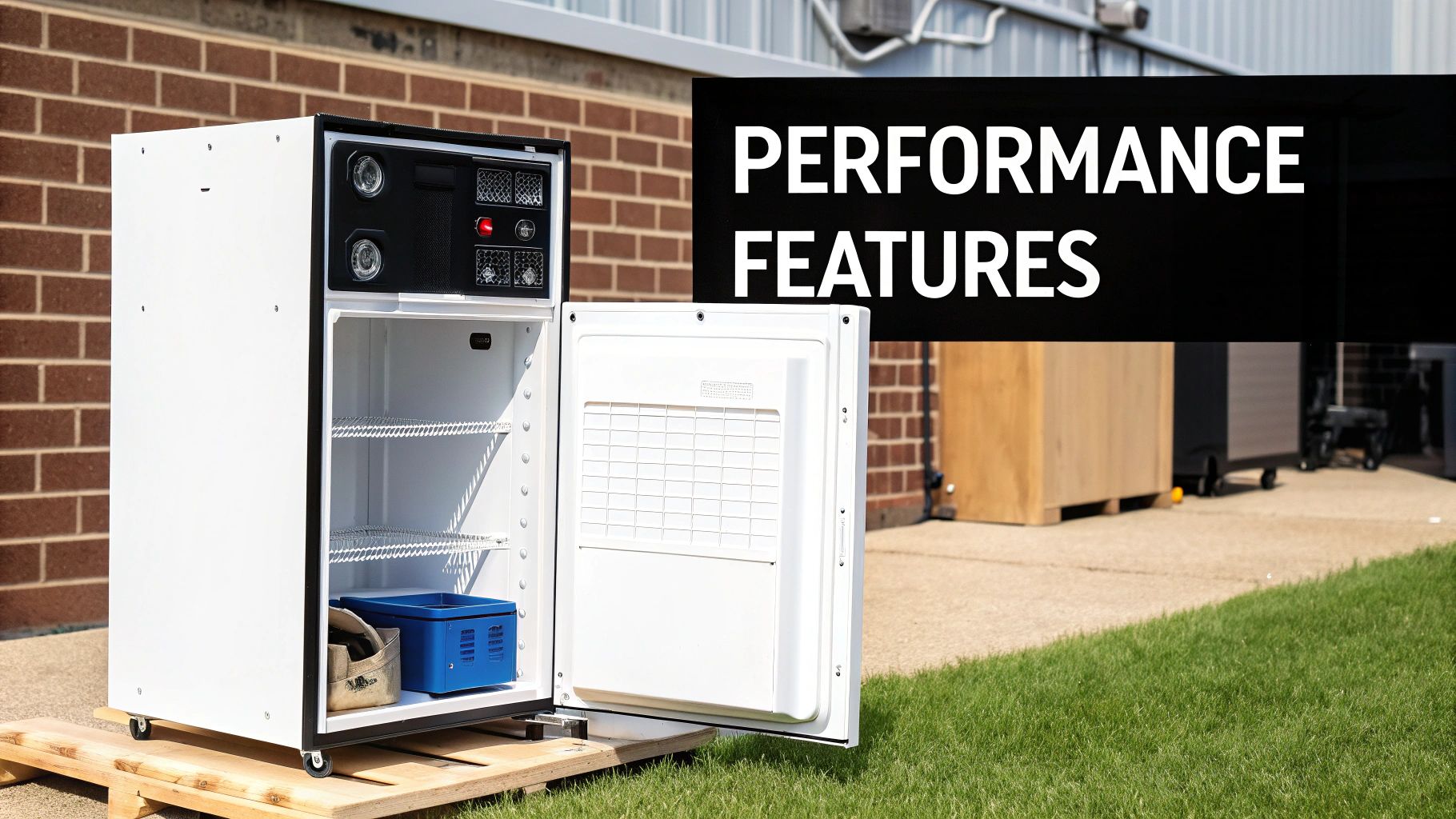
Knowing these key components is crucial for picking the best commercial freezers. From the compressor's placement to the defrost system, every detail impacts your kitchen's workflow, energy bills, and food safety. This is how you learn to read a spec sheet like a pro and make a decision you won't regret.
The Heart of the Freezer: The Compressor
The compressor is the engine of your freezer, pumping refrigerant through the system to pull heat out. Where it’s located—either on top or on the bottom—is one of the most important choices you'll make.
- Top-Mount Compressors: These units are a lifesaver in kitchens with a lot of flour, dust, or other debris on the floor. By pulling in cleaner air from up high, the condenser coils stay cleaner for longer, which means better efficiency. They also push hot air up and away from your staff, helping keep the kitchen line a little cooler.
- Bottom-Mount Compressors: These are often the go-to for ergonomic reasons. The lowest shelf is raised, so your team doesn't have to bend over as far to grab inventory. Plus, the compressor itself is much easier to get to for routine cleaning and maintenance, which saves a ton of time and effort.
Your choice really depends on your kitchen's environment. A bakery or pizzeria would probably benefit from a top-mount unit, while a standard restaurant might prefer the easy-access design of a bottom-mount model.
Keeping Things Clear: Automatic Defrost Systems
Ice buildup is a fact of life for any freezer, but it can absolutely kill your unit's efficiency and temperature stability. That's why an automatic defrost system is a non-negotiable feature for just about any busy commercial kitchen. It works by periodically warming up the cooling coils just enough to melt away frost before it can build up.
This saves a massive amount of labor compared to the old-school manual defrost method, which involves emptying the entire freezer and shutting it down for hours. Even more important, it keeps the temperature stable, protecting your expensive inventory from the damage of constant temperature swings. It’s a standard feature on most modern reach-ins and undercounter freezers for a very good reason.
Doors: Efficiency vs. Merchandising
The type of door on your freezer has a direct impact on both energy bills and how you use it. You’ve got two main options: solid and glass.
Solid Doors
Solid doors provide way better insulation, which means better energy efficiency. They are the workhorses for back-of-house storage where seeing inside isn't the priority. They're also tougher and less likely to get damaged in a chaotic kitchen.
Glass Doors
Glass doors are perfect for merchandising or for any spot where staff need to see what's inside at a glance. Think of Seattle coffee shop refrigerators displaying different milk cartons or a bar freezer for quick access. While they don't insulate quite as well, being able to find an item before opening the door means it stays open for less time, which helps offset some energy loss.
The choice between solid and glass doors really boils down to a simple trade-off: maximum energy efficiency versus the convenience and visual appeal of seeing what's inside.
Beyond the Basics: Durability and Control
A few other features make a big difference in a freezer's performance and how long it lasts. High-quality, adjustable shelving lets you customize the interior to fit everything from bulky boxes to small containers. Look for shelves with a tough coating, like PVC, to stop rust and corrosion in its tracks.
Precise digital temperature controls are also a must-have. They let you set and monitor the temperature with accuracy, ensuring you’re meeting food safety regulations. Many newer units even have alarms that go off if the temperature gets too high, which could save you thousands of dollars in spoiled food.
Technology is moving fast in this space. The North America commercial and medical refrigerators and freezers market was valued at USD 13,552.9 million in 2024 and is expected to keep growing. This is driven by new features like IoT monitoring, which can cut downtime by 15%, and the switch to eco-friendly refrigerants. You can learn more about how technology is driving the commercial refrigeration market.
Calculating the True Cost of Your Freezer
That price tag on a new commercial freezer? That’s just the down payment, not the final bill. The real cost shows up over the life of the unit, something we in the business call the total cost of ownership. It means you have to look past the initial number and weigh it against what you’ll be spending to run it month after month.
Think of it like buying a delivery van. You could grab an older, cheaper model that drinks gas like it's going out of style. Or, you could put a little more money down on a modern, efficient van. That initial hit to your wallet stings a bit more, but the fuel savings quickly make up for it and then some. The best commercial freezers work the exact same way.
An energy-efficient freezer is one of the smartest investments you can make to lower your utility bills and fatten up your bottom line. This is where knowing what to look for on the spec sheet really pays off.
Decoding Energy Efficiency
When you’re comparing freezers, the ENERGY STAR® label is your best friend. A unit with that blue sticker has been proven to be way more efficient than standard models, often using 15-20% less energy. That might not sound like a lot, but over the ten-plus years you'll own that freezer, the savings stack up to thousands of dollars.
So, how do they do it? It’s all about smarter tech running behind the scenes.
- Variable-Speed Compressors: Old-school compressors are either on or off, running at full blast every time they kick in. These modern "engines" are smarter, adjusting their speed based on how much cooling is actually needed. This slashes energy use, especially during off-peak hours.
- High-Efficiency Fan Motors: Better fan designs push more cold air around while sipping electricity.
- LED Lighting: This is such a simple win. LEDs use almost no energy compared to old-fashioned bulbs, and they don't produce heat. That means your compressor doesn’t have to work overtime just to counteract the heat from its own light source.
Paying attention to these features helps you see the future of your expenses, letting you make a decision that’s good for your bank account and your sustainability goals. You can dive deeper into this topic in our guide to energy-efficient commercial refrigeration.
Here's the bottom line: every dollar you don't send to the power company is a dollar that goes straight back into your business. That could be better ingredients, a bigger marketing budget, or a nice bonus for your staff.
Projecting Your Long-Term Savings
Let's run some quick numbers to see how this plays out. Say you’re looking at two freezers. Freezer A costs $2,500 and will cost about $600 a year in electricity to run. Freezer B is an ENERGY STAR model that costs $3,000, but it only uses $450 in electricity per year.
Freezer A looks like the winner at first, but hold on. Freezer B saves you $150 every single year. Over a decade, that's $1,500 in electricity savings alone. You've completely erased the initial $500 price difference and put an extra $1,000 back in your pocket.
This is the kind of math you need to be doing for all your big equipment purchases, whether it's a walk-in, a pizza prep table, or one of our undercounter freezers. Investing in efficiency isn't an expense—it's a strategy that always pays you back.
Freezer Setups for Real Seattle Businesses
Spec sheets are one thing, but how does all this theory play out in a real Seattle kitchen? Seeing how different businesses tackle their cold storage needs helps translate these concepts into a practical plan for your own space.
Let’s walk through a few familiar Seattle scenes to see how the pros configure their setups. This makes the whole process less about abstract numbers and more about solving real-world workflow challenges.
A smart refrigeration plan isn't about buying the biggest, fanciest unit. It's about matching the equipment to the unique rhythm of your business, making sure every freezer supports your team and protects your bottom line.
The Capitol Hill Restaurant
Picture a slammed full-service spot in Capitol Hill on a Friday night. Their kitchen is a machine, and the cold storage has to keep up. This calls for a multi-zone approach.
- On the Line: Speed is everything here. You'll find a series of undercounter freezers and under counter refrigerators tucked directly beneath the prep counters. This keeps pre-portioned steaks, signature sauces, and finishing garnishes right where the chefs need them, cutting out wasted motion during the dinner rush.
- Station by Station: The pantry might have its own dedicated sandwich prep table with cold wells for toppings, while the pizza station relies on a pizza prep table. Zoning like this prevents cross-contamination and lets each station operate independently. A nearby deep fryer station requires careful placement to not overwork the refrigeration.
- The Back of House: A large walk-in freezer acts as the main hub for bulk inventory. But to save countless trips, there's usually a reach-in commercial freezer right by the prep area, holding ingredients needed for the next day or two.
The Pike Place Market Fishmonger
Down at Pike Place Market, a fishmonger has two big priorities: showing off the product and keeping it impeccably fresh. Their setup is a mix of smart merchandising and deep storage.
Up front, a glass-door reach-in freezer is a must-have for displaying premium frozen goods like Alaskan king crab legs or perfectly vacuum-sealed salmon. In the back, for the hundreds of pounds of fish that need to be frozen, a big chest freezer is the workhorse. Its wide-open capacity is perfect for bulky or odd-shaped boxes. If you're running a similar setup, it’s worth learning how to organize a chest freezer to make sure you can find what you need, when you need it.
The South Lake Union Food Truck
A food truck is the ultimate exercise in kitchen efficiency. Every single inch counts, and every piece of gear has to pull double duty. The undisputed champion in this world is the undercounter freezer.
This single unit has to store everything from burger patties to french fries. Its stainless steel top becomes a much-needed extra prep surface—a critical advantage when your kitchen is on wheels. Durability is non-negotiable, too; it has to be built tough enough to handle the bumps and vibrations of daily travel.
The right freezer configuration isn't about having the biggest or most expensive unit. It's about strategically placing the right types of units to create a seamless, efficient workflow that supports your specific business model.
Specialized Seattle Bar and Coffee Shop Equipment
This same logic extends to Seattle’s legendary coffee and bar culture. A Fremont coffee shop might run its entire operation with Seattle coffee shop refrigerators—specifically, undercounter models for milk and oat milk—plus a small chest freezer for smoothie packs and frozen pastries.
Over in Belltown, a bar’s speed depends entirely on specialized Seattle bar equipment. We're talking back bar coolers for bottles and a dedicated undercounter freezer for ice cream, frozen garnishes, and specialty cocktail ingredients. The goal is always the same: put the cold storage exactly where the action is.
This trend toward specialized, high-performance units is growing. The global market for commercial blast freezers, a niche focused on rapid cooling for food safety, is projected to hit USD 1,305.9 million by 2035. You can discover more insights about the growing demand for specialized freezers on futuremarketinsights.com.
Protecting Your Investment with Proactive Maintenance
Think of your commercial freezer as one of the most reliable employees in your kitchen. It works 24/7, without a break, protecting thousands of dollars of your inventory. And just like any critical team member, it needs a little care to perform at its best. A simple, consistent maintenance routine is the best insurance you can get against a middle-of-the-night breakdown and the nightmare of spoiled food.
Putting off maintenance is a risky bet. When a condenser coil gets clogged with kitchen grease and dust, it's like forcing your freezer to run a marathon in a winter coat. The compressor has to work overtime, your energy bills creep up, and eventually, the whole system gives out. A tiny tear in a door gasket seems small, but it lets in warm, humid air, creating frost buildup and forcing the unit to struggle just to stay cold. These little things always snowball into big, expensive problems.
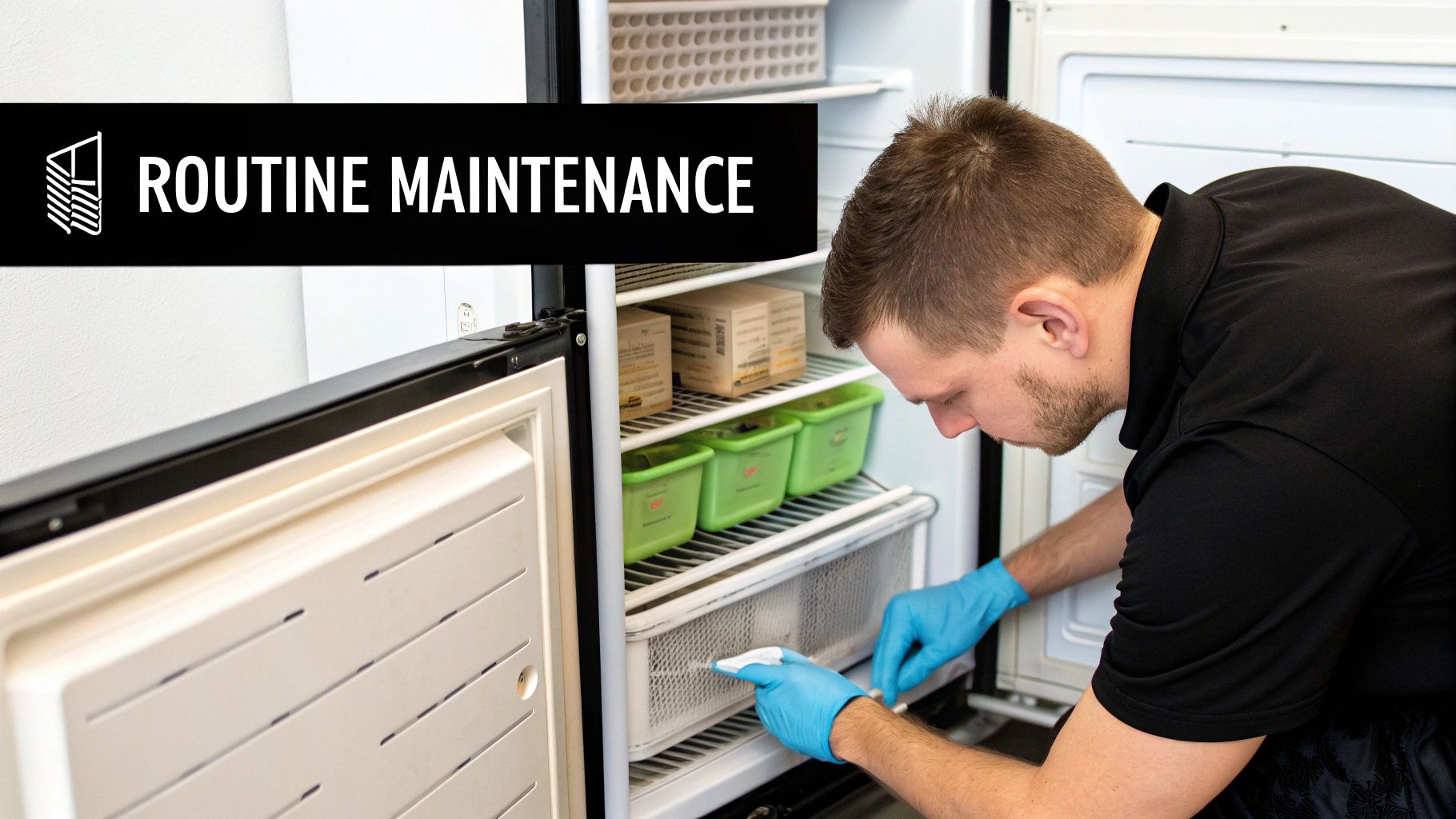
A proactive approach doesn't just save you a ton of money on emergency repairs—it keeps your equipment running safely and efficiently for the long haul.
Your Essential Maintenance Checklist
The secret to staying on top of maintenance is building it right into your existing schedule. Adding these quick tasks to your weekly and monthly cleaning routines will keep all your freezers—from big walk-ins to compact undercounter freezers—humming along.
- Clean Condenser Coils Monthly: The coils are basically your freezer's radiator; they push heat out of the system. If they're caked in dust, the freezer can't cool properly. A quick pass with a stiff brush or vacuum once a month is the single most important thing you can do for its health.
- Inspect Door Gaskets Weekly: Take a look at the rubber seals around the doors. Are they cracked, torn, or getting hard? A good seal is everything. Try the dollar bill test: close the door on a bill. If you can pull it out with zero resistance, it’s probably time for a new gasket.
- Wipe Down Interior Surfaces Regularly: Spills happen. Cleaning them up right away prevents weird odors, stops cross-contamination, and keeps acidic messes from damaging the interior surfaces of everything from your main freezer to specialized pizza prep tables.
- Ensure Proper Airflow: It's tempting to cram every last box inside, but your freezer needs room to breathe. Cold air has to circulate to keep everything evenly frozen. Always leave a couple of inches of space between your product and the walls.
Think of regular maintenance as a small, ongoing investment in your kitchen's reliability. A few minutes of cleaning each month can prevent a multi-thousand-dollar failure and the loss of your entire frozen inventory.
Quick Troubleshooting Common Freezer Issues
Even the best-maintained equipment can have an off day. Knowing how to spot a simple fix versus a real problem can save you a service call fee and a lot of stress.
Seeing a lot of ice buildup? First, check that the door is closing all the way and the gaskets are making a tight seal. Freezer not feeling cold enough? The first two steps are always cleaning the condenser coils and making sure nothing is blocking the fans inside. A lot of the time, that's all it takes.
But if you’ve done that and the unit is still making loud, strange noises or the temperature alarm won't shut off, don't wait. It's time to call in a professional technician.
Answering Your Top Commercial Freezer Questions
When you're looking to buy a commercial freezer, a lot of practical questions come up. Getting straight answers is the key to making a smart investment that will serve your business well for years. Here are some of the most common things we hear from Seattle-area business owners.
What's the Biggest Mistake Restaurants Make When Buying a Freezer?
Hands down, the most common mistake is misjudging capacity needs or simply forgetting to measure the unit's physical footprint. We see it all the time—a business picks a freezer that's too small for their peak inventory, which leads to overstuffing and bad cooling. On the flip side, buying a unit that's too big for the space creates a world of installation and workflow headaches.
Here at Seattle Restaurant Equipment, we always push our clients to measure their space carefully and plan for future growth. We can help you look at your menu and sales volume to find that perfect balance. That means thinking about everything from your main commercial freezers to specialized gear like pizza prep tables and handy undercounter freezers to really get the most out of your layout.
How Do I Decide Between a Top-Mount and a Bottom-Mount Compressor?
The right call here really depends on your specific kitchen environment. Top-mount compressors are fantastic for kitchens that kick up a lot of floor debris like flour or dust, since they pull in cleaner air from higher up. They also do a great job of keeping the kitchen a bit cooler by pushing hot air upward and out of the way.
Bottom-mount compressors, on the other hand, are more ergonomic. They raise the lowest shelf off the floor, which means less bending and straining for your staff. They’re also a lot easier for your team to get to for routine cleaning and maintenance. Our team can talk through your specific setup and needs—whether it's for a primary freezer or for Seattle coffee shop refrigerators—and point you in the right direction.
Does Seattle Restaurant Equipment Offer Financing or Delivery?
Yes, we absolutely do. We get that big-ticket items like commercial refrigerators and freezers are a major investment for any business. That's exactly why we offer flexible financing options to help you manage your budget without stress.
We also provide professional delivery and installation services all over the Seattle area to make sure your new unit is set up correctly and running safely from day one. Our whole goal is to make the entire process, from picking the right unit to getting it installed, as smooth and simple as possible.
Ready to find the perfect freezer for your business? Explore the full range of reliable, high-performance commercial kitchen equipment at Seattle Restaurant Equipment and get the support you need to make the right choice. https://seattlerestaurantequipment.com