

Choosing the best espresso machine for a coffee shop is hands down the most critical equipment decision you’ll make. This machine is the heart of your entire operation. It directly shapes the quality of your coffee, the speed of your service, and, let's be honest, your bottom line.
The right machine becomes a dependable partner in your daily grind, while the wrong one can create a frustrating bottleneck, costing you sales and damaging your reputation.
Your Coffee Shop's Most Important Decision
Picking the perfect espresso machine isn’t about chasing brand names or finding the cheapest price tag. It's about finding a perfect match for your specific business model. Are you planning to open a high-volume cafe on a bustling Seattle street, or a quiet, cozy neighborhood spot where craft and conversation are the main draw?
The answer to that question will point you toward very different types of equipment. A machine that’s a workhorse in one shop might be completely wrong for another, affecting everything from how you train your staff to your daily revenue.
This decision also lays the groundwork for your entire operational workflow. An espresso machine doesn't operate in a vacuum; it needs a whole ecosystem of supporting equipment to function efficiently. This is why you have to think about your entire bar area from the get-go.
Picture how your new machine will work alongside:
- Seattle coffee shop refrigerators for easy, ergonomic access to milk and creamers.
- Under counter refrigerators and under counter freezers placed just right to keep your baristas from running back and forth.
- Sandwich prep tables or even pizza prep tables if you're building a food menu to go with your coffee.
Thinking about the big picture now saves you from expensive layout headaches later. A smooth workflow, supported by reliable equipment like commercial refrigerators and commercial freezers, means your team can handle the morning rush without missing a beat. It's about creating a system where every piece, from the espresso machine to the deep fryers for your donuts, works together.
Key Factors to Consider
Before you even start looking at specific models, you need to have a clear picture of your operational needs. This first step will drastically narrow your options and stop you from overspending on features you'll never use or, worse, underspending on a machine that can't keep up.
| Key Factor | High-Volume Cafe Scenario | Craft-Focused Cafe Scenario |
|---|---|---|
| Control vs. Speed | A super-automatic machine is all about consistency and speed. It's crucial for plowing through long lines and makes staff training a breeze. | A semi-automatic machine gives baristas full control to dial in that perfect shot, which is exactly what you want for a brand built on artistry. |
| Boiler System | A dual boiler system is the king of temperature stability. You can brew and steam at the same time without any drop in performance, which is non-negotiable during a rush. | A heat exchange system is often more than enough and more budget-friendly. It’s ideal for lower-volume shops with less simultaneous demand. |
| Group Capacity | A 2- or 3-group machine is essential. You need to be able to serve multiple customers at once during peak hours to prevent people from walking out. | A 1- or 2-group machine usually fits the bill. It matches the slower, more deliberate pace of a quality-focused environment. |
Comparing Commercial Espresso Machine Types
Picking the right espresso machine for your coffee shop goes way beyond a simple feature list. It's about understanding how that machine will shape your daily workflow, your brand's identity, and, at the end of the day, your bottom line. The choice between a semi-automatic and a super-automatic is a huge one, setting the stage for everything from staff training and service speed to the consistency of every single cup you serve. You're essentially choosing between artisanal control and automated precision, and the right answer really depends on your business model.
A semi-automatic machine puts the art of espresso squarely in your barista's hands. They control the grind, the tamp, and how long the shot pulls, letting them dial in the perfect extraction for each unique bean. This hands-on approach is perfect for a craft-focused cafe where the story and quality behind the coffee are the main event. For a Seattle coffee shop that wants to be a destination for espresso lovers, this kind of control isn't just nice to have—it's essential.
On the other hand, a super-automatic machine is a beast of efficiency and consistency. With just the press of a button, it grinds, tamps, and brews a perfect shot every time, no matter who's running it. This makes it an ideal fit for a high-volume spot, a business with a big food menu where staff need to multitask, or any shop that values speed and predictability over handcrafted details.
To help you see this core decision more clearly, this flow chart breaks down the key factors of volume, boiler type, and control that should guide your choice.
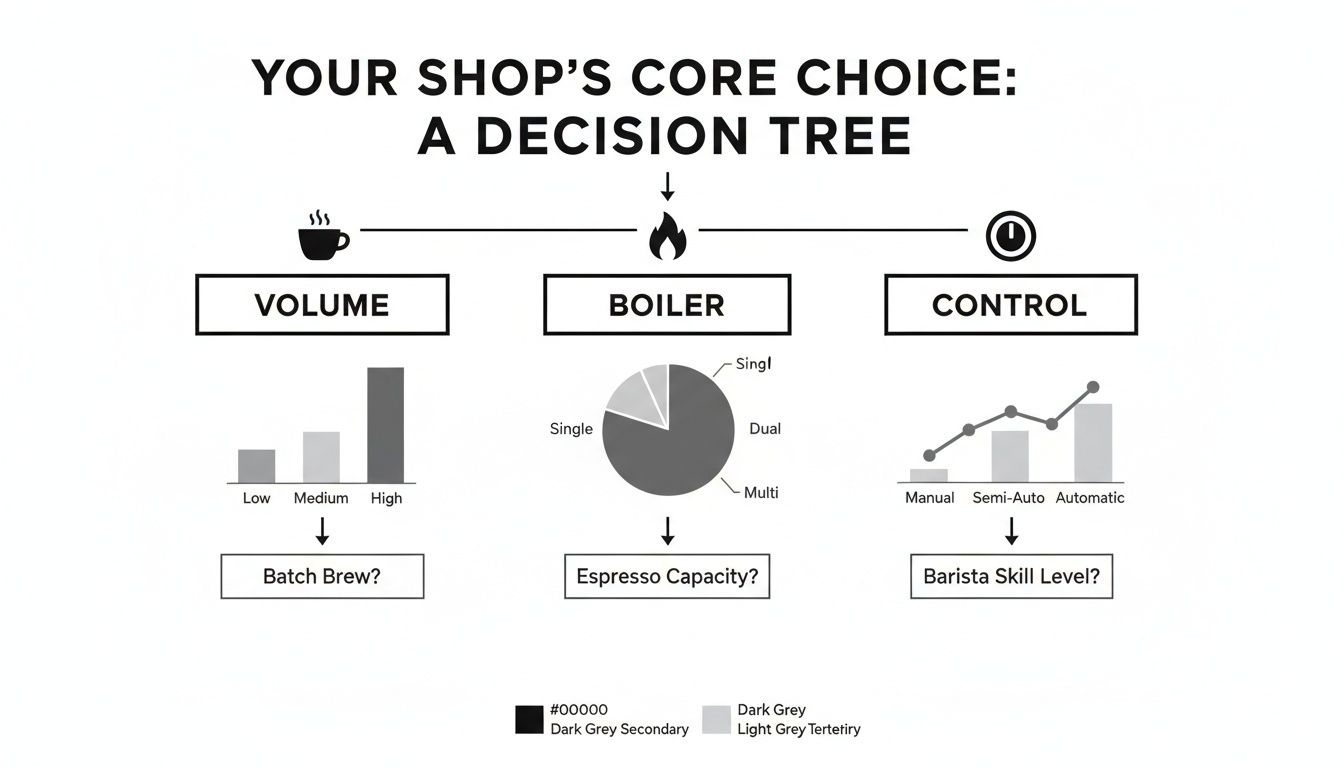
As you can see, your expected customer volume and the level of control you want your baristas to have are the two biggest things driving you toward the right machine for your shop.
To help you weigh the options for your specific needs, here’s a direct comparison of the two machine types.
Machine Type Comparison Semi-Automatic vs. Super-Automatic
| Feature | Semi-Automatic Espresso Machine | Super-Automatic Espresso Machine |
|---|---|---|
| Best For | Specialty coffee shops, artisan cafes, businesses focused on craft and quality. | High-volume cafes, restaurants, offices, businesses prioritizing speed & consistency. |
| Barista Skill | Requires significant training and skill to produce consistent, high-quality shots. | Minimal training required; anyone can operate it with the push of a button. |
| Consistency | Highly dependent on the individual barista's skill and attention to detail. | Excellent. Produces the exact same shot every single time. |
| Speed | Slower workflow; best for a measured, craft-oriented pace. | Very fast. Can produce 200-300 drinks per hour with ease. |
| Customization | Offers complete control over every variable (grind, tamp, pressure, time). | Limited to pre-programmed drink recipes. |
| Maintenance | Requires daily cleaning and regular professional maintenance. | Often has automated cleaning cycles, but internal mechanics can be complex to service. |
This table lays out the fundamental trade-offs. Now, let's see how these differences play out in the real world.
Semi-Automatic In a Real-World Scenario
Picture a specialty coffee bar in Seattle's Capitol Hill. Their whole business is built around single-origin beans and showing off the unique flavors of each roast. A semi-automatic machine is the heart of this operation. The baristas are pros who chat with customers, explaining the details of the coffee they’re serving.
Their ability to tweak the grind and shot time by hand lets them pull the absolute best flavor from the beans, creating an experience that justifies a higher price. The workflow is slower, sure, but that’s part of the show. Customers watch the careful preparation, which boosts their perception of quality. This whole setup is supported by well-placed under counter refrigerators holding various milks, so the barista can create their masterpiece without taking a step.
Super-Automatic In a Real-World Scenario
Now, think about a busy cafe in downtown Tacoma, mobbed with commuters during the morning rush. Here, speed, consistency, and a big menu with breakfast sandwiches are what make money. A super-automatic is the obvious choice. New staff can be trained in minutes, and every latte comes out identical, no matter who’s on shift.
The machine's raw speed allows the shop to serve hundreds of customers an hour, making the most of peak times. It may lack that "craft" feel, but it delivers a consistently good product incredibly fast—which is exactly what this crowd wants. The workflow is built for volume, with commercial refrigerators and sandwich prep tables ready for action, letting staff handle food and coffee orders at the same time without creating a bottleneck.
For a business where speed is everything, the ability to make 200-300 drinks per hour with barely any training is a massive operational win. The consistency of a super-automatic machine protects your brand's reputation with every cup.
The market trends absolutely back this up. When you look at the best espresso machine for a coffee shop, the dominance of super-automatics tells a clear story—they command over 60% of the global market. Their rise matches the explosion of cafe culture perfectly, with shops benefiting from automation that can cut barista training time by up to 50% and crank out 200-300 drinks per hour. You can read more about these market trends and how they’re shaping the industry.
The right choice isn’t about which machine is "better." It’s about which one fits your operational goals and your brand promise. It's about building a complete system—from the espresso machine to the Seattle bar equipment and even the deep fryers—that all works together to deliver the exact experience your customers are looking for.
Choosing Your Boiler System and Group Head Capacity
Once you've decided between hands-on semi-automatic control and push-button super-automatic speed, it’s time to look under the hood. The real engine of any serious commercial espresso machine is its boiler system and group head setup. These two components dictate how your machine will perform under the relentless pressure of a morning rush, directly impacting both your service speed and the quality of every drink you serve.
Getting this part right is a huge piece of the puzzle. The wrong setup can create a frustrating bottleneck during your busiest hours. On the other hand, you could end up with an oversized, underused machine that was an unnecessary hit to your budget. Let’s break down the practical differences to help you make a smart investment.
Heat Exchange vs. Dual Boiler Systems
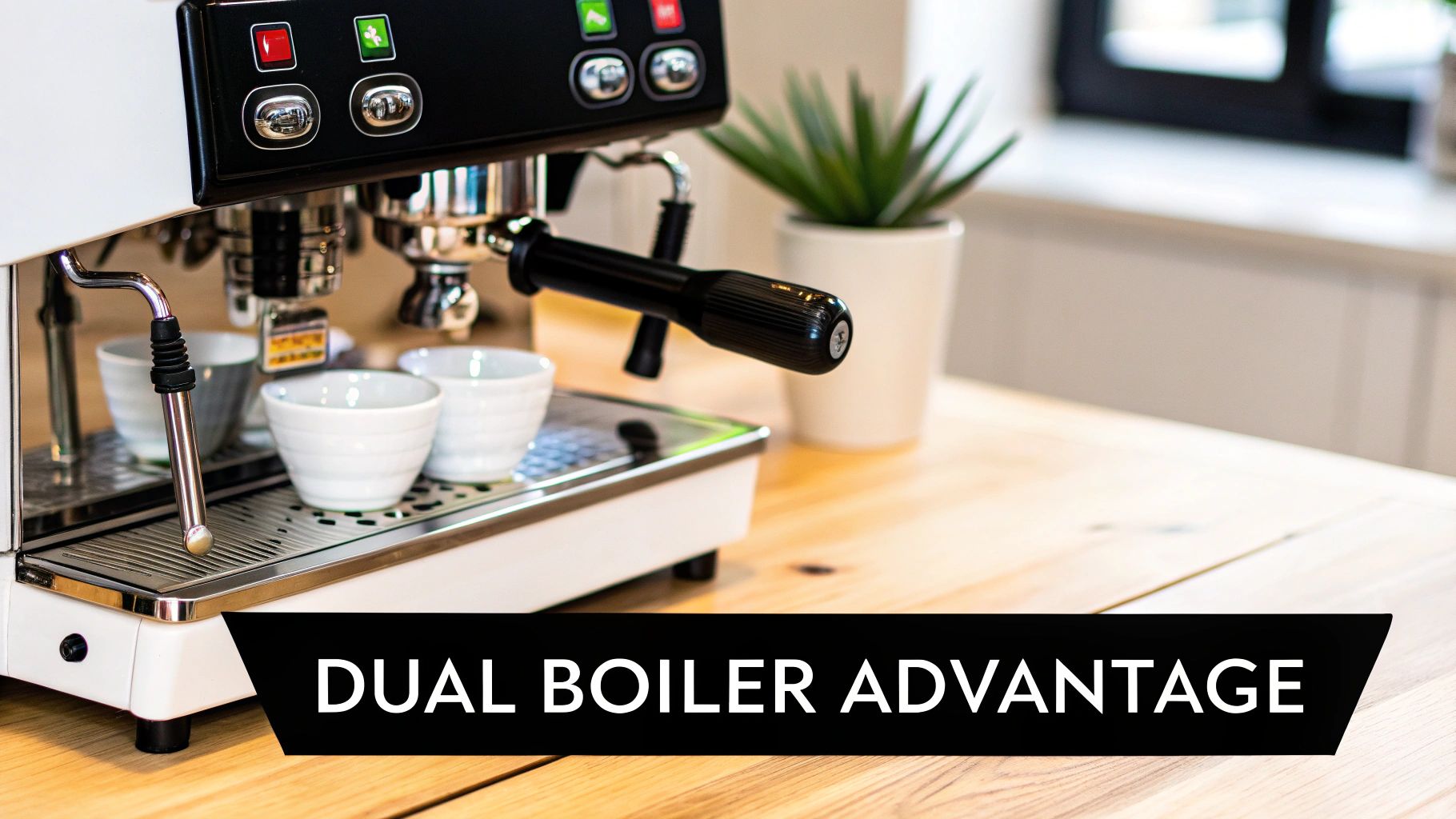
The boiler is the heart of the machine, responsible for heating water to brew espresso and create steam for milk. In the commercial world, you'll mainly find two types: Heat Exchange (HX) and Dual Boiler (DB). They both get the job done, but they behave very differently during continuous, heavy use.
A Heat Exchange (HX) machine has one big boiler that creates steam. A copper tube carrying the brew water passes through this steam boiler, "exchanging" heat to bring it up to the right temperature for pulling a shot. This design is cost-effective and energy-efficient, making it a solid choice for cafes with low-to-moderate volume. It's perfect if your baristas aren't constantly pulling shots and steaming milk at the exact same time for long stretches.
A Dual Boiler (DB) machine, just like it sounds, features two separate boilers—one is dedicated solely to brewing espresso, and the other is dedicated to producing steam. For a busy shop, this separation is a complete game-changer.
The biggest advantage of a dual boiler system is its rock-solid temperature stability. By isolating the brew and steam functions, a DB machine can pull perfect, temperature-consistent shots while simultaneously steaming big pitchers of milk without any drop in pressure or performance.
This kind of stability isn't a luxury; it's a necessity for high-volume cafes. When a line of customers is ordering lattes and cappuccinos, the ability to brew and steam at the same time without compromise is what keeps that line moving and ensures every single drink is perfect. A DB machine costs more upfront, but the return you get in workflow efficiency and product consistency is massive.
Calculating Your Group Head Capacity
After you’ve landed on a boiler system, you need to decide how many group heads you need. The group head is where the portafilter locks in and hot water is pushed through the coffee grounds. Commercial machines usually come with one, two, or three groups.
The right number depends entirely on your projected sales during peak hours. If you overestimate, you’re tying up capital in equipment you don't need. If you underestimate, you’re creating a service bottleneck that will cost you customers. The easiest way to figure this out is to work backward from your busiest hour.
Capacity Calculation:
- One-Group Machine: A great fit for very low-volume cafes, restaurants where coffee is a secondary offering, or mobile coffee carts. It can produce roughly 50-70 drinks per hour.
- Two-Group Machine: This is the industry standard for a reason. It's the most versatile option for most coffee shops, allowing two baristas to work at once to produce 100-150 drinks per hour.
- Three-Group Machine: This is the powerhouse reserved for extremely high-volume spots, like a busy downtown cafe or a drive-thru. It can handle over 200 drinks per hour.
For most shops, a two-group machine is the sweet spot. It provides enough capacity to crush the morning rush without the larger footprint and higher cost of a three-group model. It’s a reliable choice that gives you room to grow.
The demand for durable, high-capacity machines like these is why the coffee equipment market is booming. The global sector was valued at $11.6 billion in 2024 and is projected to hit $18.4 billion by 2034, with the U.S. market alone reaching $2.7 billion. You can discover more insights about these coffee machine market trends online. This growth shows just how critical it is to invest in a machine built for commercial endurance if you're serious about long-term success.
Essential Infrastructure for Your Espresso Machine
Picking out the perfect espresso machine is a huge milestone, but don't stop there. The machine itself is just one piece of a much larger puzzle. Your investment is only as strong as the infrastructure holding it up. Without the right water, power, and maintenance, even the most expensive, high-tech machine will stumble, break down, and bleed you dry with repairs and lost sales.
These behind-the-scenes details are every bit as important as the boiler system or the number of group heads. Skipping over them is a rookie mistake, and a costly one at that. A solid foundation is what guarantees your equipment runs like a dream for years, protecting the very heart of your business.
Water Quality: The Silent Machine Killer
The number one enemy of any commercial espresso machine is limescale buildup from hard water. Minerals like calcium and magnesium are invisible assassins, slowly building up on heating elements and clogging the machine's delicate internal pathways. This silent siege forces your machine to work harder, messes with your temperature stability, and will eventually lead to a total system failure.
A professional water filtration system isn't a luxury—it's an absolute must-have. Here in Washington, standard tap water in many areas is more than hard enough to start causing real damage in just a matter of months.
Think of a proper water softening and filtration system as the best insurance policy you can buy for your espresso machine. It stops the leading cause of expensive repairs and guarantees your coffee's flavor is pure, not tainted by weird mineral tastes.
The right setup will be calibrated specifically for coffee equipment. It’s designed to strip out the damaging minerals while leaving behind the ones that actually help with flavor extraction. This is a double win: you protect your machine and you guarantee a consistently delicious shot of espresso every time.
Powering Your Operation the Right Way
Another detail that can bring your grand opening to a screeching halt is the electrical supply. Almost every commercial-grade espresso machine needs a 220V electrical outlet, not the standard 110V outlets you have at home. This is not something you want to discover on installation day.
Get a licensed electrician involved early in your planning. They’ll need to run a dedicated 220V line right to the spot where your machine will live. Whatever you do, don't try to use adapters or converters. It's a fire hazard, and it will instantly void your machine's warranty. Planning your electrical layout is a critical first step, and you can dive deeper into this by checking out our guide on setting up a commercial kitchen.
While you're at it, map out the power needs for all your other essential gear, like:
- Commercial refrigerators and freezers
- Deep fryers or other heavy-duty cooking equipment
- Seattle bar equipment like high-powered blenders and ice machines
Building a Rock-Solid Maintenance Schedule
Finally, a proactive maintenance routine is what separates a machine that gives you five good years from one that becomes a fifteen-year legend. This schedule really has two parts: the daily rituals your baristas handle and the periodic check-ups from a pro.
Daily Barista Cleaning:
- Backflushing: At the end of the day, run a cleaning cycle with a specialized detergent. This clears out all the gunk and coffee oils from the group head.
- Steam Wand Purging: After every single use, wipe and purge the steam wand. No exceptions. This prevents nasty milk from building up and clogging it.
- Portafilter and Basket Cleaning: Let these soak overnight in a cleaning solution to dissolve any stubborn residue.
These are simple habits that take just a few minutes, but they are absolutely essential for preventing flavor contamination and clogs.
Periodic Professional Service:
At least once or twice a year, bring in a qualified technician for a full physical. They'll handle the deeper work—replacing worn-out gaskets and screens, hunting for internal leaks, and recalibrating the pressure and temperature. This professional tune-up catches tiny issues before they become catastrophic, expensive failures, ensuring your machine stays the reliable workhorse you need it to be.
Building an Efficient Coffee Shop Workflow
An elite espresso machine might be the star of the show, but it can't perform its best without a strong supporting cast. Choosing the right machine is only half the battle; the other half is building a smart, efficient workflow around it. This entire ecosystem of supporting equipment is what turns a great machine into a profit-generating powerhouse.
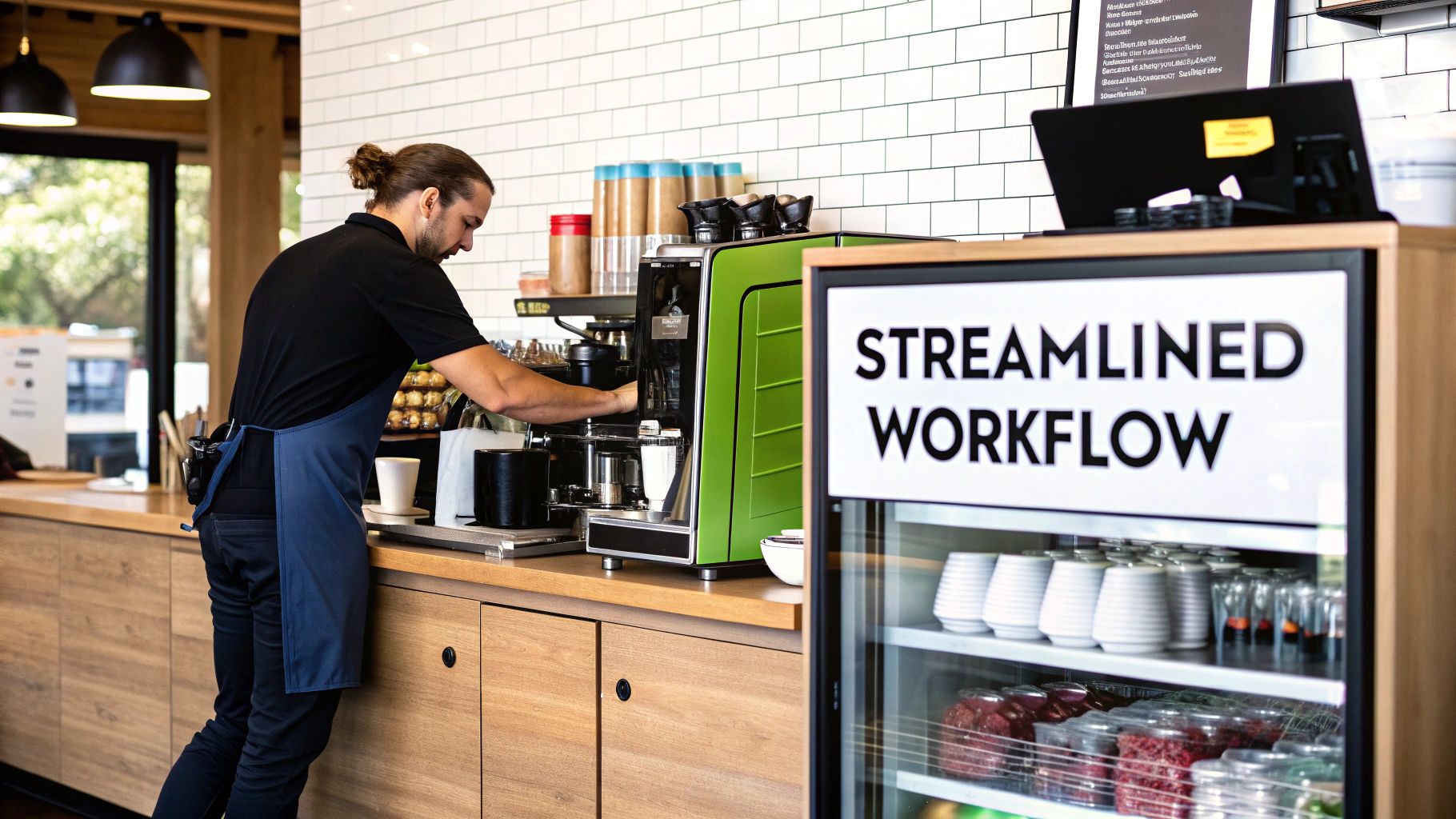
Think about it: every single step your baristas take costs you time and money. A holistic approach to your bar's layout pays off big time. Smart placement isn't just about looking good—it's about cutting down on staff movement, reducing physical strain, and shaving precious seconds off every single order.
Integrating Refrigeration for Speed and Access
Aside from pulling shots, what's the one thing a barista does over and over? Grabbing milk. That's why placing under-counter refrigerators directly beneath the espresso machine is a non-negotiable part of an efficient bar. This simple move stops your staff from having to turn around or walk to a larger fridge, saving time that really adds up during a morning rush.
Dedicated Seattle coffee shop refrigerators are also crucial for storing syrups, alternative milks, and cold brew concentrate, keeping everything within arm's reach. And if you have a food program, commercial freezers keep pastries and breakfast sandwiches fresh and accessible, so no one has to interrupt the drink flow.
Expanding Your Menu with Prep Tables
A truly profitable coffee shop often sells more than just coffee. Adding a food menu can dramatically increase your average ticket size, but it can't get in the way of your core coffee service. This is where ergonomic prep tables become essential.
- Sandwich Prep Tables: These units are brilliant. They combine refrigerated ingredient wells with a dedicated workspace, letting an employee assemble food orders without ever leaving their station.
- Pizza Prep Tables: For more ambitious menus, these larger tables give you plenty of space and cooling for a variety of ingredients, allowing for a surprisingly robust food offering from a compact footprint.
By creating a dedicated food prep zone, you avoid cross-contamination and keep the coffee bar clear for what it does best: making drinks fast. This kind of thoughtful separation is a key principle we cover in our guide to effective restaurant kitchen layout design.
The Bigger Picture: Seattle Bar Equipment
Beyond the immediate coffee station, the right supporting equipment completes your operational circuit. Specialized Seattle bar equipment, like high-performance blenders for frappes or ice machines that can keep up with summer demand, should be placed in a logical sequence. Even equipment like deep fryers for donuts can be integrated into a back-of-house workflow that supports the front bar without causing chaos.
A well-designed workflow is a silent partner in your business's success. It lowers ticket times, minimizes staff errors, and creates a less stressful environment—all of which lead to better customer service and happier employees who stick around.
The incredible growth in the coffee world shows why this efficiency is so vital. The global commercial espresso machine market hit $1,941.52 million in 2021 and is projected to reach $2,631.42 million by 2025. North America makes up 31.75% of this market, showing just how competitive things are getting. Investing in a complete, efficient workflow is how you claim your piece of that pie. At Seattle Restaurant Equipment, we help you build that entire system from the ground up.
Your Final Espresso Machine Buying Checklist
Making the final call on an espresso machine for your coffee shop isn't something to rush. You need a clear, methodical way to think through it. To pull everything together, we've put together this checklist. It breaks down the essential steps to make sure you invest in a machine that becomes the reliable heart of your cafe, not a constant source of headaches.
Think of this as your path to a confident, well-informed purchase. It all starts with being honest about your needs—from drink volume to the very identity of your brand. Nail this first step, and you'll avoid overspending on a beast of a machine you'll never max out or, worse, underspending on one that crumbles during your morning rush.
Your Step-by-Step Evaluation Process
Run through these steps to cover all your bases before you sign on the dotted line. This simple framework will help make sure your final choice lines up perfectly with how you actually operate and what you want to achieve.
-
Be Realistic About Volume: Get an honest count of your projected peak-hour drink output. For most cafes, a 2-group machine is the industry standard and the perfect workhorse. But if you're planning a high-volume drive-thru, you'll probably need the raw power of a 3-group machine.
-
Match the Machine to Your Vibe: This is a big one. Are you semi-automatic or super-automatic? A craft-focused cafe absolutely thrives on the control and artistry of a semi-automatic machine. On the other hand, a business that needs to prioritize speed and absolute consistency will get far more value from a super-automatic.
-
Check Your Infrastructure: Before you even think about delivery, confirm you have a dedicated 220V electrical circuit ready to go. You also need a solid plan for a professional water filtration system. Skipping this is a classic, costly mistake that leads to expensive, and totally preventable, repairs down the line.
-
Map Out Your Workflow: Your espresso machine doesn't exist in a vacuum. Think about how it fits with everything else. Smartly placed under counter refrigerators and sandwich prep tables create a smooth, efficient flow for your baristas, which means more speed and more profit.
-
Lock Down Local Support: This is non-negotiable. Partner with a supplier who offers installation, training, and—most importantly—fast service when you need it. Downtime is absolutely deadly for a coffee shop, making expert local support a must-have.
Our Take: For a craft-focused cafe, a 2-group dual boiler semi-automatic machine strikes the perfect balance between quality control and capacity. For a high-volume shop where speed is king, a 2-group super-automatic is the clear winner for its relentless consistency and efficiency.
At the end of the day, your espresso machine is just one piece of a much larger puzzle. To see how it all fits together, check out our comprehensive coffee shop equipment checklist. It gives you a detailed breakdown of everything else you'll need, from commercial refrigeration to the small stuff.
When you work with Seattle Restaurant Equipment, you're making sure every piece of that puzzle, from commercial freezers to Seattle bar equipment, works in perfect harmony.
A Few Common Questions
If you're opening a coffee shop, you're not alone in asking these questions. Most new owners have the same concerns when it's time to pick out the heart of their operation. Getting straight, real-world answers is the key to investing with confidence in an espresso machine that will pay for itself.
What's a Realistic Budget for a Commercial Espresso Machine?
The sticker price is just the beginning. A solid 2-group machine might run you anywhere from $8,000 to over $20,000, but that's not the whole story.
You have to factor in the support system. This means professional installation, getting a dedicated 220V electrical circuit wired in, and a commercial-grade water filtration system. All told, these essentials can easily add another $1,500 to $3,000 to your startup cost.
What's the Real-World Difference Between a 2-Group and 3-Group Machine?
This all comes down to one thing: can you handle your busiest hour without making customers wait?
- A 2-group machine is what you see in most cafes. It’s the workhorse of the industry, capable of pulling 100-150 drinks per hour. This is perfect for two baristas working in tandem during the morning rush.
- A 3-group machine is for places that are slammed non-stop. Think high-volume drive-thrus or a cafe in a busy transit hub. These can push out over 200 drinks per hour.
Picking the right size means you’re ready for your peak hours without shelling out cash for a group head that just sits there.
How Important Is It to Have a Local Service Technician?
Honestly, a local tech is your lifeline. When your espresso machine goes down, your business grinds to a halt. Every hour of downtime is money walking out the door and customers getting frustrated.
Having an expert nearby who can show up fast for repairs and handle routine maintenance is non-negotiable. It’s the difference between a minor hiccup and a business-killing catastrophe. This is what keeps your cafe running smoothly and profitably, day in and day out.
At Seattle Restaurant Equipment, we do more than just sell you a machine. We're here to be your partner, helping with everything from under-counter refrigerators to designing an efficient workflow. Explore all our commercial kitchen solutions at Seattle Restaurant Equipment.