

Outfitting your food truck with the right gear is probably the single most important decision you'll make. It directly impacts how fast you work, what you can put on your menu, and ultimately, how much money you make. The essential equipment for food truck kitchens always starts with the basics: reliable commercial refrigerators and commercial freezers for food safety, versatile prep tables to keep your workflow smooth, and the right deep fryers or griddles to actually cook your food. Sourcing durable, commercial-grade equipment is the foundation you'll build your entire mobile business on.
Building Your Mobile Kitchen From The Ground Up

Starting a food truck is an amazing journey, but your success hinges entirely on what’s inside that truck. A mobile kitchen is a different beast altogether. It’s defined by its limits—tight spaces, finite power, and the constant rattle of the road. This is exactly why picking the right commercial-grade equipment isn't just a suggestion; it's your core business strategy.
Unlike a brick-and-mortar restaurant with plenty of room to spread out, every single piece of gear in a food truck has to be compact, efficient, and tough as nails. Think of it like you're outfitting a submarine galley, not a sprawling kitchen. Every inch matters, and every appliance has to earn its spot.
The Foundation of Food Truck Success
Your equipment choices directly shape what you're capable of doing. The right setup lets you crank out food quickly, safely, and consistently, even when you’ve got a line down the block during the lunch rush. For food truck operators here in Washington, this means investing smart in the essentials that can handle the daily grind of mobile service. This is where getting focused, core pieces from a supplier you trust really pays off.
At Seattle Restaurant Equipment, we specialize in the gear that powers mobile success. We're talking about the workhorses:
- Commercial Refrigerators & Commercial Freezers: Powerful, compact units like under counter refrigerators and under counter freezers are essential for keeping ingredients at safe temps.
- Sandwich Prep Tables & Pizza Prep Tables: These are the ultimate multi-taskers, combining refrigerated storage with a dedicated workspace to streamline your whole assembly line.
- Deep Fryers: You need high-output fryers that can keep up with demand. For so many popular food truck concepts, this is a non-negotiable.
- Seattle Bar Equipment & Seattle Coffee Shop Refrigerators: Specialized gear for mobile bars or coffee carts that maximizes efficiency in a small footprint.
Navigating the Booming Food Truck Market
The food truck scene has absolutely exploded, which makes investing in the right equipment more critical than ever. The U.S. food truck market is projected to be worth around $2.8 billion for 2025, with over 92,257 businesses competing for customers.
For those of us in Washington, that intense competition means your gear simply cannot fail. Investing in warrantied, commercial-grade equipment like under counter refrigerators and professional deep fryers from a dependable source like Seattle Restaurant Equipment ensures you can cash in on this thriving market without the nightmare of costly downtime. If you want to dig into the numbers, you can explore more insights on the food truck market's growth over at IBISWorld.com.
Choosing Your Essential Refrigeration Units

On a food truck, refrigeration is much more than a convenience—it's the backbone of your entire operation. Your cold storage, from commercial refrigerators to commercial freezers, is the unsung hero, quietly working to keep every ingredient safe, fresh, and ready to go. Without reliable cooling, everything grinds to a halt before you even take your first order.
The trick is finding units that are strong enough to pass health inspections but small enough to squeeze into your limited space. This is where getting strategic about your equipment for food truck kitchens really pays off.
The Power of Under Counter Units
When every single inch matters, building your kitchen around under counter units is a total game-changer. Both under counter refrigerators and under counter freezers are designed to slide right under your prep counters, turning what would be dead space into prime cold storage. This keeps your kitchen feeling open and your workflow smooth.
Forget about a giant, upright unit eating up floor space. These compact workhorses put your chilled and frozen goods right where you need them, which is a lifesaver during a crazy lunch rush.
Multi-Functional Prep Tables: The Ultimate Space Savers
To push your space-saving even further, you absolutely need to look at multi-functional prep tables. These units are the best two-in-one deal you can get, combining refrigerated storage down below with a food-safe prep surface on top.
- Sandwich Prep Tables: These come with a refrigerated base and a top rail loaded with chilled pans for your toppings, proteins, and sauces. They're perfect for quickly assembling sandwiches, salads, or bowls.
- Pizza Prep Tables: Built on the same idea, these tables have a wider, raised rail made for holding big pizza doughs and all the toppings you can imagine, making the whole process incredibly efficient.
By merging your workspace with your cold storage, you cut down on movement, slash prep time, and keep the whole operation running like a well-oiled machine. It's simply the smartest way to set up a small kitchen for high-volume service.
Key Insight: In a food truck, every piece of equipment has to do double duty. A prep table isn't just a counter; it's a core part of your refrigeration and workflow system that directly impacts how fast you can serve customers.
Specialized Cooling for Every Niche
Depending on your menu, you might need some more specialized cooling. If you're running a mobile coffee cart, a small Seattle coffee shop refrigerator is ideal for milk. For a craft cocktail truck, Seattle bar equipment like an under-counter back bar cooler will keep your bottles and garnishes perfectly chilled.
Space is tight, so multi-functional gear is a must. It's no surprise that medium-sized trucks are so popular—they strike the right balance between mobility and capacity. The U.S. food truck industry supports over 92,000 businesses, and operators say 60-70% of their kitchen is taken up by cooking and cold storage. This is why durable under counter units and prep tables are so vital. You can find more insights on the growing food truck market over at Technavio.com.
Don't forget to think about power draw. Your truck's generator can only handle so much, so choosing energy-efficient models is a no-brainer. They put less strain on your power supply and save you money on fuel costs in the long run. To help you pick the right one, you can learn more about energy-efficient commercial refrigeration and how it can help your bottom line.
Selecting Your Cooking Powerhouse Equipment
While refrigeration keeps your ingredients safe and sound, your cooking line is where the real magic happens. This isn't just a collection of appliances; it's the heart and soul of your food truck, the engine that turns raw products into the incredible meals your customers are lining up for. Picking the right gear is a balancing act—you need to match your menu's ambition with the very real power and space limits of a mobile kitchen.
Think about it: your cooking equipment directly dictates how fast you can serve and what you can even offer. A high-output deep fryer is your best friend during a lunch rush, cranking out crispy fries without missing a beat. A versatile griddle can flip pancakes in the morning and sling smash burgers by night. The trick is choosing appliances that are not only powerful but also smart for your specific setup.
The Great Debate: Gas vs. Electric
The very first fork in the road is deciding how you'll fuel that fire: propane gas or electricity? This choice ripples through everything, from your daily setup routine and operating costs to how hot it gets inside your truck on a summer day. Each has its own personality, and one will likely suit your food truck concept better than the other.
Gas, almost always propane in a food truck, is the king of raw power and instant heat. It's the go-to for charbroilers that need to put a perfect sear on a steak or for deep fryers that have to recover temperature in a flash between batches. The trade-off? You'll be managing heavy propane tanks and need to be absolutely certain your ventilation system is top-notch.
Electric equipment, on the other hand, brings a beautiful simplicity to the kitchen. It often means a safer, cooler working environment—a huge plus in a tight space. It’s an amazing choice for gear like convection ovens or induction cooktops where precision is key. The major catch is the heavy demand it puts on your generator. You have to be sure your power supply can handle the load without tripping a breaker right in the middle of service.
Core Cooking Appliances for Any Menu
No matter what you're cooking up, a few key pieces of equipment form the foundation of most food truck kitchens. These are the versatile workhorses you’ll depend on, day in and day out.
- Commercial Deep Fryers: An absolute must-have for a massive range of popular street foods. Look for compact countertop models that heat up fast and are a breeze to clean. A double-basket fryer can be a true lifesaver for handling high-volume orders without breaking a sweat.
- Griddles and Flat Tops: This might just be the most versatile piece of steel you can own. A commercial griddle can cook a huge variety of items all at once, saving precious space and cutting down on the need for a bunch of different pans.
- Charbroilers: If you’re serving up burgers, steaks, or kebabs, a charbroiler is non-negotiable. It’s the only way to deliver that authentic, smoky flavor and those beautiful grill marks that customers crave.
Pro Tip: When you're looking at equipment, always check the BTU (for gas) or wattage (for electric) ratings. You absolutely have to match these numbers to your truck's generator capacity and ventilation system. It’s not just about efficiency; it's about operating safely.
A Clear Comparison: Gas vs. Electric Equipment
Trying to decide between gas and electric can feel like a tough call. To make it easier, let's lay out the key differences side-by-side. This should help you line up your equipment choice with what matters most for your menu and how you want to run your truck.
Gas vs. Electric Food Truck Cooking Equipment Comparison
| Feature | Gas Equipment (Propane) | Electric Equipment |
|---|---|---|
| Heat Source | An open flame gives you instant, powerful heat that’s incredibly responsive. | Heating elements provide consistent, even heat that’s simple to regulate precisely. |
| Best For | High-temperature cooking like searing, charbroiling, and high-volume frying. | Baking, holding food, and precision cooking where steady temps are critical. |
| Power Needs | Requires a steady supply of propane, which means managing and refilling tanks. | Demands a powerful, reliable generator or access to shore power to handle the load. |
| Installation | Needs professional installation for gas lines and a robust ventilation system for safety. | Usually a simpler plug-and-play installation, but requires careful electrical load management. |
| Operational Heat | Kicks out a lot of ambient heat, making a powerful exhaust hood absolutely essential. | Produces much less ambient heat, creating a cooler and more comfortable kitchen. |
At the end of the day, many of the smartest food truck operators I've seen use a hybrid approach. They might pair a beastly gas griddle with an efficient electric convection oven to truly get the best of both worlds. This strategy lets you match the right power source to the right task, creating a kitchen that’s both balanced and incredibly effective. Your menu and your truck’s capabilities will be your ultimate guide.
Optimizing Your Food Truck Layout And Workflow
In a food truck, every single inch is prime real estate. Let's be honest, a cluttered or poorly planned layout doesn't just slow you down—it costs you sales and creates a stressful, unsafe place to work. Smart kitchen design isn't about looking good; it's about survival.
When you nail your layout, you boost your efficiency, fly through health inspections, and create a workflow that lets your team pump out orders with serious speed and precision.
Think of your food truck's interior like a chef's knife roll. Every tool has its place, and you should be able to grab what you need without a second thought. The whole point is to cut down on wasted steps and movement. A smart layout ensures that from the moment an order comes in to the second it's handed to a customer, every action flows logically to the next.
Designing for a Logical Flow
The most successful food trucks I've seen operate on an assembly line or galley-style layout. It just works.
An assembly line layout moves in a straight line: from cold storage and prep, to cooking, and finally to the service window. This is incredibly efficient for high-volume, straightforward menus. A galley layout, on the other hand, places equipment along two parallel walls, creating a central corridor for staff. This is a great fit for more complex menus that require a bit more movement between stations.
No matter which style you pick, the placement of your key equipment is absolutely critical.
- Cold Storage: Your under counter refrigerators and under counter freezers need to be at the start of the line, right next to your prep area. This keeps your raw ingredients right where you need them.
- Prep Stations: This is where the magic starts. Your sandwich prep tables or pizza prep tables are the heart of the assembly process. They should sit neatly between your cold storage and the cooking line.
- Cooking Line: This is your hot zone. The heavy hitters—like deep fryers, griddles, and ranges—should be grouped together under the main ventilation hood.
- Service Window: The finish line. Position warming lamps, garnish stations, and your point-of-sale system here for a smooth, fast handoff to the customer.
This simple concept map breaks down the two main power sources for your cooking gear, which is a huge decision you'll make early in the planning process.
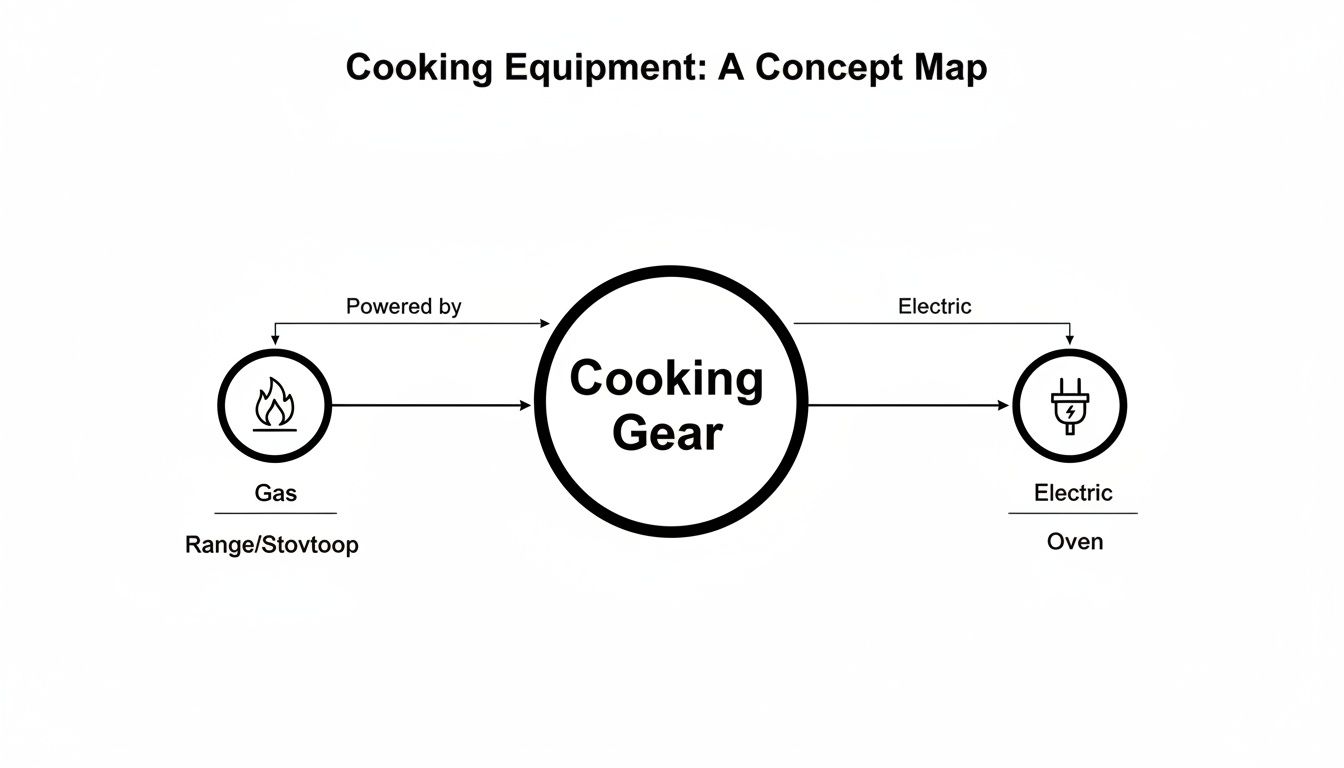
As you can see, choosing between gas and electric directly impacts where you place ventilation and how you'll manage the truck's overall power load.
Meeting Health and Safety Requirements
A great workflow is completely useless if it doesn't pass a health inspection. Your local health department has strict rules about spacing, sanitation, and safety that have to be baked into your design from day one. This means designated hand-washing sinks, three-compartment sinks for dishwashing, and proper ventilation over all your cooking equipment.
Crucial Takeaway: Don't guess. Your layout must provide enough clearance around equipment for safe operation and easy cleaning. Health inspectors will absolutely check that there's enough space between hot equipment like fryers and refrigeration units like commercial refrigerators to prevent issues.
For example, you’ll need non-porous and easily cleanable surfaces, like stainless steel, for all prep areas. You'll also have to prove your ventilation system can handle all the grease and heat coming off your cooking line. Planning for plumbing and power before you bolt anything down will save you from massive headaches and expensive rebuilds down the road.
To get a deeper understanding of these principles, check out some expert advice on creating a functional restaurant kitchen layout design—many of the same rules apply, just on a smaller scale.
At the end of the day, a well-optimized layout is your secret weapon. By thoughtfully arranging your equipment, you create a workspace that is not just compliant and safe, but also incredibly productive.
Budgeting And Financing Your Food Truck Kitchen
Figuring out how to pay for your food truck kitchen is one of the biggest steps you'll take. It feels like a huge hurdle, but getting your finances in order from the start is a massive advantage. The first thing you need is a detailed budget. This gives you a realistic roadmap of what you need and what it’s going to cost. It’s not just about the final price—it’s about building a kitchen that works hard and makes you money from day one.
Start by making a list of every single piece of equipment for food truck kitchens you need. I mean everything. Go down the line from the big stuff like commercial refrigerators and deep fryers to the smaller workhorses like under counter units. Look up realistic prices for new, commercial-grade equipment that includes a warranty. Used gear might look tempting with its lower price tag, but a sudden breakdown and expensive repair bill can wipe out those savings in a heartbeat.
Understanding Equipment Costs
The total cost really depends on how complex your menu is, but it helps to have a baseline number in mind for planning. Core pieces like a commercial freezer or a good sandwich prep table are investments that directly affect how fast and well you can serve your customers. Don't forget any specialty items your concept needs, like pizza prep tables, Seattle coffee shop refrigerators, or even specific Seattle bar equipment.
Here’s a rough idea of what you can expect to spend on the essentials:
- Refrigeration: Units like under counter refrigerators or under counter freezers can run anywhere from $1,500 to $4,000.
- Cooking Line: A solid commercial deep fryer or a new griddle will likely be in the $800 to $3,000 range.
- Prep Stations: Those all-in-one sandwich prep tables and pizza prep tables are usually priced from $2,000 to $5,000.
These are just ballpark figures, of course. The most important thing is to choose equipment that’s reliable and efficient enough to handle the daily chaos of a busy truck.
Smart Financing Makes Quality Affordable
For most folks just starting out, buying all this equipment with cash isn't realistic. This is where financing becomes your best friend. When you work with a supplier that offers good financing programs, you can get high-quality, brand-new equipment without emptying your bank account. That leaves you with cash on hand for all the other startup costs—permits, your first food order, and getting the word out.
The reliability of your refrigeration and cooking equipment is the backbone of your profitability. With the US food truck market growing and operators facing initial equipment outlays of $60,000-$120,000, finding affordable, warrantied gear is essential for independent success. You can explore more detailed insights into food truck revenue and costs at Cloudwaitress.com.
At Seattle Restaurant Equipment, we help connect operators with financing built for people in the food business. These programs make it possible to get the kitchen you really want, filled with dependable appliances, while keeping your cash flow healthy. By financing, you're investing in the right tools right away, which puts your business on the right track for the long run. To see what might work for you, learn more about our restaurant equipment financing options.
Sourcing Your Equipment For Long-Term Success
Picking out the perfect deep fryer or commercial refrigerator is a big deal, but who you buy it from is just as critical. The right vendor can be the difference between a smooth launch and a string of headaches. Think of your equipment supplier less like a store and more like a partner who's actually invested in your success on the streets of Seattle.
The first sign you’re in the right place? A seamless buying process. You should be able to easily browse and compare models of under counter refrigerators or commercial freezers online, without a salesperson breathing down your neck. This modern, pressure-free approach, backed by real industry experts you can call for advice, is the best way to get the exact equipment for food truck kitchens you really need.
The Value of a Washington-Based Partner
For any food truck operator here in Washington, sticking with a local supplier like Seattle Restaurant Equipment just makes sense. Fast, free shipping across the state—from Tacoma all the way to Spokane—means your gear arrives quickly, often in just 1-2 business days. That speed is everything; it gets your kitchen up and running so you can start making money instead of sitting around waiting for a delivery truck.
It's not just about speed, though. A local supplier knows the regional scene. Whether you're building out a mobile espresso bar and need a compact Seattle coffee shop refrigerator or you’re launching a cocktail truck and need tough Seattle bar equipment, a local partner gets it.
Key Takeaway: Your relationship with a supplier goes way beyond that first purchase. You need a partner who offers solid product warranties, stands behind reliable commercial-grade gear, and has the expertise to help you solve problems fast to keep your truck on the road.
Equipping Your Specific Concept
Every food truck menu is different, and your supplier needs to have the inventory to match whatever you’re cooking up. A well-stocked vendor will have the specialized gear to make your vision a reality.
- For Sandwich or Deli Trucks: You absolutely need high-quality sandwich prep tables. They're the key to fast assembly and rock-solid food safety.
- For Pizzerias on Wheels: Durable pizza prep tables with wide rails give you the workspace to sling pies efficiently, even in a tight space.
- For Fried Food Favorites: A reliable, high-output deep fryer is a must. It has to keep up when that lunch rush hits.
- For All-Around Cold Storage: Versatile under counter freezers and refrigerators are your best friend for making the most of every last square inch.
At the end of the day, sourcing your equipment is the final, crucial step in building your dream. Choosing a trusted vendor like Seattle Restaurant Equipment means you can affordably and confidently outfit your mobile kitchen with reliable, warrantied gear that's built to last.
Your Top Questions, Answered
Getting a food truck up and running means you've got a million questions. When it comes to the kitchen, getting the right answers can save you a ton of time, cash, and serious headaches down the road. Let's tackle some of the most common things operators ask about gearing up.
What’s The Single Most Essential Piece Of Equipment I Need To Buy?
Your menu is going to dictate your specific cooking gear, but the one thing nobody can operate without is solid, reliable refrigeration. A good commercial refrigerator or a versatile sandwich prep table is the absolute heart of your operation.
Think about it: this isn't just about keeping lettuce crisp. It's the core of your food safety program. You can't pass a health inspection, keep your customers safe, or protect your reputation without proper cold storage. No fridge, no business. It's that simple.
How Do I Decide Between Gas Or Electric Cooking Equipment?
This is a big one. Choosing between a gas deep fryer and an electric one, for instance, really comes down to your truck's power setup and what you're cooking.
- Gas (Propane): You get that powerful, instant heat that's incredible for high-volume work like searing burgers or frying up baskets of fries. The trade-off? You're managing heavy propane tanks and you absolutely need a top-notch ventilation system.
- Electric: Generally, this is a simpler and safer option. It also tends to make for a cooler kitchen, which is a huge plus in a tight space. The catch is that commercial electric appliances are power hogs. You'll need a beast of a generator or access to shore power to keep them running.
Before you pull the trigger, it's always smart to talk it over with an equipment pro who can look at your truck's power specs and your menu to help you make the right call.
Can I Actually Get Financing For My Food Truck Gear?
Yes, absolutely. Any supplier worth their salt knows that outfitting a kitchen is one of the biggest checks a new business has to write. That’s why many, including us at Seattle Restaurant Equipment, work with financing partners who get the foodservice industry.
Here's the bottom line: Financing lets you get the brand-new, quality gear you need to start off right—like dependable under counter freezers and tough-as-nails prep tables—without draining all your startup cash at once.
Why Is It So Important To Buy New Equipment With A Warranty?
In a brick-and-mortar spot, if a cooler goes down, you might have a backup or a walk-in to save the day. On a truck, if your commercial freezer or deep fryer dies, you're done. Your business is literally closed until it's fixed.
That’s a full day’s revenue—hundreds, maybe thousands of dollars—gone in an instant.
Buying new equipment with a solid warranty is your insurance policy against that kind of disaster. You’re getting reliable, efficient gear that’s backed by the manufacturer. It drastically cuts down your risk of a surprise breakdown and a massive repair bill when you're on the road, trying to make money. It’s a direct investment in keeping your truck open and serving.
Ready to build a kitchen that can keep up with your vision? The team at Seattle Restaurant Equipment is here to help you pick out the perfect, road-tested gear for your food truck.
Explore our full range of new commercial kitchen equipment today!