

So you're launching a food truck. It's an incredible journey, but before you hit the streets and serve your first customer, you need a solid plan. The most important part of that plan? The equipment.
Building out a mobile kitchen is like solving a high-stakes puzzle. Every single piece has to fit perfectly to create a workspace that's not just functional, but fast, efficient, and safe. Your equipment list is the blueprint for your entire business—get it right, and you're set up for success.
This guide is here to cut through the confusion of outfitting your truck. We'll go beyond just a simple list and dig into the "why" behind each choice. The goal is to get you from feeling overwhelmed to feeling confident, focusing on the core pillars every great food truck is built on.
The Four Pillars of Food Truck Equipment
Every piece of gear you'll need falls into one of four key categories. Thinking about it this way helps organize your planning, your layout, and your budget, making sure nothing critical gets missed.
-
Cooking Equipment: This is the heart of your operation, the engine that powers your menu. We're talking about your deep fryers, griddles, ranges—whatever it takes to bring your recipes to life.
-
Refrigeration and Storage: Think of these as your food safety guardians. From commercial refrigerators and commercial freezers to versatile sandwich prep tables, this gear keeps your ingredients fresh and up to code.
-
Preparation and Service: This is where you win or lose on speed and efficiency. It covers everything from the stainless steel worktables where you chop and assemble to the POS system where you take orders.
-
Sanitation and Safety: These are completely non-negotiable. This pillar includes your multi-compartment sinks, handwashing stations, and fire suppression systems—everything you need to pass your health inspection with flying colors.
The food truck world is absolutely booming. Getting a new truck fully equipped can cost anywhere from $50,000 to $150,000. With the U.S. market hitting $2.8 billion in 2025, it's clear there’s a huge opportunity for entrepreneurs who plan properly.
Here's a quick look at how these categories break down.
Core Equipment Categories At A Glance
| Category | Primary Function | Key Equipment Examples |
|---|---|---|
| Cooking | Bringing your menu to life through heat application. | Griddles, Charbroilers, Fryers, Ranges, Ovens |
| Refrigeration | Keeping ingredients fresh and at safe temperatures. | Reach-In Refrigerators, Undercounter Freezers, Prep Tables |
| Preparation | Creating an efficient space for assembling dishes. | Stainless Steel Worktables, Food Processors, Mixers |
| Sanitation | Maintaining a clean, safe, and code-compliant environment. | 3-Compartment Sinks, Handwashing Sinks, Exhaust Hoods |
Understanding these pillars is the first step to building a logical, workable kitchen on wheels.
One of the biggest mistakes new owners make is buying equipment before finalizing their layout. Always map out your workflow first. Your gear should support your process, not force you into a clumsy one. This kind of careful planning, much like the process of setting up a commercial kitchen, prevents expensive and frustrating bottlenecks later on and makes sure every square inch of your truck is working for you.
Equipping The Heart Of Your Mobile Kitchen
The real engine of your food truck isn’t under the hood—it's the cooking and prep equipment that brings your entire menu to life. This is where you'll transform simple ingredients into the signature dishes that people will line up for. Choosing the right gear for this "heart" of your operation is a constant balancing act between power, size, and what you actually need to cook.
Think of your cooking line as a small, specialized team where every player has a crucial job. A deep fryer is your go-to for those perfectly crispy fries and golden-brown everything, while a flat-top griddle is the undisputed champ for burgers, pancakes, and quesadillas. If your menu is a bit more complex with sauces or sautés, a commercial range with a few burners gives you that unmatched versatility.
Your equipment choices have to be a direct reflection of your menu. A taco truck is going nowhere fast without a powerful griddle and a steam table. A gourmet donut truck, on the other hand, would prioritize a high-capacity deep fryer and a heavy-duty mixer. Fight the urge to buy equipment for "just in case" dishes; every single square inch on that truck is prime real estate.
The infographic below breaks down the four core pillars you need to build your equipment plan around, starting with the cooking and prep gear that truly powers your service.
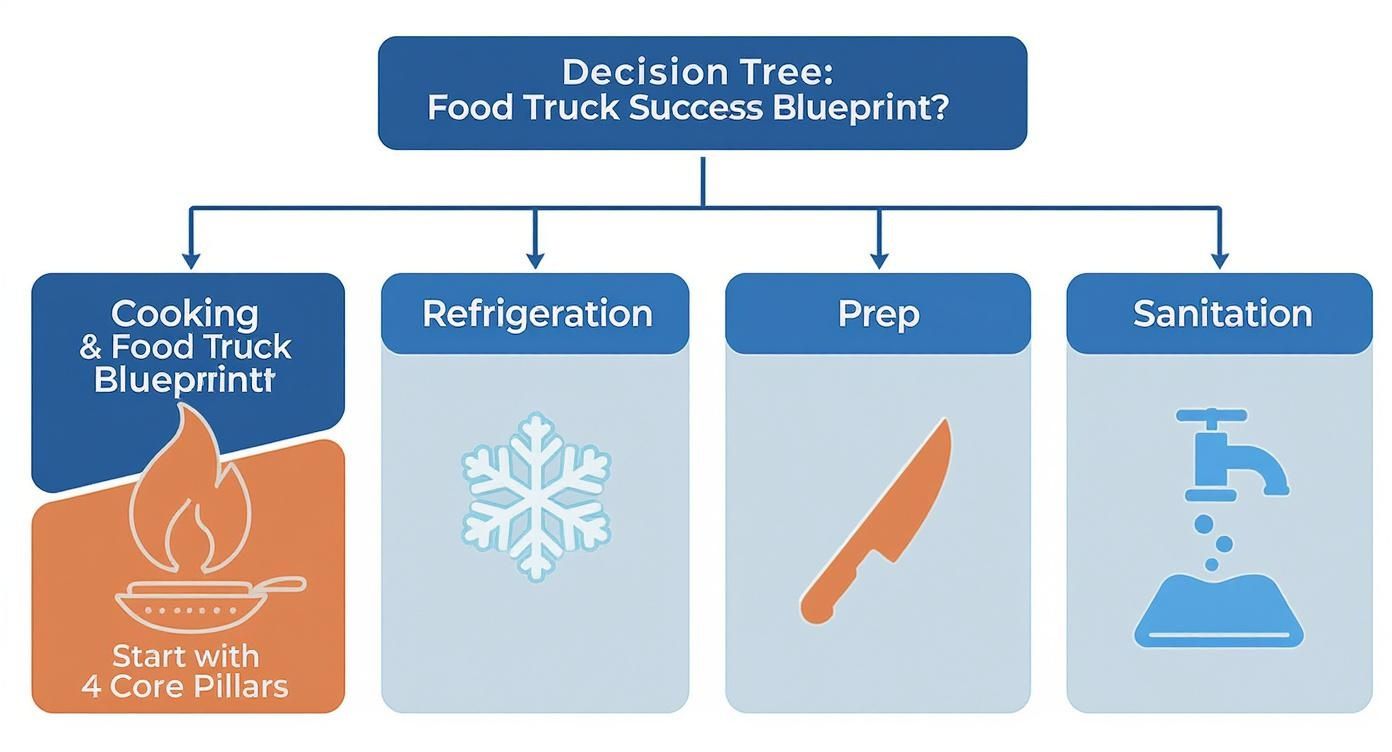
This blueprint really shows how a successful truck is built on a solid foundation of cooking, refrigeration, prep, and sanitation—all working together in an incredibly tight space.
Selecting Your Primary Cooking Appliances
When it's time to pick your main cooking units, the first big decision is usually gas versus electric. Propane is powerful and heats up in a flash, which is why it's a favorite for high-volume griddles and deep fryers. That said, electric models can give you much more precise temperature control and might even be required if you plan on working any indoor or restricted-access venues.
Let's look at some of the core components you’ll find at Seattle Restaurant Equipment:
- Deep Fryers: Absolutely essential for a massive range of popular street foods. You'll want to look for models with a fast temperature recovery time so you don't fall behind during that lunch rush.
- Griddles and Charbroilers: A griddle gives you that solid, even cooking surface that's perfect for everything from eggs to smash burgers. A charbroiler is what you need for those coveted grill marks and smoky flavor on steaks and chicken.
- Commercial Ranges: These are the versatile workhorses, combining open burners up top with an oven down below. They're a must for any truck that needs to boil, sauté, and bake.
Just remember, any piece of equipment that produces grease-laden vapor—like your fryers and griddles—will legally require a commercial ventilation hood and a fire suppression system. This is a non-negotiable safety and compliance item for your food truck equipment list. Don't overlook it.
The Unsung Heroes: Preparation Equipment
While the big cooking appliances get all the glory, your preparation equipment is what keeps service running smooth, fast, and organized. This is where efficiency is either won or lost. In the cramped quarters of a food truck, multi-functional pieces are your absolute best friends.
Take sandwich prep tables or pizza prep tables, for example. These brilliant units from Seattle Restaurant Equipment combine a refrigerated base for all your ingredients with a cutting board work surface right on top. This setup keeps everything within arm's length, minimizing how much you have to move around and dramatically speeding up assembly time.
A well-chosen prep table isn't just a refrigerator with a workspace—it's the central hub of your entire assembly line. By keeping your most-used ingredients chilled and accessible, you reduce ticket times, minimize food safety risks, and create a less chaotic workflow for your team.
For operations here in Seattle, especially if you're catering to the bar scene or the always-bustling coffee shop culture, specialized refrigeration can be a game-changer. This might include Seattle bar equipment like back bar coolers or even direct-draw beer dispensers. For the coffee crowd, compact Seattle coffee shop refrigerators for milk and dairy are key.
Likewise, space-saving under counter refrigerators and under counter freezers can be tucked neatly beneath workstations, maximizing your prep area without sacrificing that crucial cold storage. Every single piece should serve a purpose—and ideally, more than one.
Mastering Cold Storage On The Go
In the tight quarters of a food truck, your refrigeration isn't just a cold box—it's the heart of your operation. It's what keeps your inventory fresh, your food safe, and your business profitable. Getting cold storage right is a non-negotiable, both for your workflow and for the health department. Without it, you’re just looking at spoiled ingredients and a business that can't get off the ground.
Think of your cold storage as the circulatory system of your truck. It has to work flawlessly in an incredibly confined space to keep everything ready for service. The choices you make here will define how smoothly your kitchen runs, what you can put on your menu, and whether you’ll pass that next inspection with flying colors.
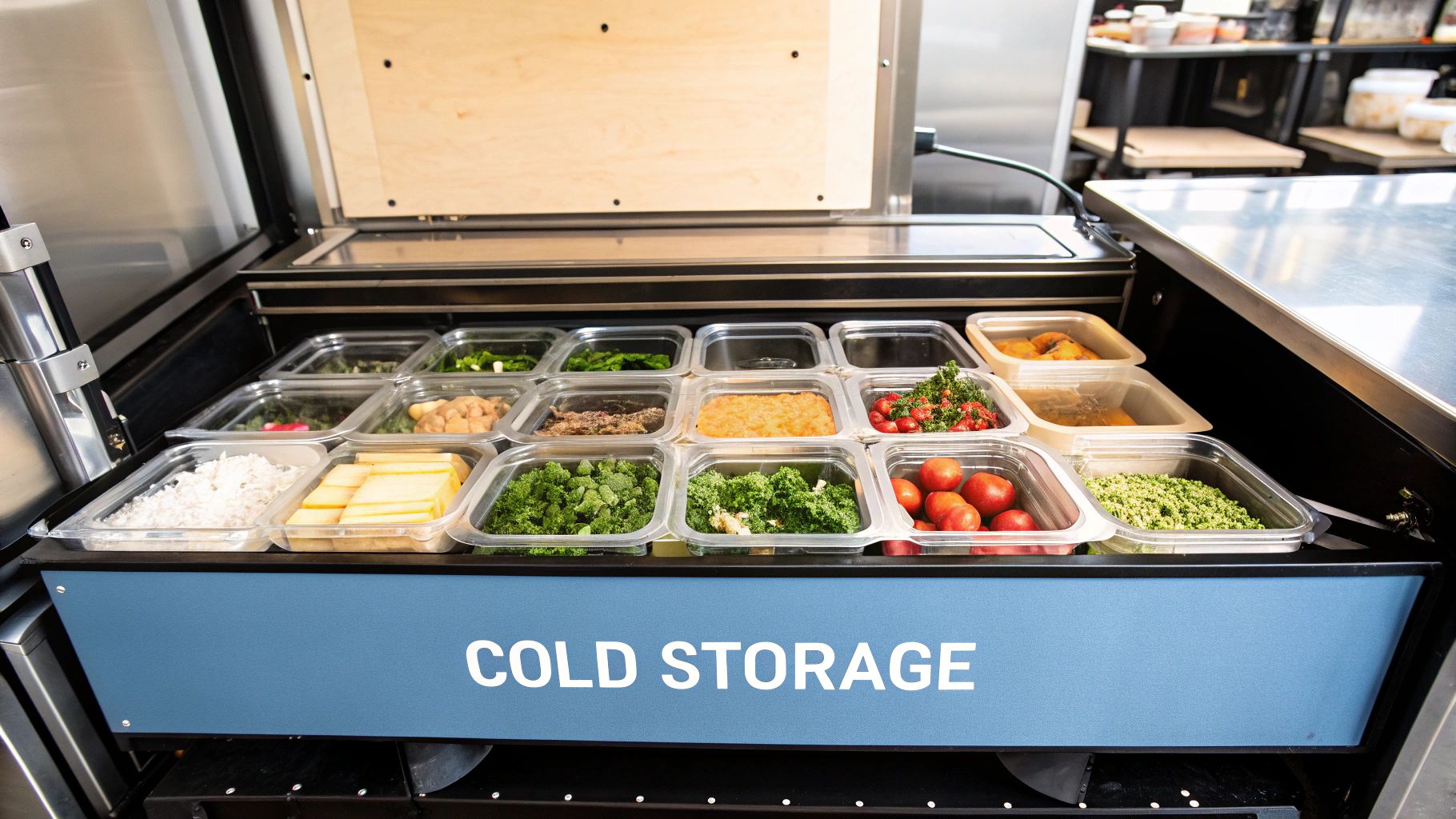
From the commercial refrigerators holding your bulk produce to the prep tables keeping toppings chilled right where you need them, every single piece of equipment has to justify the space it takes up.
Core Refrigeration and Freezer Units
Your main fridge and freezer are the absolute workhorses of your kitchen. A standard upright commercial refrigerator gives you the most storage for your vertical space, making it perfect for stashing cases of produce or big containers of prepped sauces. Right next to it, a commercial freezer is a must-have for things like meats, french fries, and anything else you need to keep frozen solid.
But on a truck, space is everything. That’s where smaller, high-efficiency units really shine.
- Under Counter Refrigerators: These are the undisputed champions of space-saving design. They tuck right under your work surfaces, putting your most-used items within easy reach without clogging up your walkway.
- Under Counter Freezers: Just like their refrigerator cousins, these freezers pack essential frozen storage into a tiny footprint. They’re perfect for holding burger patties, frozen desserts, or anything you need to grab in the middle of a rush.
Mixing and matching these units creates a kitchen that just flows better, cutting down on the frantic steps your crew has to take when things get busy. You can find a great selection of space-saving commercial under counter refrigerator models perfect for Seattle food trucks built for exactly this kind of environment.
Dual-Purpose Prep Tables: The Smart Solution
If there’s one piece of gear that perfectly captures the "work smarter, not harder" food truck philosophy, it's the dual-purpose prep table. These units are genius—they combine refrigerated storage with a dedicated workspace, becoming the central hub of your assembly line.
Sandwich prep tables are designed with a row of chilled food pans right behind a cutting board. It’s the perfect setup for building sandwiches, tacos, salads, or anything that needs a bunch of fresh toppings. Everything stays cold and right at your fingertips, which seriously slashes your assembly time.
Along the same lines, pizza prep tables give you a wider refrigerated rail and a deeper cutting board to handle large pizza doughs. You can go from stretching the dough to adding sauce and toppings all in one streamlined spot. The food truck market is highly specialized, and this shows how equipment needs change based on what you’re cooking. In fact, customized trucks make up 35% of the global market, with equipment costs often accounting for 40-50% of the initial startup price. You can see more in this in-depth industry report on food truck trends.
Choosing the right refrigeration all comes down to your menu. A burger truck will live and die by its undercounter fridge and a prep table next to the griddle. A mobile coffee shop, on the other hand, might just need a good Seattle coffee shop refrigerator for all its milk and cream. Your cold storage should be a perfect reflection of what you're serving.
To help you figure it out, here’s a quick comparison of the options we carry at Seattle Restaurant Equipment.
Choosing Your Commercial Refrigeration
Deciding on the right refrigeration is one of the biggest calls you'll make. This table breaks down the most common types to help you match the unit to your truck's specific needs.
| Equipment Type | Best For | Space Considerations | Key Feature |
|---|---|---|---|
| Upright Refrigerator | Storing bulk ingredients and prepped items in large containers. | Requires significant vertical floor space. | Maximum storage capacity for its footprint. |
| Under Counter Freezer | Quick access to frozen items like patties, fries, or desserts. | Fits seamlessly under workstations. | Frees up valuable counter and floor space. |
| Sandwich Prep Table | Trucks with menus based on salads, sandwiches, tacos, or bowls. | Combines workspace and storage in one footprint. | Refrigerated rail keeps toppings chilled and organized. |
| Pizza Prep Table | Mobile pizzerias or flatbread concepts. | Needs more depth than a standard prep table. | Deep work surface designed for dough preparation. |
Each piece plays a role, and the right combination will make your daily operations feel less like a struggle and more like a well-oiled machine.
At the end of the day, mastering your on-the-go cold storage is about making smart, strategic choices. It’s about supporting your menu, making the most of every square inch, and keeping your food safe from the first customer to the last.
Building Your Truck's Support Systems
Everyone gets excited about the sizzling griddles and bubbling deep fryers, but it's the quiet, humming support systems that really keep a food truck running. These are the behind-the-scenes workhorses—sanitation, safety, and utilities—and they're the first thing a health inspector will check.
Think of these systems as the truck's vital organs. Just like a person can't live without a heart or lungs, your mobile kitchen is dead in the water without a proper water supply, compliant sinks, and a safe power source. Getting this part of your food truck equipment list right is the difference between passing inspections with a smile and getting hit with a costly shutdown.
Mastering Sanitation And Water Systems
Health codes for mobile kitchens are notoriously strict, and for good reason. Your plumbing and sanitation setup is your first defense in food safety. Just about every health department will demand two separate sink systems, at a minimum.
-
Three-Compartment Sink: This is your warewashing station, and it's non-negotiable. You'll have one bay for washing, a second for rinsing, and a third for sanitizing. A common rule is that the bays must be big enough to completely submerge your largest pot.
-
Dedicated Handwashing Sink: This sink must be totally separate from your main sink and used only for washing hands. It needs hot and cold running water and must be stocked with soap and paper towels at all times.
To supply these sinks, you'll need two water tanks. One holds clean, potable water, and the other—the gray water tank—holds all the wastewater. A critical rule of thumb is that your gray water tank must be at least 15% larger than your freshwater tank to prevent any nasty overflows.
Powering Your Operation And Ensuring Safety
Your food truck is a power-hungry beast. You need a reliable workhorse to keep everything from your commercial refrigerators to your POS system online. This is where a quality commercial generator comes into play.
To choose the right one, add up the total electrical load of all your equipment, then add a buffer of about 20-25%. This extra juice handles the power surge when appliances kick on.
Choosing a generator isn’t just about wattage; it's also about noise. A roaring generator can drive away customers and might even violate local noise ordinances at events. Look for models rated for quiet operation—it makes for a much better vibe.
Finally, you absolutely cannot cut corners on safety systems. Any equipment that creates greasy vapor—like your griddles, ranges, and deep fryers—must be under a commercial ventilation hood with an automated fire suppression system. This will be one of the biggest and most important investments you make. It's not just a piece of metal; it’s what protects your crew, your customers, and your entire business.
Designing Your Layout For Maximum Profit
Having the right food truck equipment list is a great start, but how you arrange it is what really separates a chaotic kitchen from a high-performance profit engine. Think of your truck's layout as the blueprint for your speed, safety, and ultimately, your bottom line. It isn’t just about cramming everything in; it's about creating a smart workflow that lets your team move with purpose.
A well-designed layout cuts down on wasted steps, prevents dangerous bottlenecks, and can seriously increase how many orders you can pump out during a busy lunch rush. It's like choreographing a dance in your kitchen—every movement should be fluid, logical, and lead straight to a finished order. This is where kitchen ergonomics becomes your best friend, transforming your truck from a tight space into an optimized workspace.
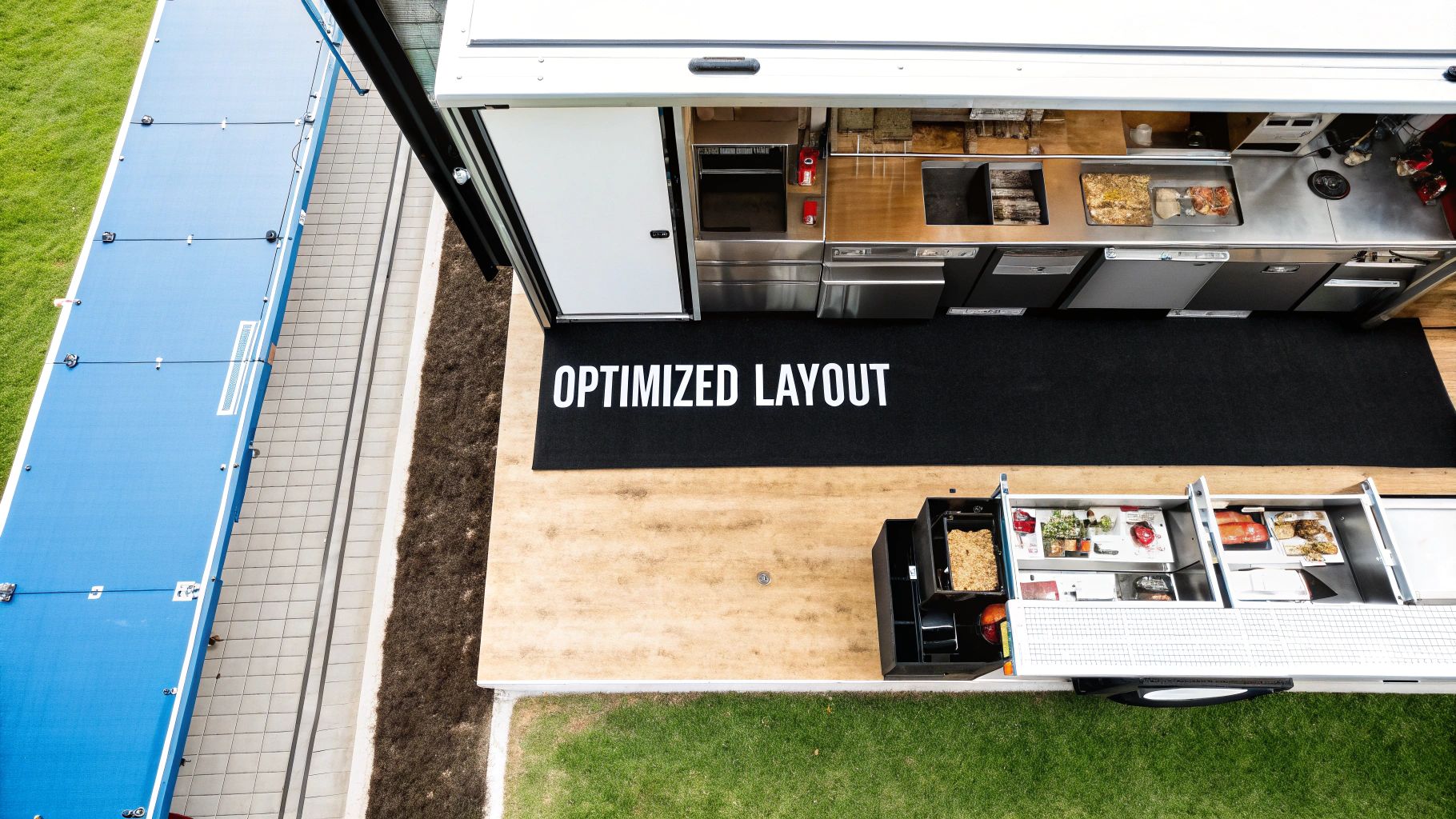
The Three Essential Zones Of Workflow
The most effective food truck layouts are almost always built around three distinct zones. This "zoning" strategy creates a natural path from raw ingredients to a happy customer, keeping your team organized and on task.
-
Preparation and Storage Zone: This is ground zero for your ingredients. It should house your main commercial refrigerators and commercial freezers, plus any dry storage. A classic space-saving trick is to put under counter refrigerators and under counter freezers right below your prep counters. Everything stays within arm's reach.
-
Cooking Zone: This is the heart of the operation—the hot line. Your deep fryers, griddles, and ranges need to be grouped together right under your ventilation hood. This setup keeps the heat and grease contained and gives your main cook a centralized station, so they aren't running all over the truck.
-
Service and Finishing Zone: This is the final handoff point. It’s where you’ll have your service window, POS system, and finishing stations like a sandwich prep table or pizza prep table. For a mobile cafe, this is where you'd want your Seattle coffee shop refrigerators for quick milk access. If you're catering events, you might even incorporate specialized Seattle bar equipment here.
Optimizing Your Seattle Food Truck Layout
The average food truck owner spends anywhere from $20,000 to $50,000 on equipment. That’s a major investment, and you need to arrange it for the best possible return. Medium-sized trucks, which make up about 45% of the market, especially need smart layouts to fit their bigger equipment lists.
A well-planned layout isn't just about efficiency—it's about safety. Creating clear pathways between the hot cooking zone and the busy service area reduces the risk of collisions, burns, and spills, making for a safer environment for everyone on board.
A common and highly effective design is the assembly line. You put the prep and storage zone at one end of the truck, the cooking line smack in the middle, and the service window at the other end. This linear flow mirrors the journey of the food itself, making the whole process intuitive and fast. For a deeper dive into optimizing your space, check out our insights on effective restaurant kitchen layout design. This approach ensures every piece of equipment, from your main commercial refrigerators down to the smallest spatula, has a logical home.
Got Questions? We've Got Answers
Stepping into the world of mobile kitchens always brings up a few questions. It's totally normal. Here are some of the most common things we hear from new food truck owners, with real-world answers to help you lock in your equipment list.
What's The Single Most Expensive Thing I'll Buy?
You might be surprised, but it's often the ventilation hood and fire suppression system. This isn't just a piece of metal—it's a non-negotiable safety and health code requirement that can easily run you several thousand dollars. Don't skimp on it.
After that, your biggest line items are usually the heavy hitters: a high-quality cooking suite or a big, tough commercial refrigerator. Of course, the final price tag always comes down to the brand, size, and features you pick for your specific setup.
Can I Get Away With Used Equipment?
Absolutely, and it's a smart move for managing those initial startup costs. The key is to buy from someone you trust. A reputable supplier inspects, services, and (most importantly) offers a warranty on their used gear, so you're not left holding the bag if something goes wrong.
When you're looking at used pieces, put on your detective hat. Pay close attention to refrigerator compressors, the wiring on high-draw items like deep fryers, and any gas lines to make sure they're safe and in good working order. And always, always check that any used equipment is NSF-certified. Your health inspector will thank you.
How Do I Figure Out My Power Needs?
It's simpler than it sounds. Start by making a master list of every single thing that plugs in on your truck. Look for the manufacturer's label on each piece and jot down its wattage or amperage.
Here's the pro tip: get a generator that can supply at least 20-25% more power than your total calculated need. That extra cushion is critical. It handles the big power surge when appliances like commercial freezers or your flat-top griddle first kick on, preventing a blown circuit right in the middle of a lunch rush.
What's The Real Difference Between A Sandwich Prep And A Pizza Prep Table?
Both are brilliant designs that merge cold storage with a workspace, but they're built for completely different kitchen dances. Nailing this choice is huge for your workflow.
-
Sandwich Prep Tables: Think of these as your go-to for assembly lines. They have a shallower cutting board and are set up for smaller, rectangular food pans—perfect for lettuce, tomatoes, onions, and cheese. They're the workhorse for building sandwiches, salads, and tacos.
-
Pizza Prep Tables: These are a whole different beast. They feature a much deeper work surface because you need room to stretch and work large pizza doughs. The refrigerated rail on top is also designed to hold round ingredient bins, tailor-made for slinging pepperoni and mushrooms.
Both of these units, along with specialized Seattle bar equipment or a compact Seattle coffee shop refrigerator, show just how important it is to match your equipment to your menu. A sandwich prep table is a jack-of-all-trades, but a pizza prep table is non-negotiable for a mobile pizzeria. In the same way, under counter refrigerators and under counter freezers solve different space-saving puzzles for every unique truck concept.
Ready to build out your truck with gear you can count on? Seattle Restaurant Equipment has everything you need, from refrigeration to cooking, with free shipping across Washington and flexible financing to get you rolling.