

If your business operates where natural gas lines just don't reach, converting a commercial range to propane isn't an option—it's a necessity. This is a technical job that involves swapping out specific internal parts, like the orifices, and adjusting the pressure regulator to safely handle propane's unique properties. It's how you ensure your high-performance fryer or griddle runs efficiently and safely, no matter where you set up shop.
Why Convert Your Commercial Range to Propane?
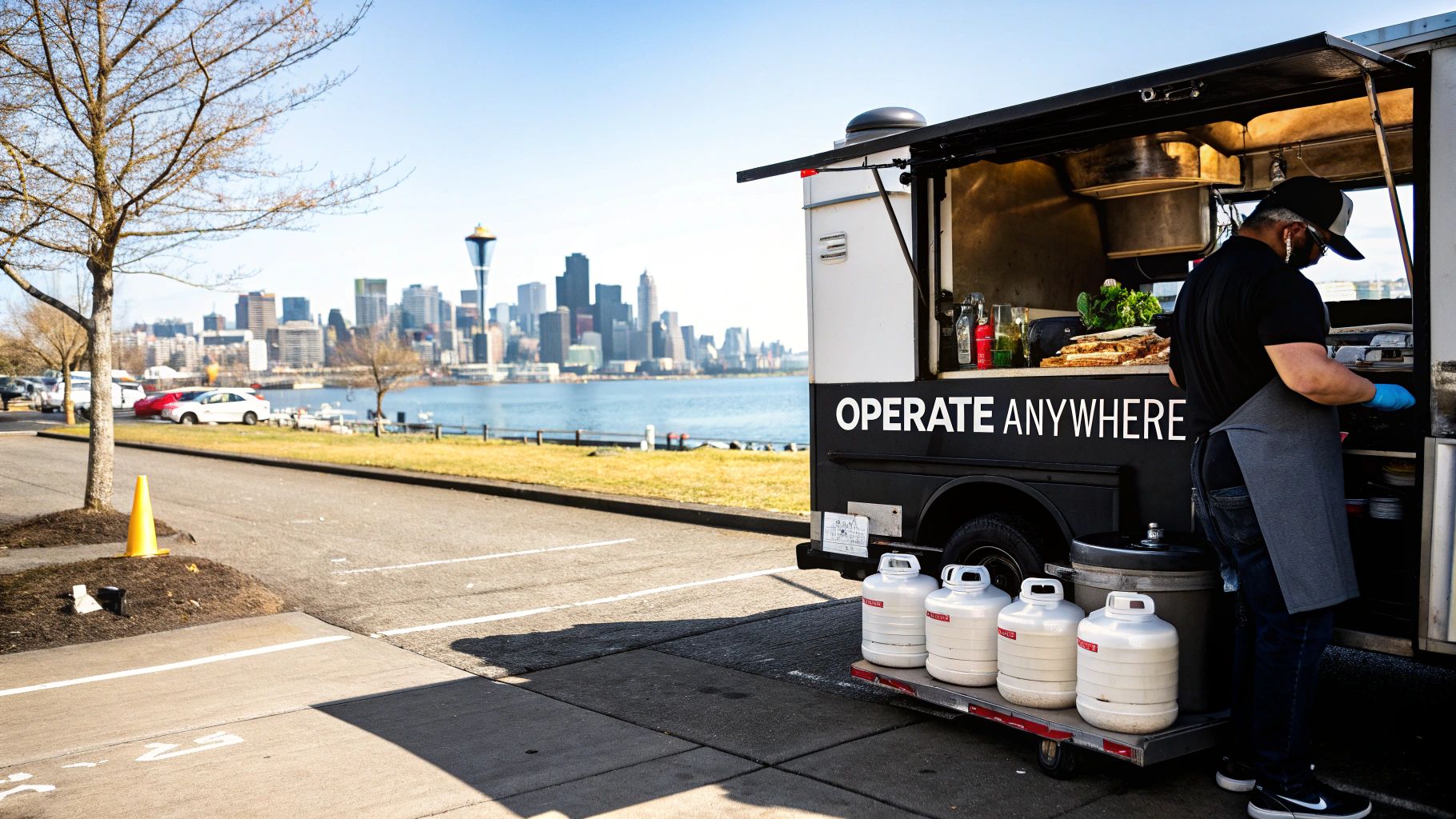
For a lot of food businesses here in Washington, the decision to go with propane is driven by sheer ambition and location. Think about a food truck firing up the grill at a weekend festival in Spokane, or a pop-up caterer setting up for a wedding in Tacoma. In these spots, you can't just plug into a natural gas pipeline. This is where converting a natural gas range to propane gives you the freedom to operate.
Propane is the lifeblood of any mobile or off-grid kitchen, offering incredible portability and power. Its real secret weapon, though, is its energy density. A cubic foot of propane packs about 2,516 BTUs (British Thermal Units), which is more than double the roughly 1,030 BTUs you get from natural gas. For your kitchen, that means your equipment gets hotter faster and holds its temperature using less fuel.
Unleash Your Kitchen’s Potential
This simple conversion untethers your business from fixed infrastructure, allowing you to run a powerful kitchen practically anywhere. For restaurant owners who get their gear from Seattle Restaurant Equipment, this kind of flexibility is a total game-changer. You can buy a top-notch, reliable commercial range and know it can be adapted for any opportunity that comes your way.
That agility is everything in the fast-moving Washington foodservice scene. Maybe you're opening a coffee shop in Everett with a killer oven that's nowhere near a gas main, or a bar in Seattle that wants to add a patio grill. Propane provides the power. It means you can run your commercial refrigerators, commercial freezers, and sandwich prep tables right alongside a propane-fueled cooking line, creating a complete, go-anywhere kitchen.
The Numbers and Logic Behind Propane
Before we dive deeper, it's helpful to see a quick side-by-side of these two fuel sources. This will give you a clearer picture of why this conversion is so common and necessary for certain business models.
Natural Gas vs. Propane: A Quick Comparison for Restaurant Owners
| Feature | Natural Gas | Propane (LP) |
|---|---|---|
| Energy Output | ~1,030 BTU per cubic foot | ~2,516 BTU per cubic foot |
| Delivery Pressure | Low pressure (typically 0.25 PSI) | High pressure (typically 100-200 PSI in tank) |
| Infrastructure | Requires a fixed pipeline connection | Delivered and stored in portable tanks |
| Best For | Brick-and-mortar restaurants in urban areas | Food trucks, caterers, remote & pop-up kitchens |
This table makes it clear: the fuels aren't interchangeable. The higher energy output and pressure of propane are precisely why you need a proper conversion to ensure safety and performance.
The practical case for propane is strong, especially when you consider that natural gas pipelines only cover about 70% of urban areas in Washington. That leaves a huge number of locations, from rural venues to new developments, that depend on propane's easy tank delivery system. And with the often-volatile natural gas prices in the Pacific Northwest, propane's efficiency can lead to real cost savings.
For a mobile business, the logic is simple: you can't bring a pipeline with you. Propane tanks are your portable power source, enabling you to fire up a pizza prep table or a deep fryer at a farmer's market, a wedding, or a remote construction site with the same efficiency as a brick-and-mortar kitchen.
This is the operational freedom that makes propane indispensable. It lets you invest in high-quality Seattle bar equipment or Seattle coffee shop refrigerators from a trusted supplier like Seattle Restaurant Equipment, knowing your cooking appliances can perform wherever your business takes you. The conversion process is what unlocks the full potential of your commercial kitchen, turning a stationary piece of equipment into a versatile asset ready for any opportunity.
Diving Into the Core Parts of a Gas Range Conversion
To really get the hang of converting a natural gas range to propane, you have to understand the nuts and bolts of it. This isn't just about swapping out a hose. It’s a precise job that accounts for the huge difference between the two fuels. Getting a feel for the "what" and "why" behind the main parts—the gas orifices and the pressure regulator—is your first step toward a safe, successful conversion.
Here’s a simple way to think about it: natural gas comes into your kitchen at very low pressure. Propane, on the other hand, is stored and delivered under much higher pressure. Trying to run one fuel through a system built for the other is like hooking a fire hose up to a garden sprinkler. It’s going to be a dangerous mess.
The All-Important Gas Orifices
The most critical parts you’ll be dealing with are the gas orifices. These are tiny, precision-drilled brass fittings that meter the exact amount of fuel flowing into each burner. Because natural gas is a lower-pressure fuel, it needs orifices with larger openings to get enough gas through for a proper flame and BTU output.
Propane, being under much higher pressure, is a whole different ballgame. If you tried to force that high-pressure propane through a large natural gas orifice, you'd end up with massive, out-of-control flames spitting out soot and carbon monoxide. To fix this, you have to switch to propane orifices, which have much, much smaller holes.
It’s a lot like putting a smaller nozzle on a pressure washer. That smaller opening restricts the flow, giving you a controlled, powerful stream to get the job done right. In the kitchen, the right orifice makes sure your flame is steady, efficient, and safe.
Manufacturers will often include specific, sometimes color-coded, orifices in their conversion kits to make sure the burner hits its intended BTU rating. That precision is everything for consistent cooking, whether you’re lighting up a deep fryer or a six-burner range in a packed Seattle restaurant.
What’s the Deal with the Pressure Regulator?
The other key player here is the pressure regulator. Think of it as the gatekeeper. Its job is to step down the high pressure from the propane tank to a safe, steady level the appliance can actually use. A regulator built for natural gas just can't handle the force of propane.
When you do a conversion, the regulator itself has to be adjusted. Usually, this means unscrewing a cap and literally flipping an internal pin or plunger. This small action changes the tension on a spring inside, recalibrating the whole device to handle propane's higher pressure. This guarantees a steady, correct pressure is sent to the manifold, which then feeds the gas out to all the burners.
Why the Science Matters in Your Kitchen
It all comes down to energy density and pressure. A propane conversion is so critical because propane packs way more punch—about 2,516 BTUs per cubic foot, while natural gas only has 1,030 BTUs. For restaurant owners in Washington state, from food trucks to pizzerias we supply at Seattle Restaurant Equipment, this means you get the same cooking power with about half the volume of fuel.
For commercial ranges, this means you absolutely have to swap the orifices. Natural gas systems run at a low 3-4 inches of water column (W.C.) pressure and need larger orifices. Propane runs at a much higher 10-11 inches W.C. and needs smaller orifices to prevent dangerous over-firing.
Getting these components right is the first step in properly outfitting your whole kitchen. A well-done conversion lets your powerful gas appliances work seamlessly with your other essential gear, like commercial refrigerators, commercial freezers, and under counter freezers. For a full rundown of what a new kitchen setup needs, check out our comprehensive commercial kitchen equipment checklist. This helps make sure every piece, from pizza prep tables to Seattle bar equipment, works together perfectly.
Your Guide to a Safe Conversion Process
Switching a commercial range from natural gas to propane isn't rocket science, but it absolutely demands your full attention and a healthy respect for the process. Think of it less like a simple repair and more like performing minor surgery on the heart of your appliance. Getting it right comes from understanding each step, having the right parts on hand, and never, ever skipping the final safety checks.
Before you even think about turning a wrench, get everything organized. This means having the correct, manufacturer-specific conversion kit for your exact range model. Lay out your tools: you'll need a good set of nut drivers, some open-end wrenches (usually 1/2-inch and 5/8-inch), pipe thread sealant rated for propane (look for the yellow stuff), and both Phillips and flat-head screwdrivers. And the most critical tool of all? A simple spray bottle with soapy water for leak detection. Don't even start without it.
This diagram breaks down the three main things you'll be dealing with: the orifice, the regulator, and the manifold.
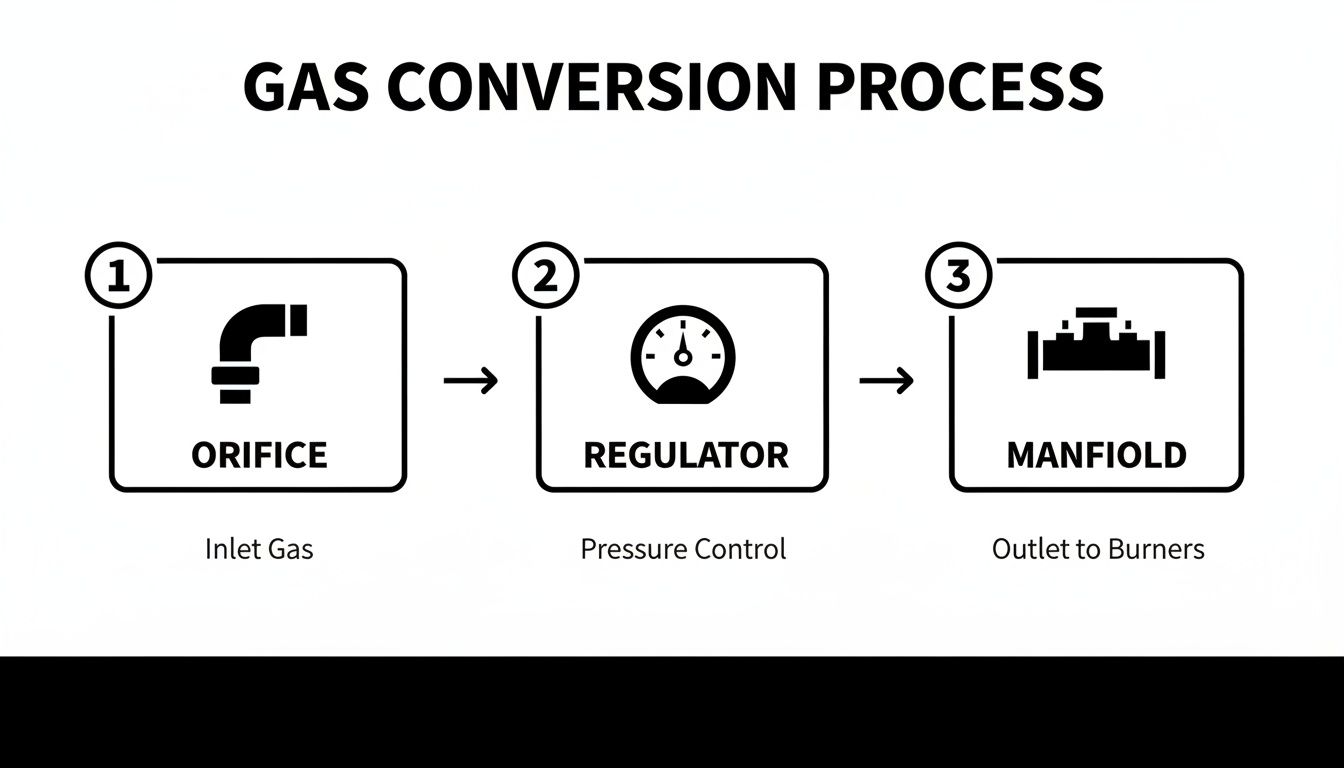
It’s a great visual for understanding how each part plays its role in taming the higher-pressure propane and delivering it safely to your burners.
Locating and Swapping the Orifices
First things first: shut off the gas supply completely and unplug the range from the wall. Now you can get to work. The main event in converting a natural gas range to propane is swapping out the orifices for each burner on the cooktop and adjusting the one for the oven. These tiny brass fittings are the gatekeepers that control how much fuel gets through.
To get to the cooktop orifices, lift off the heavy grates, burner caps, and the burner heads themselves. You’ll see the natural gas orifices sitting at the base. Using the right size nut driver, carefully unscrew each one. Here’s a pro tip: stick a small piece of masking tape inside the socket of your nut driver. It creates just enough grip to hold onto that tiny orifice so you don't drop it down into the guts of the range—a real headache you want to avoid.
With the old ones out, you'll install the new, smaller propane orifices from your kit. Always start threading them by hand to make sure you don't cross-thread them, then tighten until they're snug. Don't go crazy here; the brass is soft and easy to damage. The oven and broiler are a bit different. You'll usually need to remove the oven's bottom panel to find the bell-shaped orifice. Instead of replacing it, you’ll typically just tighten it down about one full turn to restrict the gas flow, but follow your kit's instructions to the letter.
Adjusting the Pressure Regulator
Next up is the pressure regulator. You'll usually find this where the main gas line connects to the back of the range. Its job is to knock the fuel pressure down to a level the appliance can actually use, and it has to be re-configured for propane's higher incoming pressure.
The fix is often surprisingly simple.
- First, use a wrench (often a 5/8-inch) to unscrew the regulator's cap.
- Inside, you'll see a plastic or metal pin.
- For natural gas, it’s set one way; for propane, you’ll pull it out, flip it over, and drop it back in before screwing the cap back on.
That tiny flip is what adjusts the internal spring, recalibrating the whole unit to handle propane's standard 10 inches of water column (W.C.) pressure. Always double-check your manufacturer's manual, as some designs can differ.
Safety First Takeaway: This entire process lives and dies by following the manufacturer's directions precisely. A guide like this gives you the roadmap, but your conversion kit's instructions are the law. Going off-script can void warranties on equipment and, more importantly, create a serious safety hazard.
The Critical Testing Phase
With all the new parts in place, it’s time for the most important step: testing your work. Do not rush this.
First, perform a leak test. Reconnect the gas line, making sure every fitting is tight. For real peace of mind, this is where quality parts matter; using professional-grade gas hoses and connection kits can make all the difference in ensuring a secure, lasting setup.
Now, turn the gas supply back on. Spray every single connection you touched—the regulator, the main fitting, and around each orifice—with your soapy water. Look closely for any bubbles forming. Bubbles mean you have a leak. If you see one, shut the gas off immediately, give the fitting a slight tighten (no more than a quarter-turn), and test again. Don't move on until you have zero bubbles.
Finally, you have to test the manifold pressure with a manometer. This is a non-negotiable final step that confirms your regulator is delivering exactly 10" W.C. of pressure. A technician connects this specialized gauge to a test port on the manifold to verify the pressure is perfect. This last check guarantees your commercial range will run safely, efficiently, and just how the manufacturer designed it to.
Navigating Safety Protocols and Washington State Regulations
When you're talking about converting a commercial gas range to propane, there's one word that comes before all others: safety. While it’s good to understand the mechanics, this is one job that absolutely must be left to a licensed gas technician. Trying to DIY this is asking for trouble—the kind of trouble no restaurant can afford.
An improper conversion can create immediate, catastrophic dangers. We're talking about gas leaks, carbon monoxide poisoning, and even explosions. In a busy kitchen packed with staff and customers, taking that kind of chance is just not an option.
Why Professional Installation Is Non-Negotiable
The technical side of a propane conversion really drives home why you need a pro. The gas pressure has to be adjusted from the 3.5-4 inches W.C. of natural gas all the way up to 9-11 inches W.C. for propane. Get that wrong, and you’re looking at leaks or worse. It’s a risk manufacturers have highlighted in their guides since the early 2000s, and it’s why modern guides always stress checking the owner’s manual for model-specific steps.
This precision isn't just for your main range; it applies to every piece of gas equipment, from a six-burner stove to a high-capacity deep fryer. A licensed professional brings the right tools, like a manometer, to verify the pressure is perfect and has the experience to make sure every connection is airtight. It's about protecting both your investment and your people.
Understanding Local Codes in Washington State
Here in Washington, local regulations add another layer of complexity. Gas installation codes aren’t the same everywhere; they can change quite a bit between cities like Seattle, Tacoma, and Spokane. A licensed technician stays current on the specific permitting requirements and inspection rules for your exact location.
For instance, Seattle might have different setback rules for propane tanks or unique ventilation standards compared to a more rural area. If you don't comply, you could be facing failed inspections, hefty fines, and serious delays in opening. A pro handles all of that, ensuring your conversion is not only safe but 100% legal. Getting this right is a core part of setting up a successful commercial kitchen.
Warranty and Liability: The High Cost of Cutting Corners
Beyond the immediate safety risks, a DIY conversion can have serious consequences for your business. Almost every commercial equipment warranty is tied to proper installation by a certified professional. If you or an unlicensed handyman messes with the conversion on a new range from a supplier like Seattle Restaurant Equipment, you’ve likely just voided the manufacturer’s warranty on the spot.
That means if anything fails down the road—even something totally unrelated to the gas line—you could be on the hook for the full cost of repairs or a replacement.
Even more critical is the liability. If an accident, fire, or injury is traced back to an improperly converted appliance, your insurance claim will almost certainly be denied. The legal and financial fallout from that could easily shut your business down for good.
Hiring a licensed professional isn't an expense; it's an essential investment in the safety, legality, and longevity of your restaurant. It protects your equipment, your staff, your customers, and your entire business from catastrophic risk.
Troubleshooting Common Conversion Mistakes
Even when you've hired a licensed pro for your conversion, knowing what to look for can make a world of difference. Understanding the signs of a problem helps you have a productive conversation with your technician and ensures the job gets done right.
A successful conversion isn't just about getting a flame to light; it's about making sure it’s the right kind of flame—safe, efficient, and clean-burning.
After converting a natural gas range to propane, small issues can sometimes pop up. These are almost always related to the fuel-to-air mixture or incorrect pressure settings. Knowing how to spot these problems helps protect your equipment, from a new six-burner range to a high-capacity deep fryer, and keeps your kitchen operating safely.
Identifying and Fixing Flame Issues
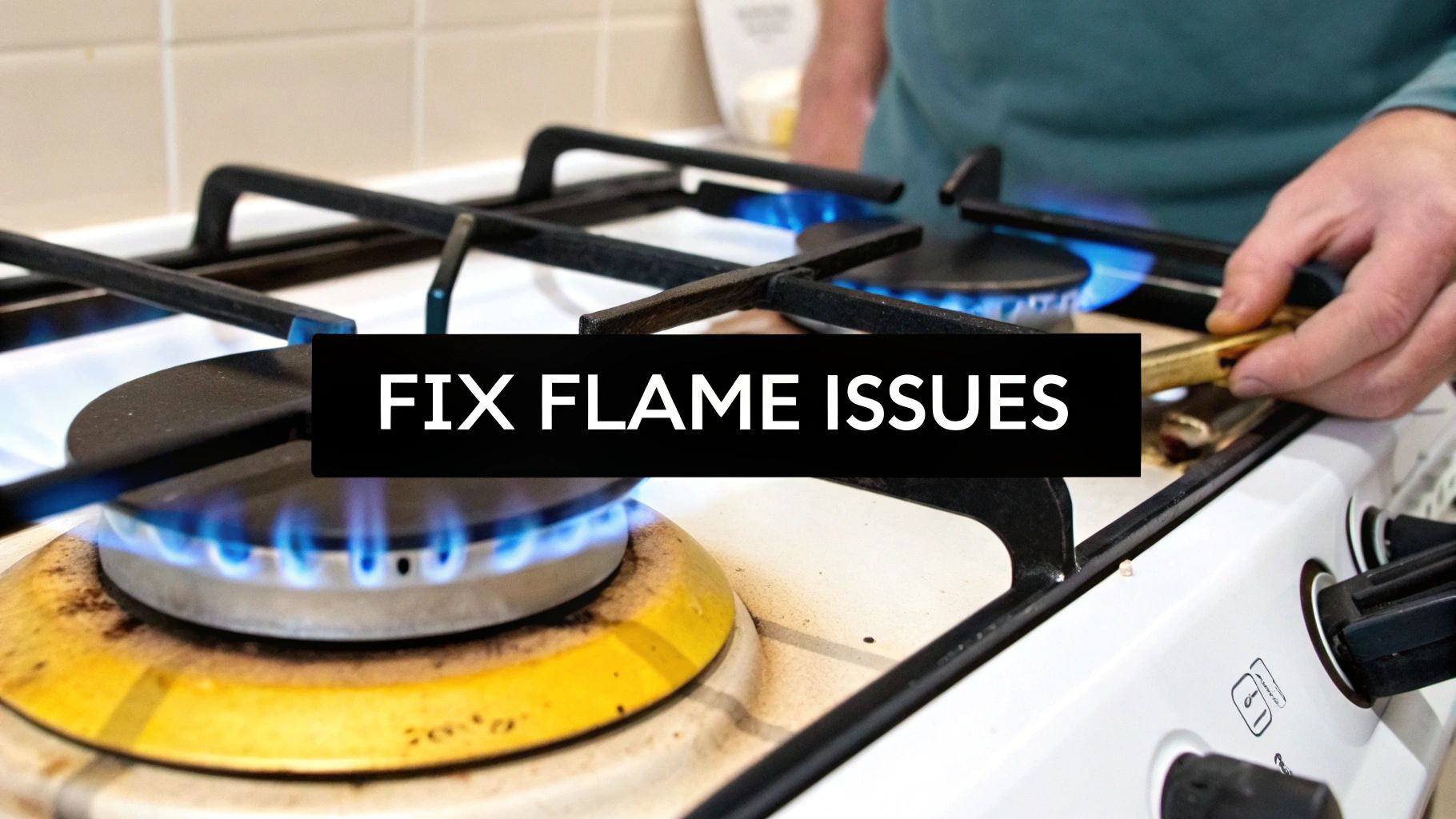
The most obvious sign of a problem is the flame itself. A perfect propane flame should be stable, quiet, and mostly blue with just a hint of yellow at the very tips. Anything else is a signal that an adjustment is needed.
-
Yellow, Sooty Flames: If you see a lazy, yellow flame leaving black soot on your cookware, the burner isn't getting enough air. This is inefficient and can produce dangerous carbon monoxide. The fix is for the technician to adjust the burner's air shutter, opening it slightly to let more oxygen into the mix.
-
Lifting, Noisy Flames: A flame that makes a "whooshing" sound or looks like it's lifting off the burner head is getting too much air. This can cause ignition problems and cook food unevenly. Your technician will need to close the air shutter a little at a time until the flame settles down and burns quietly.
-
Flames Are Too High: If the flames are huge even on the lowest setting, that’s a major red flag. This almost always means either the wrong orifices were used (the natural gas ones were left in) or the pressure regulator wasn't set correctly for propane. This requires shutting everything down immediately for a re-check of all converted components.
Addressing Pilot Light Problems
For appliances with a standing pilot light, the pilot itself can be another trouble spot. If it won't stay lit after the conversion, it's often a simple fix.
The pilot light has its own tiny orifice and adjustment screw. A technician may need to slightly increase the gas flow to the pilot or make sure the thermocouple is positioned correctly in the flame to keep it going.
Critical Safety Protocol: If you ever smell gas—that distinct rotten egg odor—do not hesitate. Immediately shut off the main gas supply valve to the appliance and the tank. Don't touch any electrical switches or create sparks. Evacuate the area and call your licensed gas technician or the fire department from a safe distance.
The Role of Manifold Pressure
Honestly, many of these issues trace right back to incorrect manifold pressure. This is exactly why that final check with a manometer is so crucial.
If the pressure is too high (above 11" W.C.) or too low (below 9" W.C.), none of the burners will operate correctly, no matter how much you fiddle with the air shutters. Verifying the pressure confirms the regulator was adjusted properly and is the foundation of a successful, safe conversion.
Ultimately, this knowledge helps you ensure every piece of your kitchen is running at peak performance. When your gas ranges and deep fryers work flawlessly, it complements the efficiency of your other essential equipment, like the commercial refrigerators and sandwich prep tables you rely on from Seattle Restaurant Equipment. A well-tuned kitchen is a safe and profitable one.
Your Top Questions About Range Conversions
When you’re thinking about switching a natural gas range to propane, you’re not alone. We get calls from restaurant owners all over Washington, from busy Seattle kitchens to food trucks in Everett, asking the same fundamental questions. Let’s clear up the confusion so you can make the right call for your business.
We’ve pulled together the most common questions and laid out the straight answers you need.
Can I Convert Any Old Natural Gas Range to Propane?
The quick answer is no, not always. Most modern commercial ranges are built to be convertible, but you have to be absolutely sure. The first place to look is the manufacturer's manual or the data plate right on the appliance.
You’re looking for specific language like "field convertible" or a chart listing specs for both natural gas and LP (liquid propane). If that manual explicitly says not to convert it, take that seriously. Some older or specialized units were only ever meant for one fuel type. Trying to force it is a huge safety gamble and a surefire way to void your warranty, even on gear from us at Seattle Restaurant Equipment.
Is It Okay to Just Grab a Generic Conversion Kit?
Let me be blunt: absolutely not. It's tempting to save a few bucks with a generic kit, but it’s one of the biggest mistakes you can make. The burners on your range are engineered for a very specific BTU output. The orifices in an OEM (Original Equipment Manufacturer) kit are drilled with precision to match those exact ratings.
Using a one-size-fits-all part can lead to a mess of problems:
- Flames that are dangerously high, creating a serious fire hazard.
- Lousy performance, with hot and cold spots that ruin your food.
- Incomplete combustion, which means soot all over your pans and, worse, deadly carbon monoxide gas filling your kitchen.
Do yourself a favor and order the exact kit for your range’s model number. It ensures every single piece, from the tiny orifices to the regulator pin, is calibrated to work safely and correctly.
What Does a Good Propane Flame Look Like?
After a proper conversion, the flame is your best friend. It tells you everything you need to know. You’re looking for a flame that’s stable, quiet, and mostly blue with just a hint of yellow at the very tip.
If you see lazy, yellow flames leaving black soot on your cookware, your fuel mix is too rich (not getting enough air). On the flip side, if the flame is noisy and looks like it's lifting right off the burner, the mix is too lean (too much air). A licensed technician knows how to adjust the burner's air shutter to dial in that perfect blue flame, making sure you’re burning fuel cleanly and efficiently. A well-tuned range is just as critical as your commercial refrigerators and pizza prep tables.
Can I Convert My Fryer and Griddle, Too?
Yes, you often can, but the same rules apply. Most commercial gas appliances follow the same conversion principle, but each one needs its own specific kit and a professional to handle the job. This goes for all the essential cooking equipment you might find at Seattle Restaurant Equipment, including:
- Commercial Deep Fryers
- Griddles and Charbroilers
- Convection Ovens
Just like with your range, you have to confirm that the manufacturer officially lists the equipment as field-convertible. Never, ever assume the process for a fryer is the same as for a range.
Ready to equip your kitchen with reliable, high-performance appliances that can adapt to your needs? Seattle Restaurant Equipment offers a wide selection of new commercial ranges, fryers, and refrigeration solutions perfect for any Washington foodservice business. Explore our inventory online and enjoy fast, free shipping across the state.