

A countertop convection oven commercial model is a game-changer for professional kitchens. These compact powerhouses use internal fans to circulate hot air, cooking food up to 25% faster and far more evenly than a traditional oven. For any business needing efficiency and consistency without sacrificing space, this is an essential piece of equipment.
Why Countertop Convection Ovens Are Essential for Modern Kitchens
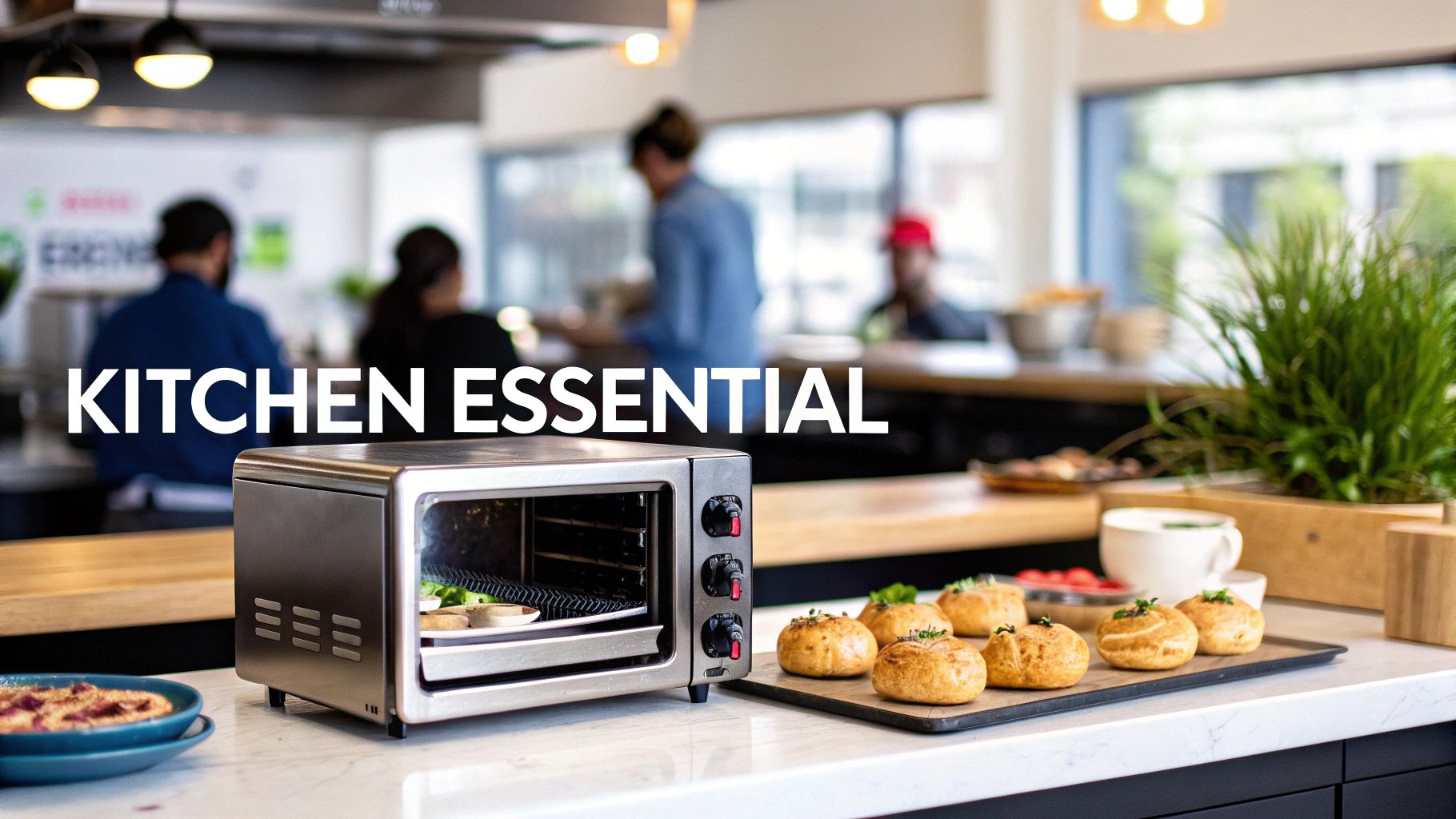
In any fast-paced Washington foodservice business, whether it's a bustling Seattle coffee shop or a busy Tacoma food truck, space and efficiency are everything. A commercial countertop convection oven gives you the muscle of a full-size oven in a compact, benchtop unit. This isn't just about saving a bit of floor space; it's about transforming your kitchen's entire workflow.
Think of it like this: you're swapping a standard car engine for a high-performance racing engine, but it fits neatly inside a compact car. You get incredible power, speed, and precision without the bulky frame. In the kitchen, that translates to rapid preheating and consistent cooking temperatures, wiping out the frustrating hot spots that plague conventional ovens. The result? Perfectly golden pastries, evenly roasted meats, and dependable results every single time.
Unlocking Versatility in Your Kitchen
The real beauty of a countertop convection oven is its sheer versatility. It’s one piece of equipment that can wear many hats, making it priceless for kitchens with diverse menus. Whether you're running a small cafe in Bellevue or a large-scale catering operation, this appliance just adapts to what you need. That kind of flexibility is a lifeline for businesses that need to do more with less.
For example, the very same oven can:
- Bake delicate scones and muffins with a perfect, golden-brown finish.
- Roast small batches of vegetables or proteins in a flash.
- Reheat pre-made meals without turning them into shoe leather.
- Finish dishes beautifully right before they head out to a hungry customer.
This adaptability lets you expand your menu without having to buy a bunch of big, specialized appliances. It fits right in alongside other key equipment, like your commercial refrigerators and sandwich prep tables, helping you build a smart, productive workspace.
At Seattle Restaurant Equipment, we see it all the time—a quality countertop oven quickly becomes the workhorse of a commercial kitchen. It’s an investment that pays you back through better speed, consistency, and energy savings, which directly helps your bottom line.
Our no-commission sales approach means you get honest advice for what your kitchen actually needs, not a pushy sales pitch. We get it; your success hinges on having reliable tools. That's why we also supply everything from Seattle bar equipment to deep fryers, all backed by our commitment to quality and free statewide shipping. We're here to help you build a fully functional kitchen with durable, high-performance gear you can count on.
How Convection Technology Transforms Your Cooking
To really get why a countertop convection oven commercial model is such a big deal, you have to understand what’s happening behind that stainless steel door. A regular oven just uses static, radiant heat—think of how the sun heats up a patch of asphalt. A convection oven, on the other hand, adds a fan to the mix, actively pushing that hot air all around the oven.
That simple fan changes everything.
Picture the difference between a scorching hot, still summer day and a day that’s just as hot but has a strong breeze. The moving air on the windy day makes the heat feel way more intense. That’s exactly what's going on inside your oven.
The fan keeps the air circulating, which gets rid of hot and cold spots and makes sure every corner of the oven is the same, consistent temperature. This active heat is why convection cooks food faster, browns everything more evenly, and gives you perfectly predictable results, time after time.
From Inconsistent to Flawless Results
In a professional kitchen, consistency is everything. A countertop convection oven makes sure every single batch of cookies comes out uniformly golden. Every roast is juicy with a perfect brown crust. Every tray of appetizers is heated to the exact same temp, whether it's on the top rack or the bottom.
This kind of precision happens because the oven wraps food in a moving blanket of heat. It doesn’t just cook faster—it also helps render fats and create that crispy skin everyone loves, all while keeping the inside perfectly moist. If you want to go deeper into how this tech stacks up against the old-school methods, check out our detailed guide on convection vs. regular ovens.
A countertop convection oven doesn't just cook food; it refines it. By mastering heat distribution, it gives chefs the control they need to produce high-quality dishes consistently, even during the busiest service rushes.
Electric Precision vs Gas Power
You need to match the oven to your menu, and the power source makes a big difference.
-
Electric Models: These are the kings of precision. Electric ovens are known for providing incredibly stable, dry heat, which is perfect for delicate baking. If your Seattle coffee shop is famous for its flawless pastries and cakes, an electric model gives you that fine-tuned control you need.
-
Gas Models: Gas is all about raw power and speed. Gas convection ovens heat up in a flash and excel in high-volume kitchens. They’re workhorses, perfect for roasting, broiling, and all-around cooking in busy restaurants or catering gigs.
It's no surprise that more kitchens are making the switch. The U.S. restaurant industry is set to grow at 2.7% annually for the next decade, and that means a bigger need for efficient gear. The global countertop oven market hit a whopping $7.68 billion in 2023, and the commercial side of that claimed a massive 74.9% share. For businesses here in Washington getting their gear from Seattle Restaurant Equipment, that means access to ovens that preheat faster and cook up to 25% quicker than old conventional units—a serious advantage for high-turnover spots in Kent or Renton. You can read more about these market trends on Verified Market Reports.
Getting a Handle on Key Oven Specs and Features
Trying to decipher the spec sheet on a countertop convection oven commercial model can feel like you're learning a new language. But don't worry—getting a grip on just a few key features is all it takes to go from confused to confident. The real goal is matching the oven’s horsepower to your kitchen’s daily grind, whether you're baking pastries in Everett or roasting meats down in Renton.
This quick decision tree can help you picture how different cooking technologies stack up against your menu goals, like getting that perfect browning or just cooking things fast.
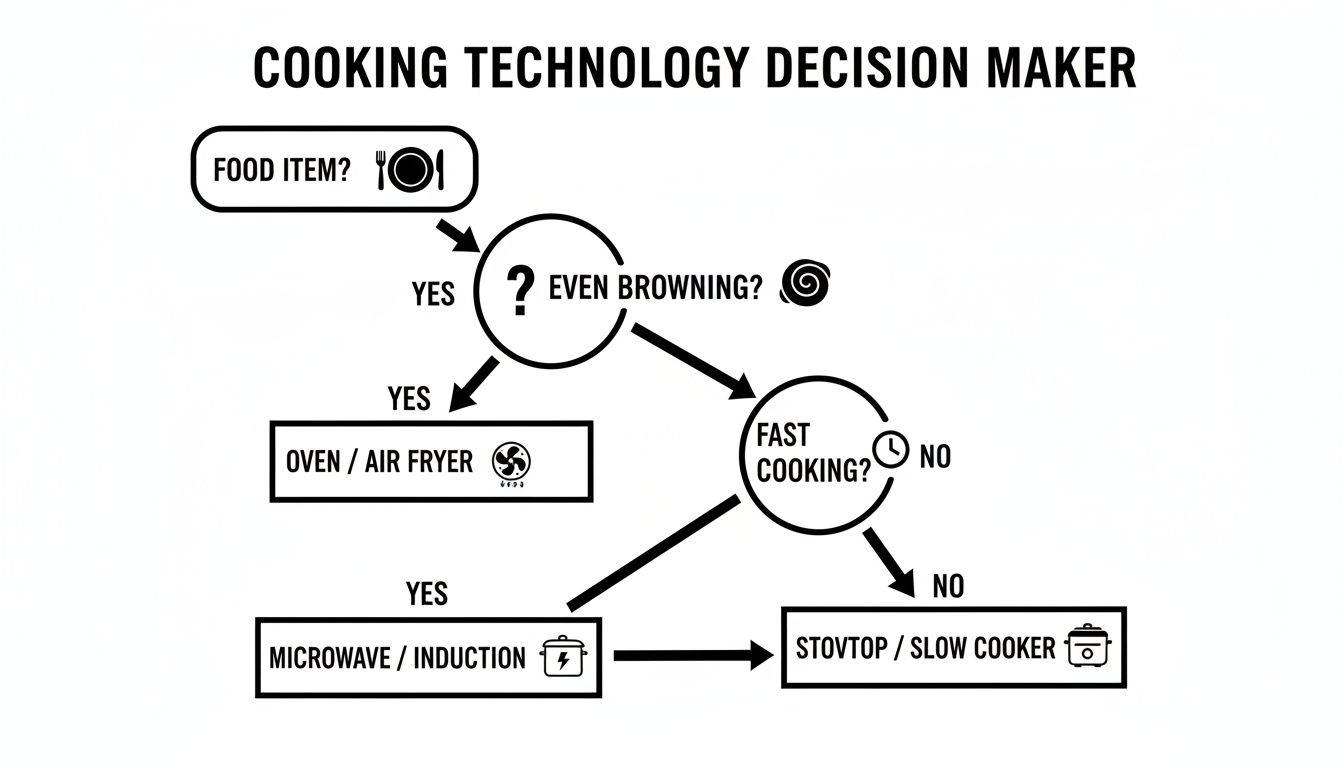
As you can see, convection technology really nails that sweet spot of even browning and fast cooking, making it a fantastic all-around player for almost any professional kitchen.
Capacity and Pan Size
First thing you’ll want to look at is capacity. This is usually measured by how many pans the oven can hold and what size they are. This spec tells you exactly how much you can cook at once.
-
Quarter-Size Ovens: These little guys are perfect for low-volume spots or kitchens where counter space is gold. Think of a Seattle coffee shop baking small batches of scones or a bar that just needs to toast a few appetizers. They fit right in next to under counter refrigerators and other compact Seattle bar equipment.
-
Half-Size Ovens: This is the size you'll see most often, and for good reason—it’s incredibly versatile. A half-size oven can handle multiple sheet pans, turning it into a workhorse for a deli baking bread for its sandwich prep tables or a restaurant roasting trays of veggies and proteins.
Think of it like this: a quarter-size oven is a nimble scooter, great for small, quick jobs. A half-size oven is your reliable delivery van, ready to handle a steady flow of orders all day long.
Power Source and Controls
Next up, you’ve got to choose your power source and control type. Electric models are famous for their rock-solid, precise temperature control, which makes them a baker's best friend. Gas models, on the other hand, heat up in a flash and pack a serious punch for high-volume roasting.
Your choice of controls really dictates how you'll interact with the oven every day:
-
Manual Controls: These are the classic knobs—simple, tough, and easy to use. They’re fantastic for straightforward jobs where you just set a temperature and timer and let it rip. Perfect for kitchens that value reliability over bells and whistles.
-
Programmable Digital Controls: This is where precision and consistency come in. You can save entire recipes with specific time and temperature stages, which means every cook on your team can produce the exact same result. It's a game-changer for maintaining quality across multiple locations or with a rotating staff.
Picking the right specs isn’t about getting the most features; it’s about getting the right features for your operation. An oven that’s perfectly matched to your menu, volume, and workflow will become one of the most valuable players in your kitchen, not just another appliance.
Construction and Durability
Finally, take a hard look at how the oven is built. A commercial kitchen is a battlefield, and your equipment has to be tough enough to handle it. You'll want to see a stainless steel exterior and interior. It’s not just durable and resistant to rust and dings, but it’s also a breeze to clean and sanitize—a non-negotiable for any food business.
Good insulation is another make-or-break feature. It ensures the oven holds its heat, which means faster recovery times when the door is opened, better energy efficiency, and a cooler kitchen for your staff. The demand for these efficient units is blowing up globally. The commercial countertop oven market is expected to jump from $240 million in 2025 to $335 million by 2031, largely thanks to smaller kitchens in food trucks and ghost kitchens needing professional power in a small footprint, right alongside their under counter freezers and deep fryers. You can read more about the growth of the commercial countertop oven market at Infinity Market Research.
To make comparing models a bit easier, we've put together a quick checklist. Use this table as a cheat sheet when you're looking at different ovens to make sure you're ticking all the right boxes for your business.
Countertop Convection Oven Specification Checklist
A quick reference guide to help buyers compare key features when selecting a commercial countertop convection oven for their specific needs.
| Specification | What to Look For | Best For (Example) |
|---|---|---|
| Capacity | Quarter-size (1-3 pans) or Half-size (3-5 pans) | Quarter-size: A café warming pastries. Half-size: A busy lunch spot roasting chicken. |
| Power Source | Electric or Gas (check voltage/BTU requirements) | Electric: A bakery needing precise temperatures. Gas: A high-volume kitchen needing fast heat. |
| Controls | Manual (knobs) or Digital (programmable) | Manual: Simple, reliable roasting. Digital: Consistent results for complex recipes. |
| Airflow | Reversing fan for even cooking | Any application where a consistent, golden-brown finish is critical, like baking cookies. |
| Temperature Range | Wide range (e.g., 150°F - 500°F) for versatility | A caterer who might need to hold food warm at a low temp or roast at a high one. |
| Construction | Stainless steel interior and exterior, double-pane glass door | Any high-traffic commercial kitchen that needs durable, easy-to-clean equipment. |
Think of this list as your starting point. Every kitchen is different, but focusing on these core specs will ensure the oven you choose is a workhorse, not a headache.
Matching Oven Size to Your Production Needs
Picking the right countertop convection oven commercial model is about so much more than what fits on your counter. The real goal here is to match the oven's capacity to your kitchen's busiest moments. Get this right, and your oven becomes a profit-generating machine instead of just another appliance.
Think of it like choosing a delivery vehicle. A little scooter is great for zipping a single pizza across town. But if you've got a catering gig for 50 people? You’re going to need a full-size van. An oven that’s too small will create a nasty production bottleneck, while one that’s too big just wastes energy and money.
Calculating Your Throughput
To nail this down, you need to think in terms of throughput—how much food you have to cook when you're slammed. The best place to start is your own point-of-sale data. Figure out what your peak demand really looks like.
Let's say a popular pizzeria in Spokane needs to crank out 30 pies an hour during that Friday night rush. If they buy a countertop oven that only holds two half-size sheet pans, they'll be falling behind all night. That means long waits and lost sales. A bigger model that holds four or five pans lets them hit that number easily, which goes straight to their bottom line.
This same logic applies to any food business. Whether you're a bakery churning out dozens of pastries or a deli roasting meats for your sandwich prep tables, figuring out your required pan capacity is the first step to a smart purchase.
Understanding Oven Recovery Time
Beyond just how many pans it holds, you have to consider recovery time. This is how fast an oven gets back up to temperature after you've opened the door to load or unload. Every single time that door opens, heat rushes out, and the oven's temperature drops.
A fast recovery time is non-negotiable for any business that relies on speed and consistency. An oven that struggles to get back to temperature will slow down your entire line, compromise food quality, and throw off your service timing.
This is a huge deal in kitchens where the oven door is constantly opening and closing. Ovens with better insulation and more powerful heating elements recover faster, making sure the tenth batch of cookies bakes just as perfectly as the first. This kind of efficiency is a big reason why the market is growing so fast.
The global demand for these ovens shows just how vital they are. Valued at about $2.51 billion in 2024, the market is expected to jump to $5.2 billion by 2035. That growth comes from places like restaurants and food trucks needing equipment that’s both versatile and space-saving. New models with better insulation can even cut energy use by up to 30% compared to older units, helping operators in Seattle and Tacoma keep costs down. You can find more details about the countertop convection oven market on wiseguyreports.com.
This focus on efficiency means your oven isn't just a cooking tool—it’s a strategic asset. When it's sized perfectly for your business, it drives profitability day in and day out. It’s an investment that should grow with you, not hold you back.
Making Your New Oven Last: Installation and Upkeep
Protecting your investment in a countertop convection oven commercial model starts the second it shows up at your door. Getting the installation right and sticking to a simple maintenance routine are non-negotiable. This is how you guarantee safety, peak performance, and a long life for your new workhorse.
Getting the Setup Right
Your first job is finding the right spot. This is about more than just clearing some counter space. Your oven needs to breathe—give it about 4-6 inches of clearance on all sides and the top. This airflow is crucial to prevent overheating, which can fry the internal parts and even become a fire hazard.
Make sure the surface it’s sitting on is perfectly level and stable. A wobbly oven is an accident waiting to happen, and an unlevel one will cook your food unevenly. Getting this right is a basic part of keeping your kitchen up to Washington health codes and ensuring a safe workspace for your team.
A Simple Cleaning Routine is Your Best Friend
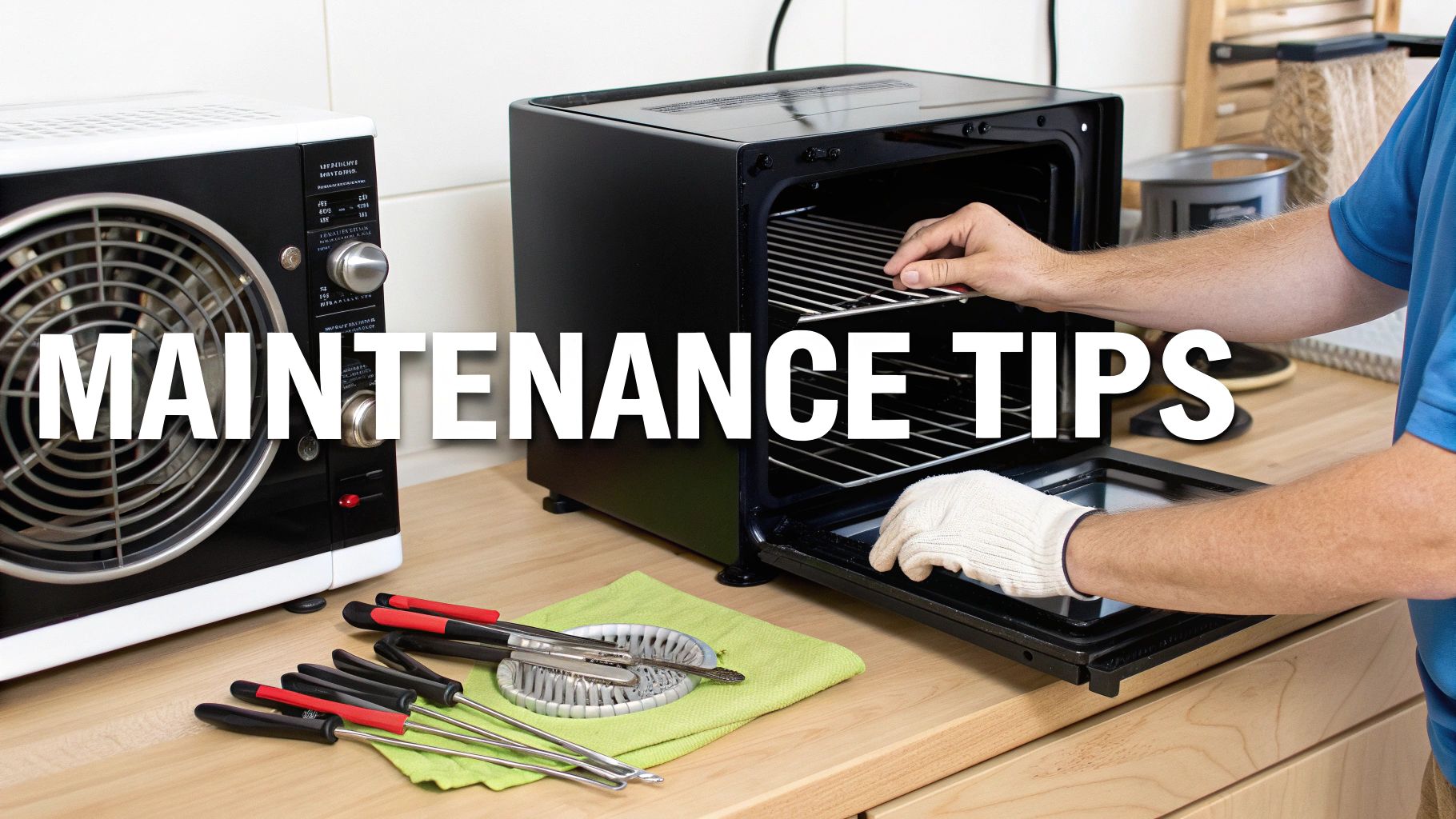
Once it's in place, a regular cleaning schedule is your best defense against problems down the road. It’s simple: a clean oven runs better. If you let grease and grime build up, it won't just make your food taste off—it becomes a serious fire risk.
A little daily and weekly effort goes a long way:
- End-of-Day Wipe-Down: After the last service, give the inside a quick wipe with a damp cloth to get rid of any spills or crumbs.
- Weekly Deep Clean: Once a week, pull the racks out for a good scrub. Use an oven cleaner that’s approved by the manufacturer on the inside, especially around the fan, to keep that air flowing freely.
Think of your oven like any other essential tool. Routine cleaning isn’t a chore; it’s just part of taking care of your equipment so it can take care of your business.
Power, Safety, and Staying Compliant
Before you even think about plugging it in, double-check the oven’s electrical needs. The spec sheet will tell you the voltage and amperage required. Smaller 120V models might work in a standard outlet, but the more powerful ovens often need their own dedicated circuit, installed by a licensed electrician. Don’t ever risk overloading a circuit.
All of this is a key part of building out your kitchen's workflow, just as important as deciding where your commercial refrigerators or sandwich prep tables will go. For a deeper dive into laying out your entire kitchen for maximum efficiency, check out our guide on setting up a commercial kitchen.
Follow these simple setup and maintenance steps, and your countertop convection oven will be a reliable, money-making asset for years.
Buying Your Oven from Seattle Restaurant Equipment
Making a big equipment purchase shouldn't be a headache. We've set up a simple, clear process to get a new countertop convection oven commercial model into your Washington kitchen, minus the stress. Our real goal is to get you the right gear to help your business grow, not just to make another sale.
That commitment starts with our dedicated, commission-free support. When you get in touch, you'll work with our expert, Sean Kearney. He’s here to give you straight advice and help you find the perfect oven—or anything else you need—without the typical sales pressure. His job is to figure out what actually works for your specific kitchen.
Smart Financing and Free Delivery Across the State
We get it—cash flow is king, especially when you're starting out or growing. Through our partnership with The Restaurant Warehouse, we offer financing options that make sense. This program helps you get the equipment you need right now, without having to sink a huge chunk of cash upfront.
Once you've picked your oven, we handle the logistics. Seattle Restaurant Equipment provides free shipping on every single order across Washington state. It doesn't matter if your kitchen is in Seattle, Tacoma, Bellevue, or Spokane. You can expect your delivery fast, usually within 1-2 business days, so you can get cooking with as little downtime as possible.
Our whole process is built to support local Washington businesses. By offering easy financing, fast and free delivery, and real expert help, we take away the usual hurdles that stand between you and the equipment you need to succeed.
Your One-Stop Shop for Kitchen Gear
Besides finding the perfect oven, we can help you build out your entire kitchen. We stock a full range of equipment designed for the local food scene. You can check out our full selection of commercial convection ovens available in Seattle and see how we can outfit your whole operation.
From the basics like refrigeration to specialized cooking gear, we have what you need to build an efficient, reliable kitchen. This includes:
- Commercial Refrigerators and Freezers: The backbone of any kitchen for keeping ingredients fresh.
- Sandwich and Pizza Prep Tables: Built to make your prep line faster and more productive.
- Deep Fryers: High-performance units that deliver perfectly crispy food every time.
- Seattle Bar Equipment: Everything from under counter refrigerators to specialty gear for your bar service.
- Seattle Coffee Shop Refrigerators: To keep your milk, drinks, and pastries perfectly chilled and ready to serve.
With our help, you can outfit your entire kitchen from one local source you can trust.
You're getting close to a decision on a countertop convection oven, but a few last-minute questions are probably floating around. We get it. Here are some of the things Washington food business owners often ask us, so you can buy your new oven with complete confidence.
Can I Use My Existing Pans?
Mostly, yes. But to really get the magic of convection cooking, you’ll want to stick with low-sided pans, like your standard sheet pans.
Think about it: the whole point is to get hot air swirling around your food. High-sided pans act like a wall, blocking that airflow and creating unevenly cooked spots. You'll also want to double-check that any pan you use can handle the oven's top temperature.
Does an Electric Oven Need Special Wiring?
It really depends on the muscle of the model you choose. The smaller, 120V units are often simple plug-and-play models. They can share a wall outlet with other gear, like your Seattle coffee shop refrigerators, without any fuss.
But the more powerful 208/240V workhorses are a different story. They need their own dedicated circuit, and you'll want a licensed electrician to install it. It's a safety and performance issue you can't skip. Always check the spec sheet before you click "buy."
Your kitchen is more than just an oven. At Seattle Restaurant Equipment, we're your source for everything that makes it run, from commercial freezers and pizza prep tables to the essentials for your Seattle bar equipment. We help you piece it all together, ensuring your under counter freezers and deep fryers work in perfect harmony.
Ready to build a smarter, faster kitchen? At Seattle Restaurant Equipment, we’ve got your back with everything from high-performance ovens to essential commercial refrigerators and sandwich prep tables. Explore our full range of commercial kitchen equipment and get free, fast shipping anywhere in Washington.