

Getting all the right permits for a food truck in Washington feels like navigating a maze of state, county, and city rules. It’s a journey that can cost thousands of dollars and stretch out for months. Honestly, your success hinges on understanding this process before you even think about buying a truck.
Decoding Washington's Food Truck Regulations
The dream of serving your signature dishes from a mobile kitchen is an exciting one, but it can get bogged down by an absolute mountain of paperwork. Before you perfect your menu or design that eye-catching truck wrap, you need to get real about the regulatory hurdles ahead. This isn't just about a few forms; it's a multi-layered marathon involving different government agencies, each with its own rulebook, fees, and timelines.
Compliance is one of the biggest checks you'll write upfront. Think about it: the dream of slinging tacos on wheels meets a wall of red tape. A report from the U.S. Chamber of Commerce Foundation, Food Truck Nation, laid it out in stark terms. To start and run a food truck for just one year, you're looking at 45 separate government procedures that take about 37 business days to complete, costing a staggering $28,276 in permits, licenses, and other compliance fees. You can see the full findings on food truck regulations and how different cities stack up.
The True Cost of Entry
Those numbers show why having a game plan for compliance is non-negotiable, especially in hot markets like Seattle, Bellevue, and Tacoma. The cost isn't just money; it’s your time. A delay with the health department’s plan review can start a domino effect, pushing back your fire inspection and, ultimately, your grand opening.
This flowchart breaks down the typical startup journey into three core parts: costs, procedures, and time.
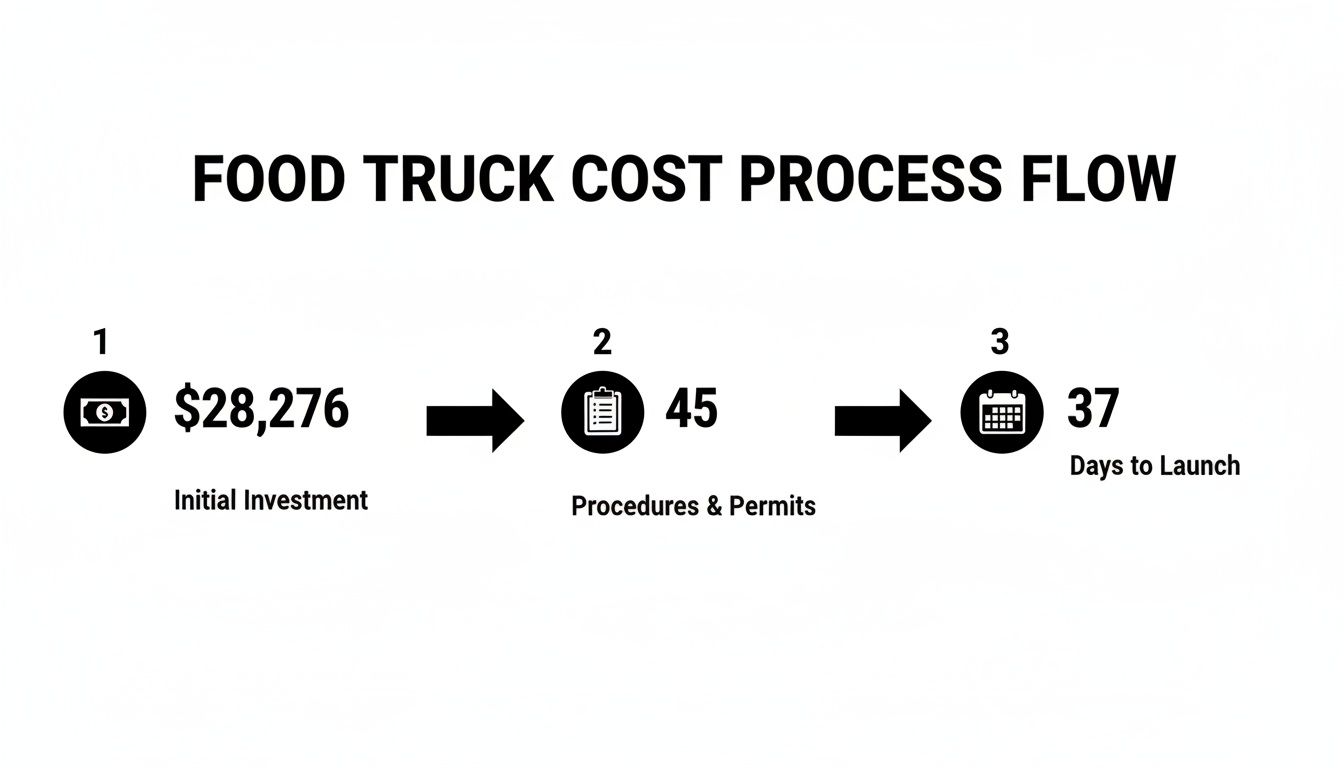
As you can see, the path to opening day is paved with more than just good intentions—it requires a whole lot of patience and paperwork.
Before diving deeper, here's a quick look at the essential paperwork you'll be dealing with. This table summarizes the core permits and licenses that form the foundation of your food truck journey in Washington State.
Essential Washington Food Truck Permit And Licensing Checklist
| Permit Or License Type | Governing Body | Primary Purpose |
|---|---|---|
| State Business License | WA Dept. of Revenue | Legally register your business with the state. |
| Mobile Food Unit Permit | County Health Dept. | Verify your truck meets all public health & safety codes. |
| Food Worker Cards | County Health Dept. | Certify all employees have basic food safety training. |
| Fire Marshal Permit | City or County Fire Marshal | Ensure fire suppression & safety systems are compliant. |
| City Business License | Individual City Gov't | Grant permission to operate within specific city limits. |
| Street Use Vending Permit | City Dept. of Transportation | Allow you to operate in designated public spaces. |
Getting these ducks in a row is your first major milestone. Each one is a critical piece of the puzzle that allows you to legally and safely serve customers.
Why Your Equipment Choices Matter From Day One
A classic rookie mistake is underestimating how tightly your equipment is tied to your permits. The commercial refrigerators, fryers, and prep tables you choose aren't just about your kitchen workflow; they're about meeting strict, non-negotiable health and fire codes.
Inspectors will be looking at every single piece of gear. For example:
- Commercial Refrigerators & Freezers: They absolutely must be NSF-certified and hold food at precise, safe temperatures. An under counter refrigerator that can't stay below 41°F is an automatic inspection fail.
- Deep Fryers & Cooking Lines: These require specific fire suppression systems and proper ventilation, which are huge components of your Fire Marshal inspection.
- Prep Tables: Both sandwich prep tables and pizza prep tables need proper sneeze guards and must be made of non-porous, easy-to-clean materials to stop cross-contamination in its tracks.
Thinking about compliance from the very beginning—when you're picking out equipment for your Seattle food truck, coffee cart, or mobile bar—will save you thousands in frustrating delays and re-inspection fees down the road.
Securing Your State And Local Business Licenses
Before you even start worrying about health inspections or fire codes, your food truck needs to be a real, legitimate business. This is the absolute first step—the bedrock for all other food truck permit requirements. It all starts with registering your business properly with the state and any cities you plan to work in.
Your journey into the world of paperwork begins with the Washington State Department of Revenue. This is where you'll officially register your business name, decide on a legal structure (like an LLC or sole proprietorship), and get your Unified Business Identifier (UBI) number.
That UBI is your business's fingerprint in Washington. You'll need it for everything from filing taxes to applying for pretty much every other permit down the line.
Think of the Washington State Business License as your master key. It allows you to legally operate somewhere in the state, but it definitely doesn't mean you can park and sell wherever you want.
Navigating Municipal Business Licenses
Once you have your state license, the real local legwork starts. Most cities—whether it's Seattle, Spokane, or Vancouver—require you to get their own separate municipal business license. So, if you're slinging tacos in Seattle for lunch and catering an event in Bellevue that evening, you're going to need a business license for both cities.
This is a classic rookie mistake. New owners often assume the state license covers everything, only to get hit with fines for operating without the right local paperwork.
My best advice? Before you do anything else, map out every single city you might possibly operate in during your first year. Open a spreadsheet and track the application links, fees, and renewal dates for each one. This bit of organization now will save you from massive headaches later.
This is also the perfect time to finalize your initial equipment list. Knowing your target cities helps you anticipate local rules that might affect your gear. For instance, some areas have strict noise ordinances that will influence your generator choice, while others have specific fire safety codes that apply to your deep fryers.
From Paperwork to Practical Application
Applying for these licenses is mostly done online through the state's portal and the individual city websites. The process is pretty direct, but the details are everything. Be ready with:
- Your UBI Number: See? This is why you get the state license first.
- Business Structure Details: Your official registered name and any formation documents.
- Personal Information: For all owners and officers.
- A Detailed Business Description: Be very specific about your mobile food operation.
Let's say you're launching a mobile coffee cart. Your state license gets you in the game. But to park in South Lake Union, you need a City of Seattle business license. Having your list of specific Seattle coffee shop refrigerators and under counter freezers ready for the application shows the city you're prepared for business.
It’s the same story for a mobile pizzeria. When you apply for your Tacoma business license, mentioning your specific pizza prep tables and commercial ovens shows you’re a serious operator who's ready for the health and fire inspections that are coming next. It’s all connected.
Getting these licenses is a huge milestone. It’s the official green light that says your business is real, allowing you to move on to the more hands-on permits and inspections. It might feel like a grind, but getting this foundational paperwork right from the start prevents costly delays and gets you on the road to opening day.
Passing Critical Health And Fire Safety Inspections
Once you've secured your basic business licenses, you're heading into the most hands-on, high-stakes part of the whole process. This is where your mobile kitchen gets put under a microscope. Passing your health department and fire marshal inspections isn't just a box to check—it’s the final gatekeeper standing between you and your grand opening.
These inspections aren't a surprise pop quiz. They're based on the detailed plan review you submitted, where officials combed through every inch of your layout, from plumbing schematics to your equipment list. This is precisely why your choice of gear is so critical to meeting food truck permit requirements. An inspector doesn't just see a grill; they see a potential fire hazard or a food safety weak point.
The Health Department Plan Review
Long before an inspector ever steps onto your truck, they'll perform a meticulous plan review. You’ll be submitting detailed blueprints of your truck’s layout, a complete equipment list, and your menu. What they're looking for is a design that promotes food safety and eliminates cross-contamination right from the start.
This is where investing in the right equipment really pays off. Listing NSF-certified sandwich prep tables with built-in cold holding and sneeze guards shows the inspector you’ve already solved a major food safety puzzle. The same goes for specifying commercial-grade under counter refrigerators and under counter freezers—it signals a serious commitment to temperature control.
Your plan needs to show a logical flow, from how you store raw ingredients to how you hand off a finished product. This has to include:
- Three-Compartment Sink: A non-negotiable setup for washing, rinsing, and sanitizing.
- Handwashing Sink: A totally separate sink, just for employees, stocked with soap and paper towels.
- Fresh and Gray Water Tanks: They must be sized for your operation. A good rule of thumb is a freshwater tank that's 25% larger than your wastewater tank.
- Proper Finishes: Every surface—walls, floors, countertops—has to be smooth, non-porous, and a breeze to clean.
A shockingly common reason for failure is not having adequate hot water. Most health codes demand water hitting at least 110°F almost instantly. A residential water heater won't cut it. You need a commercial-grade unit to pass, period.
Key Equipment for a Successful Inspection
Inspectors have an eagle eye for compliance, and your big-ticket appliances will be their first stop. Submitting a plan with the right gear from Seattle Restaurant Equipment can make this whole process a lot smoother.
Refrigeration is absolutely non-negotiable. Whether it's a coffee truck or a mobile bar, your cold storage has to perform flawlessly. Inspectors will bring their own thermometers to check the temps on your commercial refrigerators and commercial freezers. For a deeper look at keeping things chilled correctly, check out our guide on ideal walk-in cooler temperature settings.
If you're running a cooking line, it's all about ventilation and fire safety. Your deep fryers and griddles must sit under a properly sized Type 1 ventilation hood that has an integrated fire suppression system. This isn't a suggestion; it's a mandatory life-safety feature the fire marshal will personally inspect and test.
The financial and operational weight of these inspections is real. Industry data shows that navigating complex licensing and zoning costs operators more than $2,000 a year, and that's before the inspection fees. In a competitive market where North America holds a dominant 23.1% of the global food truck scene, these high costs can push owners to find cities with friendlier rules.
Surviving the Fire Marshal's Visit
While the health department is all about sanitation, the fire marshal’s job is to prevent fires and ensure everyone can get out safely if one starts. Their checklist is just as strict, with zero room for error.
Here's what they'll be looking for:
- Fire Suppression System: Your hood system needs to be professionally installed, certified, and recently serviced. They will check the service tag.
- Propane Safety: All propane tanks have to be securely mounted on the outside of the truck, far from any ignition sources, and equipped with proper safety valves.
- Fire Extinguishers: You'll need at least one Class K extinguisher for grease fires (if you have deep fryers) and a multi-purpose ABC extinguisher.
- Clear Egress: Both your service window and exit door must be completely unobstructed and easy to open.
A classic, real-world failure is using a standard orange extension cord to power a high-draw appliance like a freezer. Fire marshals demand that all electrical connections be heavy-duty and rated for commercial use to stop them from overheating. It doesn't matter if it's Seattle bar equipment or Seattle coffee shop refrigerators; everything must be hard-wired or plugged in with approved cords. Thinking through these small details beforehand will save you the headache and cost of a failed inspection and a delayed opening.
Equipping Your Truck For Compliance And Success

The gear you choose for your truck is so much more than just a way to cook. It's one of the biggest pieces of the entire permit puzzle. Every decision you make when outfitting your mobile kitchen connects directly to whether you pass or fail your inspections.
Investing in the right commercial-grade equipment isn’t just a smart move for your business—it's an absolute must for meeting food truck permit requirements.
Health and fire inspectors see things differently. They don’t just see appliances; they see potential violations. That residential fridge might look like a great way to save a few bucks, but an inspector sees it as an automatic fail. Why? Because it can't hold food-safe temperatures under the pressure of a real service rush. This is where your equipment strategy becomes your compliance strategy.
Mastering Temperature Control For Health Inspectors
One of the first things a health inspector will zero in on is your cold-holding game. Keeping foodborne illness at bay is their top priority, which means your refrigeration setup has to be perfect. This is true for every mobile food business, from a taco truck to an espresso cart.
They’ll come prepared with their own calibrated thermometers to make sure your commercial refrigerators are holding steady at 41°F or below. For your commercial freezers, that number is 0°F or colder. There is absolutely no wiggle room on these temperatures.
This is why getting your equipment right in the initial plan review is so critical.
- Under Counter Refrigerators: These are lifesavers in tight spaces, but they need to be powerful enough to recover their temperature quickly after being opened and closed a hundred times during a busy lunch service. An inspector will absolutely check this.
- Under Counter Freezers: Just like the fridges, these have to prove they can keep everything frozen solid, even when the summer heat is cranking up the temperature inside your truck.
- Seattle Coffee Shop Refrigerators: If you're running a mobile cafe, having a reliable glass-door merchandiser or milk cooler that meets health codes is a must-have for both safety and showing off your goods.
Failing a temperature check is one of the fastest ways to get your grand opening delayed. It means expensive re-inspection fees and, worse, lost time and money.
Sanitation And Workflow: Your Prep Stations
After checking temps, inspectors will be looking hard at sanitation and cross-contamination risks. Your prep surfaces are ground zero for food safety. That's precisely why sandwich prep tables and pizza prep tables come with built-in, refrigerated wells for all your ingredients.
These units are designed to keep toppings out of the "danger zone"—that temperature range where bacteria grows like crazy—while giving you a stainless-steel work surface that’s easy to clean. The health department demands that all your equipment be NSF-certified, which is your guarantee that it’s designed for easy, thorough sanitation.
An inspector thinks in simple terms: if a surface isn't smooth, non-porous, and easy to sanitize, it's a hazard. This goes for everything from your prep tables to the walls and floors. Outfitting your kitchen correctly from day one is the only real way to get ahead of this.
Fire Safety: Your Cooking Line Equipment
While the health department is focused on what’s in your coolers, the fire marshal cares about your hot line. Your cooking equipment—especially things like deep fryers and griddles—represents the biggest fire risk on a food truck.
Any piece of cooking equipment that creates grease-laden vapor has to be placed under a Type 1 ventilation hood with a built-in fire suppression system. An inspector will literally take out a tape measure to confirm the hood hangs over the cooking surfaces on all sides. They'll also check the tags to verify the fire suppression system was professionally installed and recently certified.
This isn't just for fry-heavy trucks, either. Even mobile bars need to pay attention. If you’re using heating elements for Seattle bar equipment, like for making hot cocktails or simple syrups, you could fall under specific fire code regulations.
Planning your layout with these safety rules in mind is non-negotiable. For a complete rundown of what you'll need, our detailed food truck equipment list is the perfect place to start building your compliant kitchen. Remember, equipping your truck isn't just about making food; it's about building a safe, legal, and successful business from the ground up.
Finding Your Place: Commissary Kitchens and Vending Locations
Alright, you’ve got your licenses in hand. Now for the real fun—where are you actually allowed to park and sell your food? This is where we move past the paperwork and into the tricky world of local zoning, parking laws, and the all-important commissary kitchen rule. Getting this right is a huge part of your food truck permit requirements.
Let’s get one thing straight: in just about every corner of Washington, you absolutely must have a signed agreement with an approved commissary kitchen. This is a non-negotiable step to get your mobile food unit permit. You can't use your home kitchen for prep or cleaning—no exceptions. The health department knows that even the best-equipped truck is too small to handle all the behind-the-scenes work safely.
A commissary is your licensed, commercial kitchen home base. It’s where you'll do the heavy lifting: bulk food prep, storing extra inventory, filling up your fresh water tanks, and—critically—legally dumping your greywater and grease.
Finding and Securing Your Commissary
When you're looking for a commissary in Seattle or Everett, you're not just renting space. You're finding a partner that keeps you in business and compliant. The health department won't even look at your application without seeing proof of your commissary agreement first.
To meet health codes, your commissary has to provide a few key services:
- Approved Food Prep Areas: This means access to commercial-grade sinks, stainless steel prep tables, and cooking equipment your truck might not have.
- Dry and Cold Storage: You'll need a place for your bulk ingredients, usually in walk-in commercial refrigerators and commercial freezers.
- Waste Disposal: The facility needs approved systems for getting rid of greywater, used cooking oil, and trash.
- Overnight Parking: Many commissaries offer a secure spot to park your truck overnight, which is often a requirement from both health inspectors and the city.
The global food truck market was valued at $5.3 billion in 2024 and is expected to hit $9.26 billion by 2033. But what often holds operators back are the "time-consuming permit processes varying by city, state, and country," which definitely includes the struggle to find an affordable commissary. If you're interested in the bigger picture, you can explore the full food truck industry analysis for more on these trends.
The Great Divide: Public vs. Private Property
Once your commissary is locked in, the daily grind becomes about finding a spot to sell. The rules for parking on a public street are completely different from setting up on private property, and you really need a game plan for both.
To operate on public property, like a prime downtown Seattle street spot, you’ll need a special street-use vending permit from the Department of Transportation. These spots are extremely limited, fiercely competitive, and come with a laundry list of rules about how far you must be from brick-and-mortar restaurants, schools, and parks.
On the flip side, setting up on private property—think an office park's parking lot or a local brewery—is usually a matter of getting permission directly from the property owner. This route can often lead to a more stable and predictable flow of customers.
Here’s a classic mistake I see all the time: assuming a private lot is a free-for-all. Even with the owner’s blessing, you still have to make sure the area is zoned for commercial activity. Always double-check with the city planning department before you commit.
Scenario Planning: Downtown Lunch vs. Weekend Festival
Let's break down how your strategy needs to shift depending on where you're headed.
Scenario A: The Downtown Lunch Spot
- Permits Needed: City business license, health permit, and that highly-coveted street-use vending permit.
- The Challenge: Competition is brutal. You're fighting against dozens of other trucks for a handful of designated spots. You have to be early, quick, and incredibly efficient.
- Equipment Focus: Your truck has to be a self-contained machine. Your under counter refrigerator and sandwich prep table better be fully stocked for the rush, because there's no running back to the commissary for more supplies.
Scenario B: The Weekend Festival
- Permits Needed: On top of your standard licenses, you'll probably need a temporary event permit. The festival organizer will also demand proof of insurance.
- The Challenge: Massive volume over a short period. Your entire workflow and equipment, from the deep fryers to your pizza prep tables, must be able to handle a nonstop line of customers.
- Equipment Focus: Reliability is everything. You're paying a steep fee to be there, so an equipment breakdown is a financial disaster. Your Seattle bar equipment or Seattle coffee shop refrigerators have to perform perfectly under extreme pressure. Our guide on setting up a commercial kitchen has some great tips that are just as relevant for a mobile setup.
Figuring out these location rules is an ongoing part of the food truck life. It takes planning, a solid grasp of local laws, and the flexibility to pivot between different types of service.
Your Top Food Truck Permit Questions, Answered
Getting into the food truck game means navigating a maze of permits and regulations. It's a world that can feel designed to trip you up, where every answer seems to lead to three more questions. We get it. Let's tackle some of the most common questions we hear from aspiring food truck owners in Washington, so you can get on the road with confidence.
How Long Does It Really Take to Get All My Permits in Seattle?
This is the big one, isn't it? The honest answer is it’s going to take longer than you think. You need to be patient. From the day you send in that first application to your first day serving customers, you should realistically budget for a 3 to 6-month process.
Getting your basic state and city business licenses is usually pretty quick, maybe a few weeks. But the real bottleneck is almost always the health department's plan review. That step alone can easily eat up 4 to 8 weeks, and that’s assuming they don’t send it back with a list of revisions.
Once your plan gets the green light, you still have to schedule the final inspections with the health department and the fire marshal. A single failure—maybe your commercial freezer isn't holding temp or your propane tanks are stored incorrectly—sends you right back to the start of the scheduling line. The absolute best thing you can do is have your plans drawn up with painstaking detail and all your NSF-certified gear, like your under counter refrigerators, already picked out.
Can I Save a Few Bucks Using a Residential Fridge?
In a word: no. Don't even think about it. This is hands-down one of the most frequent and expensive mistakes a rookie operator can make.
Health departments and fire marshals across Washington State have a zero-tolerance policy here: every single piece of equipment in your truck must be commercial-grade and NSF-certified. That means everything.
- Commercial refrigerators and commercial freezers
- Sandwich prep tables and pizza prep tables
- Deep fryers, griddles, and ranges
- Sinks, shelving, and work surfaces
A home appliance just isn't built for the grind of a commercial kitchen. More importantly, it can't be sanitized to the level required by the health code. Showing up to an inspection with a residential fridge is an automatic fail. You’ll be forced to replace it and pay for a re-inspection.
What’s a Commissary Kitchen, and Do I Really Need One?
Yes, you absolutely do. In almost every part of Washington, a signed agreement with an approved commissary kitchen is non-negotiable. You can't get your mobile food unit permit without it. Think of the commissary as your home base—a licensed, brick-and-mortar commercial kitchen.
You cannot legally use your home kitchen for any part of your food truck operation. The commissary is where you'll do your heavy prep work, store extra inventory, fill your fresh water tanks, properly dispose of grey water and grease, and give your truck a deep clean.
Health departments mandate this because even the best-designed truck is too small to handle all food safety operations safely. Locking down your commissary agreement is one of the very first things you need to do, long before you even think about applying for your health permit.
What Are the Most Common Reasons Food Trucks Fail Inspections?
Failed inspections are a massive headache, but the good news is they're usually avoidable. Most failures come down to a handful of key areas: water, power, ventilation, and equipment.
Inspectors are sticklers for hot water. They’ll often flag a truck if the water system can't maintain a constant temperature of at least 110°F. Other classic slip-ups include incorrect plumbing for the handwashing and three-compartment sinks, or a ventilation hood that doesn't completely cover all your cooking equipment like deep fryers.
Another huge red flag is improper power. Using non-commercial, unapproved extension cords to run heavy-duty appliances like Seattle coffee shop refrigerators or other Seattle bar equipment will get you failed on the spot. And of course, any equipment that isn't NSF-certified or isn't bolted down securely is an easy "no" from an inspector. The best way to dodge these bullets? Treat the health and fire code checklists like your bible from day one of your build.
From reliable under counter freezers to NSF-certified prep tables, outfitting your truck for compliance is the key to success. Seattle Restaurant Equipment offers a huge selection of new, commercial-grade gear to help you pass your inspections the first time. Shop our full collection online and get your food truck on the road faster.