

Getting your grease trap calculation right is the absolute first step in avoiding a plumbing nightmare. It's how you stop catastrophic failures, dodge hefty fines, and keep your commercial kitchen humming along. This isn't just about ticking a box for the health inspector; it’s about figuring out exactly what your kitchen can throw at your plumbing and choosing a trap that can handle it.
Think of it as the foundation of your kitchen’s plumbing health. Getting it right from the start is non-negotiable for any restaurant, cafe, or food truck.
The Steep Price of a Bad Guess
Screwing up your grease trap calculation isn't a minor slip-up—it's a direct threat to your business. An undersized trap is a ticking time bomb, practically guaranteed to fail at the worst possible moment. Just picture a complete plumbing backup during a packed Saturday night dinner service. That’s what happens when your grease interceptor can’t keep up with a sudden rush of wastewater from your three-compartment sink and commercial dishwasher firing at once.
This isn’t some far-fetched what-if scenario. It’s a painful reality for too many Washington restaurant owners. The fallout goes way beyond a messy floor. You’re suddenly dealing with:
- Sudden Business Shutdowns: A major FOG-related backup can easily shut you down for days. That’s revenue you’ll never get back and customers who might not return.
- Sky-High Emergency Repairs: Calling in emergency plumbers and paying for trap replacements or water damage cleanup can run into thousands of dollars without warning.
- Painful Municipal Fines: Local authorities, especially in King County, don't mess around with FOG violations. Non-compliance can lead to penalties that sting.
- A Damaged Reputation: Word travels fast. A shutdown over sanitation issues can permanently tarnish your restaurant's name in the crowded Seattle food scene.
Real-World Consequences of Miscalculation
Let's talk real numbers. I knew a bustling bistro that learned this lesson the hard way on its grand opening weekend. They figured their peak flow would be manageable and installed a 125-gallon trap. But when the dinner rush hit, the combined force of multiple sinks draining and a high-temp dishwasher cycle sent a tidal wave of greasy water into a system that just couldn't cope.
The result? A flooded kitchen, a two-day shutdown, and a bill topping $15,000 for repairs, lost business, and health department fines. This kind of disaster is why U.S. wastewater systems face a staggering $25 billion repair bill each year, with nearly half of all sewer clogs being traced back to FOG.
An improperly sized grease trap doesn't just fail; it fails spectacularly. It's the difference between a smooth-running operation and a costly, reputation-damaging disaster that was completely avoidable.
How Your Equipment Dictates Your Needs
The need for a precise calculation is tied directly to the gear in your kitchen. A small Seattle coffee shop with an under counter refrigerator and a hand sink has a tiny FOG footprint compared to a high-volume pizzeria running multiple deep fryers and pizza prep tables. Every single piece of equipment you get from Seattle Restaurant Equipment adds to your total wastewater output.
Think about the FOG load coming from:
- Commercial Refrigerators and Commercial Freezers: They don't make grease, but the food they store sure does.
- Sandwich Prep Tables and Pizza Prep Tables: These workstations almost always have sinks for rinsing produce and utensils, adding to the flow.
- Seattle Bar Equipment: Even bar sinks used for washing glassware contribute to the total volume your trap has to manage.
- Deep Fryers: These are your primary FOG producers. If you have fryers, a correctly sized trap is non-negotiable.
Ultimately, a precise grease trap calculation is your kitchen's first line of defense. It's a fundamental part of setting up a commercial kitchen for long-term success, protecting your investment and keeping your doors open.
Decoding the Core Grease Trap Sizing Formulas
To get your grease trap calculation right, you have to understand the basic formulas that everyone in the business uses. Sure, local codes might throw in a few extra rules, but nearly every calculation starts with one of two core methods. These approaches give you a solid baseline for figuring out the right size interceptor for your place, whether you're setting up a new coffee shop in Seattle or upgrading a slammed Tacoma restaurant.
The two most common ways to do this are the sink dimension formula and the Drainage Fixture Unit (DFU) approach. Each has its place, and knowing when to use which one is the key to getting a number you can rely on. Let's walk through how they work with real-world examples you’d find in any commercial kitchen.
This visual shows exactly what happens when you don't stay on top of your Fats, Oils, and Grease (FOG)—it can create huge operational and financial headaches for any restaurant.
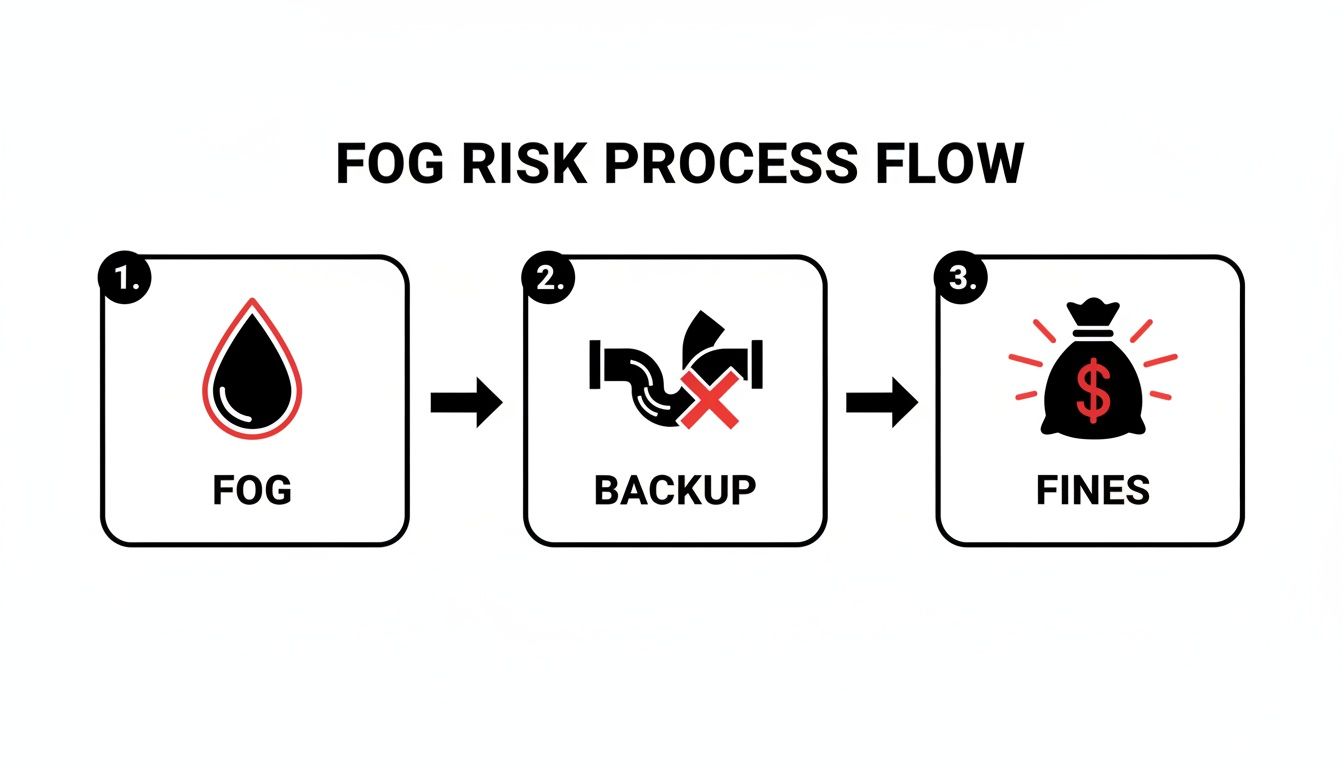
As you can see, letting FOG go down the drain leads directly to plumbing backups. And that's a fast track to expensive fines and even potential shutdowns.
Sizing Based on Sink Dimensions
The most direct way to size a grease trap is simply by calculating the total volume of your sinks. It's a straightforward approach because it's based on the absolute maximum amount of water you could possibly dump at one time. This method is especially handy for smaller kitchens or when your sinks are the main source of greasy wastewater.
To do this, you just need a tape measure and a calculator. The idea is to find the total volume of all your sink compartments in cubic inches and then switch that over to gallons.
Here's the rundown:
- Measure Each Sink Compartment: For every sink draining into the trap, measure the length, width, and depth in inches.
- Calculate the Volume: Multiply length x width x depth for each compartment. That gives you its volume in cubic inches.
- Sum the Volumes: Add up the volumes of all compartments to get one total cubic inch figure.
- Convert to Gallons: Divide that total by 231 (the number of cubic inches in one U.S. gallon) to get your total liquid capacity.
- Apply the Fill Factor: No one fills a sink to the very brim. So, multiply the total gallons by 0.75 (a 75% fill factor) to get a more realistic maximum discharge volume.
A common mistake I see is people only measuring one compartment of a three-compartment sink. You have to calculate the volume for all compartments draining into the trap. If you don't, you'll end up severely underestimating what you need.
Applying the Drainage Fixture Unit (DFU) Method
While the sink formula is great for direct measurements, the Drainage Fixture Unit (DFU) method is the standardized way to account for all the equipment that produces wastewater. A DFU is just a number assigned to different plumbing fixtures that represents how much they'll likely discharge into the drains. This method is a must for bigger kitchens with a wide range of equipment, from deep fryers to pizza prep tables.
Sizing a grease trap isn't rocket science, but a math error can cost a Washington business big time. One of the most reliable formulas, used from coast to coast, starts with sink volumes. For example, a pretty standard three-compartment sink with bowls measuring 24x18x12 inches each holds about 67 gallons. With a 75% fill factor, that works out to a grease retention need of about 50 pounds, which points you toward a 75-gallon trap. But once you add more equipment, like a pot wash sink (2 DFUs) and a mop sink (3 DFUs), your flow rate jumps and you'll need a much bigger interceptor. For our Seattle Restaurant Equipment customers outfitting kitchens with high-FOG producers like deep fryers, getting this right is non-negotiable. To see these calculations in more detail, you can check out these grease trap sizing formula data sheets.
Using the DFU method is pretty simple. You identify every fixture that will drain into the grease trap and just add up their DFU values. Local plumbing codes, like those here in Washington, have tables with all these values.
Here's a quick look at some common DFU values you'll encounter.
Common Kitchen Fixture DFU Values
This table provides a handy reference for the Drainage Fixture Unit (DFU) values of standard commercial kitchen equipment. Use it to help you total up the load for your flow rate calculation.
| Fixture Type | Typical DFU Value |
|---|---|
| Three-Compartment Sink | 3 DFUs |
| Two-Compartment Sink | 2 DFUs |
| Single Compartment Sink | 2 DFUs |
| Prep Sink | 2 DFUs |
| Dishwasher (Commercial) | 4-6 DFUs |
| Floor Drain / Floor Sink | 2 DFUs |
| Mop Sink / Service Sink | 3 DFUs |
Once you have the total DFU count from all your fixtures, you can use a standard conversion chart to turn that number into a Gallons Per Minute (GPM) flow rate. That GPM figure is the magic number you need to choose the right grease interceptor for your whole kitchen, including drainage from things like sandwich prep tables and under counter freezers with floor drains.
Factoring in Peak Flow Rate and Retention Time
Sizing a grease trap correctly goes way beyond just adding up the volumes of your sinks. That's a starting point, but it doesn't reflect the chaos of a real commercial kitchen. To get it right, we have to talk about two critical concepts: peak flow rate and retention time.
Nailing these two factors is what separates a trap that does its job from one that fails under pressure. It's how you size your system for the real world, not just what looks good on paper.
Why Retention Time is King
Retention time is simply how long wastewater gets to sit inside the grease trap before flowing out. Think of it as a pause button. If water blasts through too quickly, the lighter fats, oils, and grease (FOG) don't have a chance to float to the top, and the heavy food scraps can't sink.
When that happens, all that FOG just gets flushed straight into the city sewer lines. This completely defeats the purpose of having a trap and is a fast track to clogs and hefty fines. The whole system works on gravity, and gravity needs a little time to do its thing.
For any grease trap, retention time is king. Most plumbing codes call for a minimum retention time of 20-30 minutes. This gives the FOG time to separate properly. For instance, a bustling Seattle pizzeria with multiple pizza prep tables and a bank of deep fryers will dump a massive amount of greasy water all at once. An estimated 47% of sewer overflows globally are traced back to FOG, which shows you just how important this is. You can get more details on how sizing affects compliance in this guide to choosing the right grease trap for commercial kitchens.
Calculating Your True Peak Flow
Peak flow rate isn't your average flow; it's the absolute maximum amount of wastewater your kitchen could produce at its busiest moment. You have to plan for this worst-case scenario.
Picture your busiest Saturday night dinner rush. What's happening all at once?
- The dishwasher is hitting its high-volume drain cycle.
- A prep cook just pulled the plugs on a full three-compartment sink.
- Someone else is blasting dishes with a high-pressure pre-rinse sprayer.
- Floor drains are catching runoff from mopping up a spill.
That simultaneous rush of water is your peak flow. A high-end Bellevue restaurant will have a wildly different peak flow than a small Kent Seattle coffee shop with just an under counter refrigerator and a hand sink. Underestimating this peak is one of the most common reasons grease traps fail.
I always tell clients to think of it like planning for traffic. You don't build a one-lane road for rush hour. Similarly, you don't size a grease trap for a slow Tuesday morning; you size it for the chaotic dinner rush when every piece of equipment is running full tilt.
To figure this out, you need to account for every piece of equipment connected to the drain—every sink, dishwasher, and floor drain. This is where your DFU totals really come in handy, as they help translate fixture counts into a Gallons Per Minute (GPM) rate. The goal is to pick a trap that's big enough to provide that crucial retention time even during that peak rush. This ensures your operation stays compliant and avoids messy, expensive backups, whether you're running a small deli with sandwich prep tables or a large steakhouse with heavy-duty Seattle bar equipment.
Navigating Seattle and Washington State Plumbing Codes
Figuring out the universal formulas for grease trap sizing is a great start, but honestly, it's only half the battle. Here in Washington, your math has to line up perfectly with local plumbing codes, which often throw in their own specific, non-negotiable rules.
These local regulations are the final say. They take your theoretical GPM and DFU numbers and turn them into a real-world, legally-required installation.
Trust me, ignoring local mandates is a common and very expensive mistake. An inspector won't care if your calculations were perfect by some textbook standard; they only care if you meet the code for Seattle, Bellevue, or wherever you're setting up shop. This is where a little homework on local rules pays off big time.
King County's Role and Why It Matters
In the Seattle area, the King County Industrial Waste Program is a major player you need to know. This agency, along with your city's planning and plumbing departments, sets the definitive rules for managing fats, oils, and grease (FOG). Their regulations can add requirements that go way beyond the basic formulas.
For instance, a standard calculation might tell you a 750-gallon interceptor will do the job. But King County might have a blanket rule mandating a 1,000-gallon minimum for any new restaurant serving hot food—no matter what your flow rate math says. These local overrides are common and are there for a reason: to protect the public sewer system from the combined impact of thousands of restaurants.
Under-Sink Traps vs. Big Outdoor Interceptors
Washington state codes make a very clear distinction between two kinds of grease management devices. It’s crucial to know which one your business needs.
-
Grease Traps (Hydromechanical Interceptors): These are the smaller, indoor units you often see installed right under a sink. They’re sized by Gallons Per Minute (GPM) and are generally fine for low-FOG spots like a small coffee shop just using Seattle coffee shop refrigerators and a sink for rinsing pitchers.
-
Grease Interceptors (Gravity Interceptors): These are the big boys. We’re talking large, high-capacity tanks that are almost always buried underground outside your building. They are mandatory for most full-service restaurants, especially if you're using equipment like deep fryers, charbroilers, or woks. These are sized in gallons and built for much longer retention times.
Your local code will spell out exactly when you need to graduate from a small trap to a large interceptor. Usually, the trigger is the type of food you serve or specific equipment, like a commercial dishwasher.
A critical local rule to watch for involves high-temperature dishwashers. Many cities, including several in Washington, prohibit connecting high-temp dishwashers directly to a grease trap or interceptor. The intense heat and powerful detergents can liquefy grease, letting it slip right through the trap and into the city sewer—exactly what you’re trying to prevent.
The Local Code is Always the Final Word
Your grease trap plan isn't finished until it’s been checked against the specific plumbing codes for your city and county. This means you have to do three things:
- Call Your Local Building Department: This is your number one source for code requirements. Ask for their FOG control ordinance.
- Ask About Minimum Sizes: Don't forget to ask if there’s a required minimum interceptor size for your type of restaurant.
- Confirm Dishwasher Rules: Get clear on the regulations for dishwasher connections. This can completely change your plumbing layout.
Skipping these steps can lead to a failed inspection, forcing you to rip out a brand-new installation and start over. That’s not just an expensive headache; it can delay your grand opening by weeks or even months.
As you plan your kitchen and pick out equipment—from sandwich prep tables to commercial freezers—remember that local compliance is the final, most important step. Staying on top of these rules is just as vital as passing your first health inspection. To get ready, you can learn more by checking out this detailed restaurant health inspection checklist.
Matching Your Trap Size to Your Kitchen Equipment
The formulas and local codes give you the "how," but the real "why" behind your grease trap calculation comes straight from the equipment humming away in your kitchen. A calculation is only as good as its connection to the real-world FOG (Fats, Oils, and Grease) your place actually produces. This is where we bridge the gap between abstract numbers and the practical demands of your menu and workflow.
At the end of the day, every piece of equipment contributes to the story your grease trap needs to tell. The goal is to match its capacity to the FOG output of your entire lineup, making sure it can handle your busiest Saturday night without breaking a sweat.
FOG Load Scenarios From Low to High
The kind of food you serve is the single biggest predictor of your FOG output. A small Seattle coffee shop has a dramatically different wastewater profile than a high-volume steakhouse. It's not even close.
Think about these two very different scenarios:
- Low FOG Producer (A Seattle Coffee Shop): The main equipment here is likely a few Seattle coffee shop refrigerators for milk, an espresso machine, and a small sink for rinsing pitchers. The FOG load is minimal, almost entirely from dairy residue. A small, under-sink grease trap is probably all you need.
- High FOG Producer (A Full-Service Restaurant): This kitchen is a FOG powerhouse. It's running multiple deep fryers, a charbroiler, and several sandwich prep tables with their own sinks. It’s also backed by walk-in commercial refrigerators and commercial freezers. The sheer volume of grease from frying and grilling demands a large, external gravity interceptor to keep things flowing.
Your menu dictates your equipment, and your equipment dictates your grease output. You can't size a trap for a burger joint using the same logic as a salad bar—the FOG realities are worlds apart.
The Role of Specific Kitchen Appliances
Let's get into the specifics of how different pieces of equipment from Seattle Restaurant Equipment factor into your grease trap calculation. Each appliance adds to the total flow rate and potential grease load your system has to handle.
An often-overlooked area is the prep station. Pizza prep tables and sandwich prep tables frequently have built-in sinks for rinsing utensils and washing produce. While the grease from one prep sink is minor, it all adds up during a dinner rush. Even Seattle bar equipment contributes, as the wastewater from bar sinks joins the total volume your interceptor has to process.
Of course, the heavy-duty cooking equipment is what really moves the needle. If your kitchen has one or more deep fryers, your FOG load skyrockets. These units need frequent oil changes and cleaning, which sends concentrated grease straight down the drain.
Even cold storage like under counter refrigerators and under counter freezers plays an indirect role. They don't make FOG themselves, but they enable a menu that does. The more high-fat ingredients you store, the more grease you'll eventually wash down the drain.
Grease Trap Sizing Guide by Business Type
To make this more tangible, let's look at how different restaurant models stack up. This table shows how equipment choices directly influence the necessary grease trap size, giving you a practical starting point for your own grease trap calculation.
| Business Type | Key FOG-Producing Equipment | Typical FOG Load | Recommended Trap Size (Gallons) |
|---|---|---|---|
| Coffee Shop | Espresso Machine, Blenders, Seattle coffee shop refrigerators | Very Low | 20 - 50 GPM (Under-sink) |
| Deli / Sandwich Shop | Sandwich Prep Tables, Slicers, Panini Press | Low | 50 - 100 GPM (Under-sink) |
| Pizzeria | Pizza Prep Tables, Deck Ovens, Deep Fryers (for wings) | Medium to High | 750 - 1,500 (External) |
| Bar / Tavern | Seattle Bar Equipment, Grill, Deep Fryers | Medium | 750 - 1,000 (External) |
| Full-Service Restaurant | Multiple Deep Fryers, Griddles, Charbroilers, Ranges | High | 1,000 - 2,000+ (External) |
You can see the pattern here: as the cooking equipment gets more complex, the grease interceptor has to get bigger. A pizzeria that adds a fryer for appetizers has a much higher FOG load than one without, pushing it firmly into the external interceptor category. This framework helps you move from a generic calculation to a decision that truly fits your kitchen.
A Few Final Questions on Grease Trap Sizing
Even after you've run the numbers, a few practical questions almost always pop up. It’s one thing to see the formulas, but it’s another to apply them in a real-world kitchen. Here are some of the most common things we get asked about once the calculator is put away.
Does My Commercial Dishwasher Really Need to Be on the Trap?
This is probably the biggest point of confusion, and for good reason. In almost every case, especially here in Seattle and across Washington, the answer is a firm no.
High-temperature commercial dishwashers use powerful detergents designed to emulsify grease. That means they break down fats and oils into tiny particles that will flow right through your interceptor and into the city sewer, which is exactly what you're trying to prevent. To stop this, plumbing codes usually demand these units bypass the grease trap entirely. Don’t even think about finalizing your plumbing diagrams until you’ve confirmed this with your local inspector.
If I Get a Bigger Trap, Can I Clean It Less Often?
Yes and no. A larger interceptor obviously holds more grease, sludge, and solids, so it will take longer to fill up than a smaller one. But buying a bigger tank doesn't mean you can just forget about it.
The industry-standard "25% Rule" is still the law of the land: once the combined layer of FOG and solids takes up 25% of the trap's volume, it's time for a pump-out. A bigger trap just gives you a longer runway before you hit that 25% mark. Your actual maintenance schedule should always be based on how much grease your kitchen produces, not just the tank's capacity.
How Does This All Work for a Food Truck?
Food trucks follow the same basic principles, but everything is compressed. Space is the number one enemy, so compact, high-efficiency hydromechanical grease traps are the go-to solution.
The trade-off? Because they’re so small, they need to be cleaned out far more often. And you can't just dump the contents anywhere. Food truck operators absolutely must have a documented plan for legally disposing of the collected waste at an approved facility. Local health departments are extremely strict about this.
What’s the Real Difference Between a Grease Trap and an Interceptor?
People use these terms interchangeably all the time, but they technically refer to two different things. It really just comes down to size and where it’s installed.
- Grease Traps: Think small. These are the little indoor units, usually under 100 gallons, that you see tucked under a 3-compartment sink. They’re a good fit for low-grease spots like a small cafe with just Seattle coffee shop refrigerators or a deli that mainly uses sandwich prep tables.
- Grease Interceptors: Now think big. These are the massive concrete or fiberglass tanks—hundreds or even thousands of gallons—buried outside your building. If you're running a full-service restaurant with a battery of deep fryers and walk-in commercial refrigerators, this is what the code will require.
At the end of the day, your local plumbing code makes the final call. Getting this last detail right ensures your kitchen is compliant, efficient, and ready for business.
Whether you’re outfitting a small cafe or a massive restaurant, it all starts with the right gear. Seattle Restaurant Equipment has a full lineup of commercial refrigerators, commercial freezers, sandwich prep tables, pizza prep tables, Seattle bar equipment, deep fryers, Seattle coffee shop refrigerators, under counter refrigerators, and under counter freezers you need to build a kitchen that works. Check out our selection and get expert help at https://seattlerestaurantequipment.com.