

Figuring out the right grease trap sizing is all about matching the interceptor's capacity to what your kitchen actually puts out. You're calculating the volume and flow rate needed to properly capture all the fats, oils, and grease (FOG) coming from your equipment. Get this right, and you'll stay compliant and avoid some seriously expensive plumbing disasters.
Why Accurate Grease Trap Sizing Is Not Optional
Getting your grease trap size right is one of the most important calls you'll make for your Seattle restaurant. This isn't just a plumbing detail; it’s a decision that protects your whole operation from some pretty nasty consequences.
An undersized trap is basically a ticking time bomb.
The reality of a poorly sized system is harsh. Picture this: it's a packed Friday night, the kitchen is slammed, and suddenly your floor drains start backing up. That's not just a mess; that's a forced shutdown, angry customers, and an emergency plumbing bill that can easily run into the thousands. This isn't some rare freak accident—it's what happens when a grease trap gets overwhelmed.
The True Cost of a Sizing Mistake
The financial pain doesn't stop with a single plumbing bill. Here in Washington, King County Public Health doesn't mess around with FOG violations. Inspectors can hand out crippling fines and even suspend your operating permit if you're not in compliance. These rules are in place for a good reason: grease blockages can cause millions in damage to the municipal sewer system.
There's a long history here. Back in the early 2000s, some major cities were reporting that over 60% of their sewer blockages were caused by FOG from restaurants. That's what led to the strict regulations we see today.
Choosing the right size from the get-go doesn't just keep you out of trouble. It can also slash your maintenance costs by up to 30%. Why? Because undersized units have to be pumped out far more often, and that gets expensive fast. You can dig into how proper equipment management affects your bottom line by checking out various market trend reports.
Beyond the fines and repair bills, an undersized trap creates an ongoing operational headache. Foul odors from rancid grease can permeate your dining room, driving customers away and damaging your restaurant's reputation far more than any single bad review ever could.
A quick look at the impact of your sizing choice makes the decision pretty clear.
Sizing Impact At a Glance
| Sizing Choice | Day-to-Day Impact | Bottom-Line Consequence |
|---|---|---|
| Correctly Sized | Fewer odors, no backups, predictable maintenance schedule. | Lower pumping costs, no emergency repair bills, no fines. |
| Undersized | Constant foul smells, frequent drain clogs, service interruptions. | High emergency plumbing fees, risk of fines, lost revenue. |
In the end, investing a little more time and money upfront to get the sizing right pays for itself many times over.
Connecting Sizing to Your Seattle Restaurant Equipment
Every single piece of equipment in your kitchen that uses water contributes to the load on your grease trap. That high-output deep fryer? It's a huge source of FOG. Even the water used to clean your sandwich prep tables and pizza prep tables adds to the total volume your interceptor has to handle. Your cold line, from large commercial refrigerators and commercial freezers to smaller under counter refrigerators and under counter freezers, also plays an indirect role based on the fatty products you store.
From the three-compartment sink to the commercial dishwasher and even the floor drains, every fixture has to be factored into the sizing calculation. If you forget something small, like a bar sink associated with your Seattle bar equipment, you could throw off the entire assessment and set yourself up for failure down the road. It’s a chain reaction where one misstep affects your entire operation.
Decoding the Math Behind Sizing Calculations
When it comes to sizing a grease trap, you don't need a degree in fluid dynamics. It really just boils down to two main methods that most plumbing codes accept, including ours here in Washington State: Drainage Fixture Units (DFU) and Gallons Per Minute (GPM).
Think of them as two different ways to measure the same thing—how much wastewater your kitchen is going to produce. Your local authority, like Seattle Public Utilities, will have the final say on which method they prefer. Let's break them down.
The Gallons Per Minute (GPM) Method
The GPM method is the most direct approach you can take. It’s all about calculating the actual flow rate from a single piece of equipment, making it perfect for sizing a trap for something like a big three-compartment sink. The formula is refreshingly simple and just requires some basic measurements.
First, you figure out the sink's total volume in cubic inches: length x width x depth. Then, you convert that number into gallons by dividing it by 231 (which is how many cubic inches are in a US gallon).
But a sink is rarely filled to the very top. To account for this, the code usually has you assume it's only filled to 75% capacity. Finally, you factor in how quickly it drains. The standard is a one-minute drain for a quick dump or a two-minute drain for more general use.
Here’s how the math plays out:
- (Length x Width x Depth in inches) / 231 = Total Gallons
- Total Gallons x 0.75 (75% capacity) = Realistic Gallons
- Realistic Gallons / Drain Time (1 or 2 minutes) = GPM Flow Rate
That final number is the flow rate your grease trap needs to handle from that sink. As a rule of thumb, you then double that number for the trap's rating. So, if a sink has a calculated flow rate of 12.5 GPM, you’d need a trap rated for at least 25 GPM to keep it from getting overwhelmed.
The Drainage Fixture Unit (DFU) Method
While the GPM method zooms in on a single fixture, the DFU method takes a wider view. This is the one you'll use when you have several pieces of equipment all feeding into one larger grease interceptor. Instead of measuring flow, you assign a standard value—a "Drainage Fixture Unit"—to each piece of equipment based on how much wastewater it's expected to produce.
The Washington State Uniform Plumbing Code (UPC) has handy charts that list DFU values for common kitchen gear. For example:
- Three-compartment sink: 3 DFUs
- Commercial dishwasher: 4 DFUs
- Prep sink: 1 DFU
- Floor drain: 2 DFUs
You just tally up the DFU values for everything draining into the interceptor. That total DFU number is then matched to a conversion chart in the plumbing code, which tells you the required grease trap size in either GPM or gallons. It's an incredibly practical system for new builds or major kitchen remodels because it standardizes the whole process.
Getting this right is critical, as the flowchart below shows.
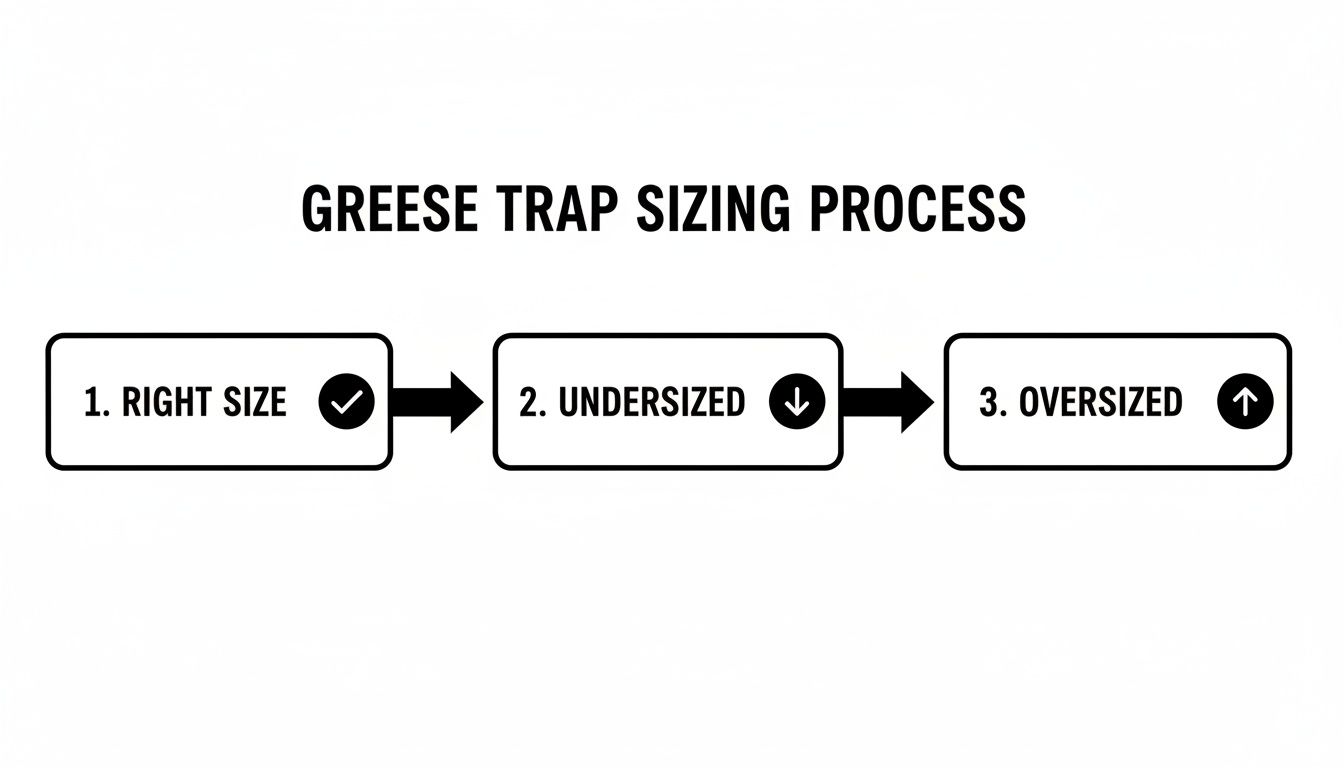
As you can see, proper sizing is the only path to an efficient, compliant system. Both undersizing and oversizing just lead to headaches and extra costs down the road.
Which Method Is Right for Your Seattle Kitchen?
So, which one do you use? The equipment itself often makes the decision for you. If you're sizing for a standalone piece of gear, like a new deep fryer station with its own sink, the GPM formula is your best bet. But if you’re mapping out a full kitchen with multiple sinks, drains, and dishwashers, the DFU method is the way to go.
The Uniform Plumbing Code (UPC) sets the standard across the U.S., with sizing requirements ranging from small units for coffee shops to massive interceptors for hotels. And it matters. A 2015 study by the Water Environment Federation found that correctly sized traps captured an impressive 95% of FOG, while undersized units only caught about 60%. You can dig into more of these industry findings over at datahorizzonresearch.com.
Pro Tip: Always, always round up to the next available trap size. If your calculation lands you at a 13 GPM requirement, don't try to squeeze by with a 10 GPM model to save a little cash. Go up to the next size, like a 15 or 20 GPM unit. That little bit of buffer is a smart investment that will save you from backups during a dinner rush.
A Real-World Sizing Walkthrough for a Seattle Bistro
Theory is great, but let's get our hands dirty. Seeing how grease trap sizing actually works in a real kitchen is where the confidence comes from. We're going to walk through a complete sizing calculation for a fictional—but totally realistic—Seattle bistro to connect the formulas to the equipment you see every day.
This exercise will bridge that gap between abstract numbers and a tangible gallon requirement. It's all about translating your kitchen's unique setup into a specific, compliant grease trap.
Setting the Scene: The Equipment Roster
Our little bistro is a busy spot with a pretty standard equipment lineup. For this example, all these fixtures will drain into a single, centrally located grease interceptor.
Here’s the inventory:
- One Three-Compartment Pot Sink: Each basin is a beefy 24" x 24" x 14". This is the FOG powerhouse, where all the greasy pots and pans get scrubbed.
- One High-Temperature Dishwasher: We checked the manufacturer's spec sheet, and it has a flow rate of 2 GPM.
- One Food Prep Sink: A smaller, single-basin sink measuring 18" x 18" x 12".
- One Floor Drain: Positioned right near the cooking line to handle spills and wash-down water.
This is a common setup for many small to mid-sized restaurants. It hits all the main types of wastewater sources you’ll need to account for when sizing your own system.
Crunching the Numbers with the GPM Method
Okay, let's start by calculating the Gallons Per Minute (GPM) for each sink. We'll use that formula we covered earlier: (L x W x D) / 231, then tweak it for 75% capacity and a two-minute drain time.
First, the big one—the three-compartment sink. Since all basins can drain at once, we have to calculate the total volume.
- Cubic Inches: (24" x 24" x 14") x 3 basins = 24,192 cubic inches
- Convert to Gallons: 24,192 / 231 = 104.7 gallons
- Adjust for 75% Capacity: 104.7 gallons x 0.75 = 78.5 gallons
- Find the GPM: 78.5 gallons / 2 minutes = 39.25 GPM
Now for the smaller prep sink. Same process, different numbers.
- Cubic Inches: 18" x 18" x 12" = 3,888 cubic inches
- Convert to Gallons: 3,888 / 231 = 16.8 gallons
- Adjust for 75% Capacity: 16.8 gallons x 0.75 = 12.6 gallons
- Find the GPM: 12.6 gallons / 2 minutes = 6.3 GPM
Of course, this bistro also has equipment like deep fryers and sandwich prep tables. While they don't drain directly, the grease from cleaning them absolutely ends up in these sinks. That’s exactly why getting the sink calculations right is so important.
Cross-Checking with the DFU Method
Now, let's look at this from another angle using the Drainage Fixture Unit (DFU) method, which is perfect for a system with multiple fixtures. We'll grab those standard UPC values we talked about.
- Three-Compartment Sink = 3 DFUs
- High-Temp Dishwasher = 4 DFUs
- Food Prep Sink = 1 DFU
- Floor Drain = 2 DFUs
Add them all up, and you get a total of 10 DFUs (3 + 4 + 1 + 2).
Next, we pull out the Washington State Plumbing Code's conversion chart. A value of 10 DFUs almost always corresponds to a required flow rate of 35-40 GPM. See how close that is to the 39.25 GPM we got from just the three-compartment sink? That's no accident. The code knows that sink is the biggest offender. If you're looking for cost-effective ways to outfit your kitchen, exploring used commercial kitchen equipment can offer some valuable insights.
Why Retention Time is Half the Battle
Getting the GPM is a huge step, but it’s only half the equation. The other critical piece is retention time—how long the wastewater actually sits inside the trap to let the FOG separate.
The industry standard, and a number you'll see in local codes everywhere, is a two-minute retention time. This isn't just a random number. It's the minimum time needed for that hot, greasy water to cool down enough for oils to float and solids to sink.
To figure out the required liquid capacity of the trap, we just multiply our GPM by that retention time.
40 GPM (our total flow rate) x 2 minutes = 80 gallons
There it is. Our Seattle bistro needs a grease interceptor with at least an 80-gallon liquid-holding capacity. In the real world, you'd go with a standard 100-gallon unit to give yourself a safe buffer.
Don't Forget Grease Storage Capacity
Last but not least, we have to think about grease storage. A good rule of thumb is that a trap's rated capacity in pounds is typically twice its GPM flow rate.
40 GPM x 2 = 80 pounds
This tells us our 100-gallon trap should hold about 80 pounds of FOG before it’s screaming for a pump-out. This is a crucial number for setting up your maintenance schedule. A kitchen with multiple deep fryers will hit that limit way faster than a small cafe with just an under counter refrigerator and a coffee maker.
By walking through this step-by-step, you can see how the different calculations and practical factors all come together. This process ensures your grease trap sizing is a precise decision, not just a guess, protecting your Seattle business for years to come.
Navigating Seattle and King County Regulations
While the universal math behind GPM and DFU gives you a solid starting point, grease trap sizing in our area is all about the local rules. Getting it right in Seattle means you have to play by the book—specifically, King County Public Health and Seattle Public Utilities' book. They don't just use the standard Uniform Plumbing Code (UPC); they build on it with their own local amendments, making the rules here a bit more stringent.
This is exactly where so many new restaurant owners get tripped up. You can nail a calculation based on some generic online guide, only to have a King County inspector reject your plans because of one small local detail you missed. Their job is to protect our public sewer system from the massive strain of thousands of kitchens, so they don't mess around.
Understanding the Local Inspector's Checklist
When your plans land on an inspector's desk in Seattle or King County, they’re looking at your whole setup. They’ll be cross-referencing your proposed equipment list with your grease trap's capacity to make sure everything adds up. They’ll check that every single fixture producing FOG—from your big three-compartment sink down to the smallest prep sink—is accounted for.
A common reason for rejection is underestimating the grease load from certain pieces of equipment. Think about your heavy hitters: commercial deep fryers, woks, and charbroilers. While they aren't plumbed directly into the interceptor, the wastewater from cleaning them absolutely is, and inspectors are well aware of this. They expect your sizing calculations to reflect the reality of a high-grease kitchen.
For a deeper look at planning your entire kitchen to meet these local standards, check out our guide on setting up a commercial kitchen. It’s a great resource to help ensure your equipment choices are compliant from the very beginning.
Local Sizing Charts and Requirements
King County provides its own specific guidance and sizing charts that can differ from the standard UPC. They are laser-focused on keeping FOG out of the sewer, which means their requirements for things like retention time and grease storage can be pretty strict. A small coffee shop with minimal food prep, for instance, will fall under a different set of expectations than a full-service restaurant.
This official resource is a must-read. It breaks down everything from best management practices to the specific requirements for different business types, making it an essential reference for any operator around here.
The global impact of getting this wrong is pretty staggering. A 2023 survey revealed that 62% of operators undersize their grease traps by 20-30%. This contributes to an estimated $500 million in yearly losses from fines and plumbing disasters. On the flip side, that same data shows that proper sizing can triple the lifespan of the equipment and prevent up to 80% of clogs. It just goes to show how critical precision is in a commercial kitchen.
The most common mistake we see is operators forgetting to account for every single fixture. An inspector will look at your Seattle bar equipment just as closely as your main kitchen line. That small sink behind the bar still needs to be included in your DFU or GPM total.
Common Compliance Pitfalls to Avoid
It’s not just about math errors. Several common slip-ups can derail your permit approval in King County. Knowing what they are ahead of time can save you a world of headaches and a lot of cash.
- Ignoring Dishwasher Discharge: High-temperature commercial dishwashers are notorious for emulsifying grease, making it way harder for a trap to do its job. Inspectors will definitely verify your trap is sized to handle that sudden, hot, high-volume blast of water.
- Forgetting Floor Drains: Those floor drains near your cooking line, especially by the deep fryers or tilt skillets, become major FOG contributors during nightly wash-downs. They absolutely must be included in your calculations.
- Miscalculating for Specialized Equipment: The grease output from pizza prep tables (all that cheese and meat) is completely different from a simple vegetable prep sink. You have to think about what’s on your menu and how you cook it.
At the end of the day, navigating local regulations is about proving you’ve done your homework. If you show up with clear documentation, an accurate equipment list—including everything from your commercial refrigerators to your smallest sinks—and a sizing calculation that reflects King County's specific rules, you're going to have a much smoother and faster approval process.
How Your Kitchen Equipment Choices Impact Sizing
The math behind sizing a grease trap is only as good as the numbers you plug into it. Every single piece of equipment in your kitchen that touches greasy waste adds to the load your interceptor has to handle. Getting this right is about understanding the entire ecosystem of your kitchen, not just the sinks.
We have to look beyond the obvious drain connections and think about how your specific menu and workflow create Fats, Oils, and Grease (FOG). A thorough equipment audit is the only way to make sure your sizing calculation matches the reality of your daily output. Skip this, and you're setting yourself up for some costly surprises down the road.
Identifying Your High-FOG Producers
Some appliances are just straight-up FOG factories. Commercial deep fryers are the undisputed champions here. While you should be rendering and disposing of the old fryer oil separately, the grease from cooking and cleaning baskets and surfaces always finds its way down the drain.
Other heavy hitters you can't ignore include:
- Woks and Griddles: These create a ton of grease splatter that gets washed into floor drains during cleanup.
- Rotisseries and Charbroilers: The runoff from cooking fatty meats is a huge contributor to your FOG load.
- Combi Ovens: When you use these for roasting, their cleaning cycles will absolutely send greasy wastewater into your system.
If you have several of these high-FOG units, your grease trap needs to be big enough to handle their combined output. Overlooking even one of these can overwhelm your system from day one.
The Role of Prep and Warewashing Equipment
They might not be as dramatic as fryers, but your prep and cleaning stations add a steady flow of wastewater that directly impacts your flow rate calculations. Cleaning sandwich prep tables or pizza prep tables introduces oils from meats, cheeses, and dressings. The FOG content is lower, but the water volume is constant and has to be part of the equation.
The specific type of equipment matters, too. For instance, Seattle coffee shop refrigerators might store dairy, leading to milky, fatty residue during cleaning. The sinks tied to Seattle bar equipment have to deal with waste from creamy drinks and oily garnishes. Each piece adds a small but measurable amount to the total FOG.
The link between your equipment and your trap is foundational. A well-planned equipment layout is the first step, and you can get some great guidance from our article on restaurant kitchen layout design.
Indirect Contributors You Can't Ignore
Sometimes the most important equipment doesn't even connect to a drain, but it has a massive indirect impact on your grease trap. Just look at your cold storage lineup.
- Commercial Refrigerators & Commercial Freezers: These units tell the story of your inventory. A kitchen stocking a lot of fatty proteins like beef and pork will naturally create more FOG than a vegetable-focused one.
- Under Counter Refrigerators & Under Counter Freezers: What’s stored here—butter, sauces, prepped meats—is often used right on the cook line, contributing directly to the grease being produced.
Here's the key takeaway: your equipment list is a roadmap to your menu. An inspector or plumber can glance at your appliances and get a very clear picture of your potential FOG output. That’s why an honest, detailed assessment is so critical for getting the sizing right.
By mapping out every piece of equipment, from the main cook line down to the smallest bar sink, you create a complete picture. This holistic view is the only way to ensure your grease interceptor is truly a good match for your kitchen's real-world needs.
Your Top Grease Trap Sizing Questions Answered
When you get into the weeds of grease trap sizing, a few questions always pop up. Let's get straight to the practical challenges Seattle restaurant owners face—the stuff that often falls between the cracks of the official rulebooks.
How Do Different Equipment Lines Affect Sizing?
The first step in getting your grease trap size right is a hard look at your kitchen inventory. Every single piece of equipment that touches food waste adds to the load your interceptor has to handle. It's that simple.
For example, if your kitchen is built around a bank of deep fryers, you're going to produce a massive amount of FOG. That naturally calls for a bigger trap. This is a totally different ballgame from a cafe that’s mostly sandwich prep tables and pizza prep tables. Sure, those stations produce grease from meats, cheeses, and dressings, but the volume is nowhere near what you get from non-stop frying.
The same logic applies to your cold line. A kitchen that relies on large commercial refrigerators and commercial freezers to hold cases of raw, fatty proteins will have a much different FOG output than a small coffee shop whose Seattle coffee shop refrigerators are just holding dairy and pastries. Even the little under counter refrigerators and under counter freezers count, since their contents usually end up on the cookline, adding to the day's grease load.
The Role of Seattle Bar and Coffee Shop Equipment
It’s a huge mistake to think bars or coffee shops can skate by with minimal grease management. The specific equipment in these places absolutely plays a role in sizing your trap, and inspectors know it.
Think about a standard Seattle bar equipment setup. The sinks used to wash glassware from creamy cocktails or rinse shakers coated in oily garnishes contribute way more FOG than you’d expect. Likewise, those Seattle coffee shop refrigerators are full of milk and cream, which leave a fatty residue that has to be caught. A King County inspector is going to look at those fixtures just as carefully as they would a three-compartment sink in a full-service restaurant.
An undersized grease trap is a liability, no matter what kind of business you run. A small trap that's constantly overflowing because it can't handle the daily FOG from a modest setup will cause the same clogs, nasty odors, and potential fines as one in a huge restaurant.
What Is the Difference Between a Grease Trap and Interceptor?
People tend to use these terms interchangeably, but in the eyes of the code, there's a big difference based on size, capacity, and where they're installed.
- Grease Trap: This is usually the smaller, indoor unit you see installed right under a sink. They’re meant for individual fixtures or a small cluster of them and are rated by their flow rate in Gallons Per Minute (GPM).
- Grease Interceptor: This is the big one. We're talking about the large, high-capacity tanks that are almost always buried underground outside. These behemoths serve the entire building's drainage system and are rated by their total holding capacity in gallons.
Knowing which one your operation needs is one of the first and most important steps in the planning and permitting process here in Seattle.
At Seattle Restaurant Equipment, we know that building a compliant and efficient kitchen involves more than just the fun stuff like grills and ovens. From figuring out your FOG management plan to choosing the right commercial refrigerators and deep fryers, our team is here to help Washington foodservice operators get it right. Check out our complete catalog of reliable, commercial-grade equipment at https://seattlerestaurantequipment.com.