

When you're outfitting a commercial kitchen, the standard size of an under counter fridge is your starting point. These workhorses are typically built in widths of 24, 36, 48, 60, or 72 inches. They’re designed with a uniform height and depth, allowing them to slide right under a standard 36-inch countertop. This makes them a fundamental, space-saving piece of equipment in any professional foodservice setup, from a small cafe to a high-volume restaurant.
Decoding Standard Commercial Fridge Dimensions
In a professional kitchen, every single inch counts. That’s exactly why commercial undercounter refrigerators are made to standardized dimensions. It's best to think of them not as just another appliance, but as integrated building blocks meant to create a smooth, efficient workflow for your crew.
These dimensions are the blueprint for everything from a compact Seattle coffee shop refrigerator to a massive pizza prep table. Understanding these standard sizes is the first step toward optimizing your kitchen's layout with the right commercial refrigerators, under counter freezers, or sandwich prep tables from our extensive selection.
H3: Common Widths and Their Applications
The width is the dimension that changes the most, and it's directly tied to how much you can store inside. Here at Seattle Restaurant Equipment, we see how different widths fit specific kitchen needs every day:
- 24-inch Models: This is your classic compact unit. It’s perfect for tucking behind a bar as part of your Seattle bar equipment setup, creating a small prep station, or just adding extra cold storage without taking up a huge footprint.
- 36 & 48-inch Models: These are the versatile MVPs of the kitchen. They strike a great balance between storage capacity and physical space, making them a go-to choice for sandwich prep tables and all-purpose under counter refrigerators.
- 60 & 72-inch Models: When you get to these larger sizes, you're talking about high-volume operations. You’ll often see them as sprawling pizza prep tables or as heavy-duty under counter freezers on a busy cook line, holding dozens of ingredient pans at the ready.
To make it easier to see how these common sizes stack up, here’s a quick reference table.
Quick Guide to Common Commercial Undercounter Fridge Sizes
This table gives you a quick overview of the most common standard dimensions you'll encounter for commercial undercounter refrigerators and freezers.
| Unit Type | Common Widths (Inches) | Standard Depth (Inches) | Standard Height (Inches) |
|---|---|---|---|
| Single-Door Refrigerator/Freezer | 24 | 30-32 | 36 |
| Two-Door Refrigerator/Freezer | 36, 48 | 30-32 | 36 |
| Three-Door Refrigerator/Freezer | 60, 72 | 30-32 | 36 |
Remember, these are the most common standards. Always double-check the exact spec sheet for any model you're considering to ensure it fits your space perfectly.
H3: The Importance of Standard Height and Depth
While the widths can vary quite a bit, the height and depth are much more consistent across the board. Most commercial units are designed with a depth around 30-32 inches and a height of about 36 inches, which usually includes the casters. This is done on purpose to make sure they line up perfectly with standard commercial countertops, creating that essential, unbroken work surface.
The whole point of standardized sizing is to create a modular, ergonomic kitchen. Whether it's a deep fryer, a griddle, or an undercounter unit, they are all designed to fit together, maximizing efficiency and minimizing wasted movement for your staff.
The undercounter refrigerator market is massive, and it serves more than just the foodservice industry. While you might see smaller 15 or 18-inch models for home use, the 24-inch model is the real starting point in any commercial setting. Its depth is specifically designed to sit flush with your cabinetry, giving you that clean, built-in look you want. You can learn more about the details of under counter refrigerator sizes and how they affect kitchen design to make the best choice for your operation.
How to Measure Your Space for a Perfect Fit
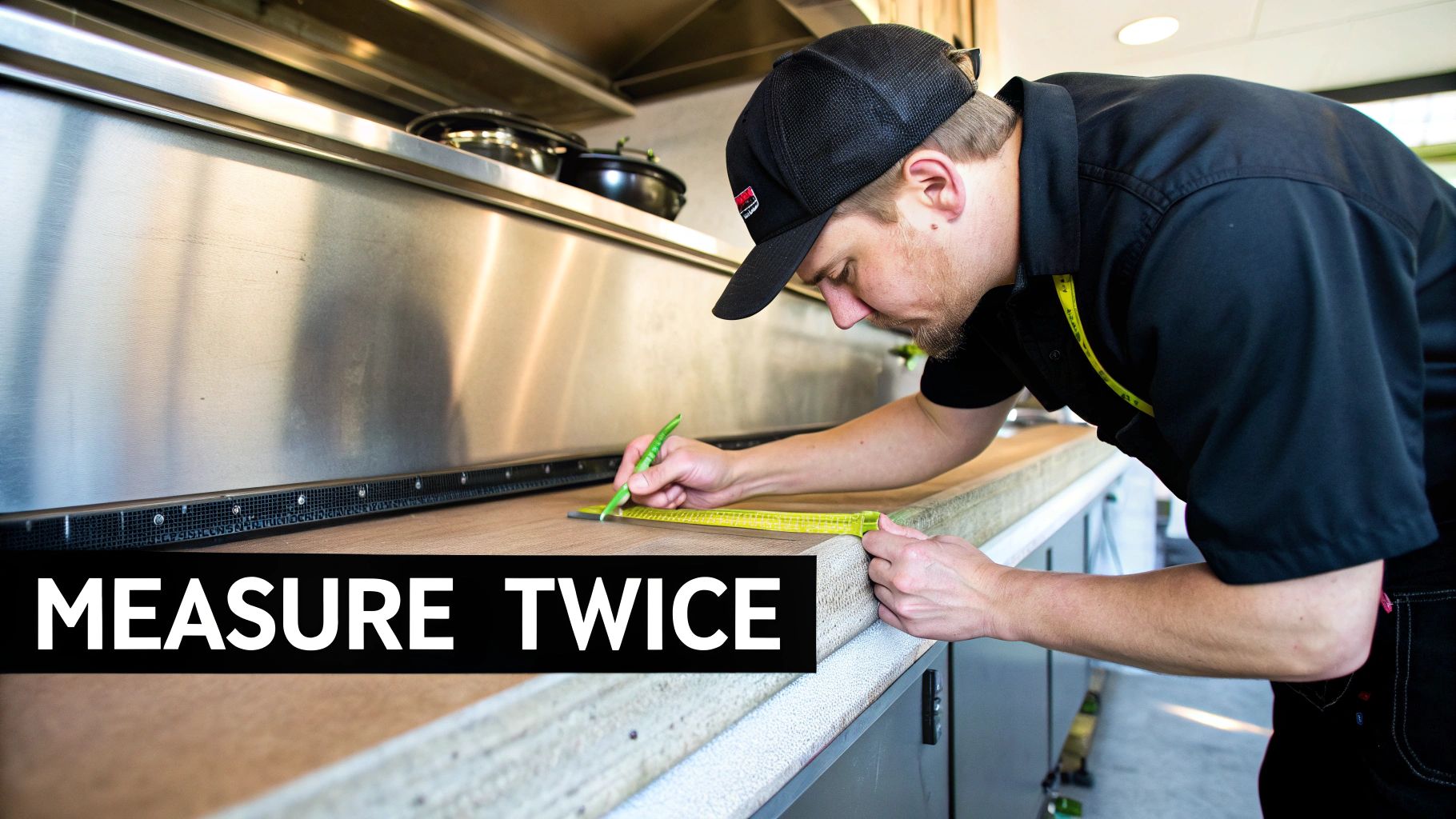
Before you even think about looking at a new under counter refrigerator, grab your tape measure. Trust me, adopting a "measure twice, install once" mindset will save you from some massive headaches, frustrating returns, and costly delays down the road. This isn’t just a quick check; it's about being methodical to make sure your new equipment fits perfectly.
The first thing to do is measure the three key dimensions: width, depth, and height. But here's a pro tip: never measure just once. Kitchens, especially in older Seattle buildings, have a way of settling. Floors aren't always level, and walls are rarely perfectly square. To avoid a nasty surprise, you need to take a few measurements for each dimension.
The Professional Measurement Checklist
Start by measuring the width at the bottom, middle, and top of the opening where the unit will go. Do the same thing for the height—get a measurement on the left, in the center, and on the right. Finally, measure the depth from the back wall to the front edge of the cabinet on both sides.
Always, and I mean always, use the smallest measurement you get for each dimension. That's your golden number. This simple step guarantees your new fridge will slide into place without a fight.
- Width: Measure near the floor, at countertop height, and at the very top of the opening.
- Height: Measure from the floor to the bottom of the countertop on both the left and right sides.
- Depth: Measure from the back wall to the front of the neighboring cabinets on both sides.
The Critical Role of Ventilation Clearance
This is the one step I see operators skip all the time, and it can kill your equipment. Commercial refrigerators, from standard under-counter models to specialized Seattle bar equipment, all generate heat. If that heat can't escape, the compressor has to work way too hard, leading to sky-high energy bills and, eventually, total failure.
Think of it like a marathon runner needing to breathe. If you don't give your refrigerator enough "breathing room," its compressor will eventually burn out from exhaustion.
Imagine the tight quarters of a Seattle food truck. It's tempting to cram in the absolute largest under counter freezer possible to maximize every inch of storage. But if you don't leave even one to two inches of clearance at the back and sides for air to circulate, you've just signed that unit's death warrant. The heat will build up, temperatures will become unstable, and you'll be making an expensive repair call sooner than you think.
Before you buy anything, check the manufacturer's spec sheet for the exact clearance requirements. Nearly every piece of commercial equipment, from prep tables to deep fryers, needs this buffer zone. Planning for this little gap isn't optional—it's essential for protecting your investment and making sure you get the right size of under counter fridge for your space.
Translating Cubic Feet into Real-World Capacity
A fridge’s spec sheet will tell you its external dimensions, but the real story is its internal capacity, measured in cubic feet. Let's be honest, "cubic feet" is just a number on a page. It doesn’t tell you a thing about how your kitchen will flow during a chaotic Friday night dinner service. To really understand what size of under counter fridge you need, you have to translate that abstract number into something that makes sense in the real world.
Think about it this way: a 7.0 cubic foot undercounter unit is a pretty common size. For a busy Seattle bar, that could mean enough room for three half-barrel kegs, keeping your most popular beers perfectly cold and ready to pour. In a coffee shop, that same space might hold 10-12 gallons of milk along with all your bottled juices and iced coffee concentrates.
From Abstract to Actionable Storage
The magic happens when you stop thinking in cubic feet and start picturing the equipment you use every single day. A commercial kitchen lives and dies by standardized pans, so knowing how many your fridge can hold is a much better way to measure its usefulness. This is especially true when you're looking at specialized gear like sandwich and pizza prep tables.
- A 24-inch sandwich prep table might give you space for six sixth-size food pans in its refrigerated rail—perfect for a small deli or a secondary prep line.
- A 48-inch sandwich prep table doubles that, holding twelve sixth-size pans, which is a must-have for any high-volume lunch spot.
This same logic applies to all your other equipment. A 36-inch undercounter freezer could be the perfect spot to stash backup frozen fries right beside the deep fryers, saving your team precious steps during a rush. For more ideas on smaller units, you can find great info on counter-top refrigeration that works well with an undercounter setup.
Matching Capacity to Your Operation
Every restaurant is different, and the right internal layout should reflect what you do. A pizzeria’s workflow is nothing like a bar's, and their refrigeration needs to match.
A fridge’s capacity isn't about how much it can hold in total; it's about how much of the right things it can hold to make your team faster and more efficient.
For instance, a pizza prep table is built with a wide, refrigerated rail designed specifically to hold a ton of topping pans, putting everything a cook needs right at their fingertips. On the other hand, Seattle bar equipment is all about shelving height and depth to fit as many bottles, cans, and kegs as possible. The goal is to pick a unit where the inside is an asset to your process, not a daily headache.
Matching Fridge Size to Your Kitchen's Workflow
Choosing the right size of under counter fridge isn’t just about finding the biggest unit you can cram into a space. It’s really about thinking strategically—how will this piece of equipment fit into the specific flow of your kitchen? The perfect unit for a bustling pizzeria is going to be completely different from what a high-end cocktail bar needs.
This decision is so critical that the global market for these units has exploded, reaching a value of around USD 3.42 billion. That growth shows just how vital these space-saving workhorses are for any modern commercial kitchen. You can learn more about the trends in the undercounter refrigerator market and see how they’re shaping the industry.
This simple decision tree can help you visualize which path to take based on your main goal.
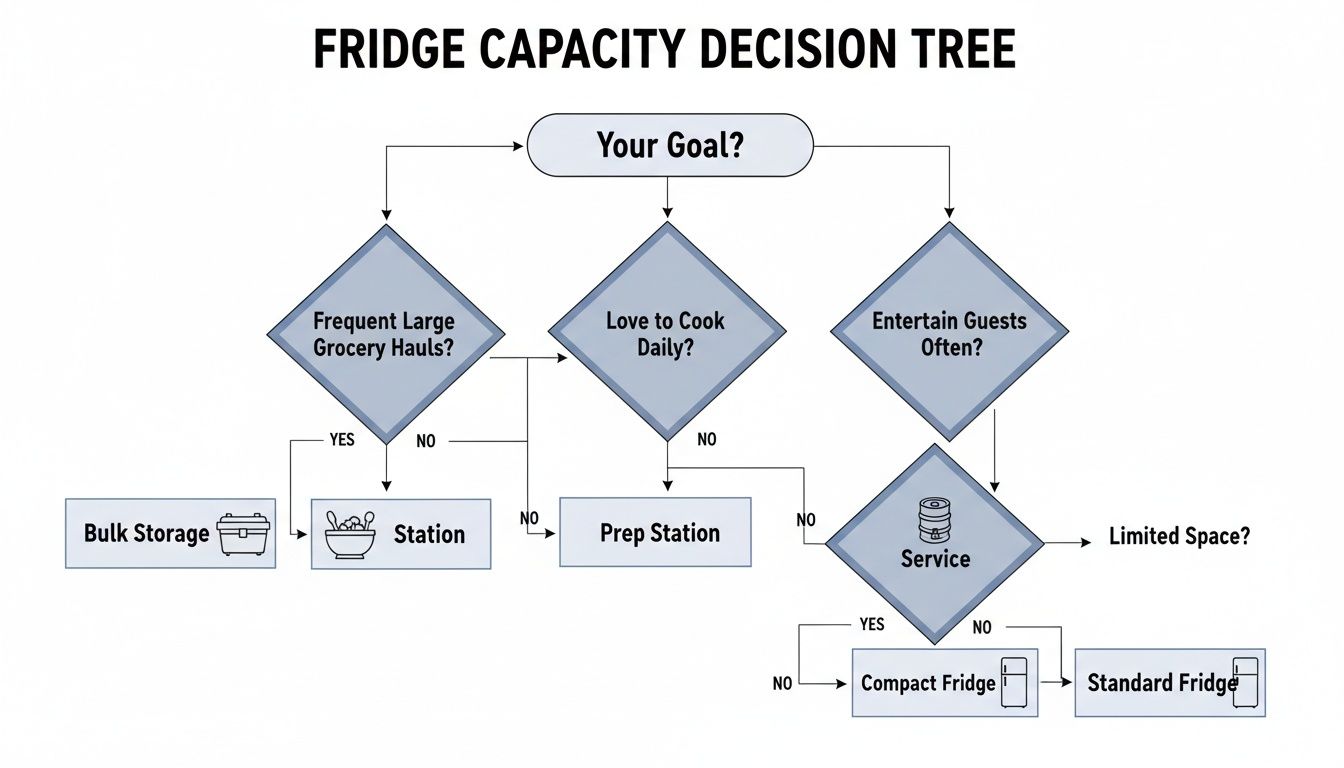
The key takeaway here is pretty clear: let your operation’s goal—whether it's high-volume prep, bulk storage, or speedy bar service—be the guide for your equipment choice.
Scenario 1: The High-Volume Pizza Parlor
Think about a pizzeria that’s constantly slinging pies. For them, speed and access are everything. The whole workflow is basically an assembly line where every single ingredient has to be within arm's reach. This is where a large prep table becomes absolutely non-negotiable.
A 60-inch or 72-inch pizza prep table is the only real choice here. Its refrigerated top rail can hold a massive array of topping pans—pepperoni, mushrooms, olives, cheese—all kept perfectly chilled and food-safe. The undercounter storage below is then packed with bulk dough boxes and backup sauces, making sure the line never has to stop. A smaller unit would create an instant bottleneck, forcing cooks to run back and forth to the walk-in.
Scenario 2: The Busy Seattle Cocktail Bar
Now, let's switch gears and head to a downtown Seattle bar. The workflow here is all about speed of service, keeping drinks ice-cold, and having garnishes ready to go. Bulk food storage is way down on the priority list.
For this spot, a 36-inch undercounter freezer is a perfect fit. It gives you plenty of space for bags of ice, frozen fruit purees, and pre-chilled glassware. Pair that with a 48-inch glass door back bar cooler, and you've created an incredibly efficient station where bartenders can grab what they need without ever turning their backs on a customer. Plus, the glass doors on the cooler double as a merchandiser, showing off the craft beer and cider selection.
Choosing the right equipment is a core part of effective kitchen design. The flow of your staff, the speed of service, and even your profitability depend on having the right tools in the right places.
As another example, a busy Bellevue coffee shop would get a huge benefit from a 24-inch glass door merchandiser. Placed right near the register, it's perfect for grab-and-go drinks, yogurt parfaits, and bottled juices, which is a great way to encourage impulse buys. The small footprint doesn't mess with the barista's workflow, but the added visibility can give sales a real boost.
Each of these scenarios proves a simple principle: the best size of under counter fridge is the one that removes friction from your team's daily tasks. If you carefully analyze how your kitchen actually operates, you can make a choice that directly supports efficiency and speed. For a deeper look into optimizing your space, check out our guide on restaurant kitchen layout design.
Why Commercial Grade Always Wins
When you're outfitting your kitchen, a less expensive residential under counter fridge might look tempting. But for any real foodservice business, this is a huge mistake. Cutting this corner can lead to lost inventory, breakdowns during a rush, and even costly health code violations.
The difference isn't just the price tag; it’s about performance, toughness, and safety. Think of it like a commercial delivery van versus a family car. Sure, they both drive, but only the van is built for the daily grind of heavy loads, constant stops, and non-stop use. A commercial under counter fridge is that van—it’s made for the battlefield.
Built to Withstand the Kitchen Battlefield
The first big difference you'll notice is the construction. Commercial refrigerators are built with high-grade stainless steel, both inside and out. This material is designed to handle the bumps, spills, and constant scrubbing that are part of any busy kitchen. Residential units, on the other hand, often use plastic liners and parts that can easily crack, stain, or become a breeding ground for bacteria.
This heavy-duty approach applies to every component:
- Heavy-Duty Compressors: These are powerful enough to get back to a safe temperature quickly, even when the door is opened every few minutes.
- Robust Shelving: Designed to hold heavy tubs of ingredients and full prep containers without bending.
- Reinforced Doors: Made to survive thousands of openings and closings during a single shift.
Superior Cooling and Smart Design
Commercial units are also engineered to perform in a hot, demanding kitchen. They have powerful compressors and fans that keep a consistent, food-safe temperature, even when the grill is firing and the ambient air is warm. A residential fridge would struggle and eventually fail in these same conditions.
The single most important design feature of a commercial under counter unit is its front-venting system. This allows the refrigerator to breathe from the front, which means you can install it completely flush under a counter without it overheating.
This front-venting design is an absolute must-have for any built-in setup. It’s what separates a professional, safe installation from a potential fire hazard. By pushing hot air out into the kitchen instead of trapping it against a back wall, these units run better and last much longer. You can learn more about how this affects your power bill by reading about energy-efficient commercial refrigeration.
Finally, commercial equipment comes with critical certifications. An NSF (National Sanitation Foundation) seal is required by almost every health department. This certification guarantees the unit is made from food-safe materials and is designed to be easily and thoroughly cleaned. Choosing a commercial-grade under counter refrigerator is about protecting your food, your investment, and your business's good name.
Common Questions About Undercounter Fridge Sizes
You’ve got the basics down, but a few practical questions might still be swirling. Let's tackle some of the most common things we hear from operators to make sure you choose the right size of under counter fridge with total confidence.
How Much Space Should I Leave Around an Undercounter Fridge?
Your first stop should always be the manufacturer's spec sheet for the specific model you’re looking at. That said, a solid rule of thumb for most commercial units is to leave at least 1-2 inches of clearance at the back and top. This small gap is more important than you might think.
This is the unit’s “breathing room.” It gives the compressor the airflow it needs to avoid overheating and working harder than it has to. Good ventilation means better energy efficiency and a much longer life for your equipment. Even if you have a front-venting model, this little bit of clearance is cheap insurance against an early breakdown.
Can I Use a Residential Undercounter Fridge in My Coffee Shop?
We get this question a lot, and our answer is always a firm no. It might look like an easy way to save some money upfront, but a residential fridge just isn't built to survive in a commercial setting like a busy Seattle coffee shop.
Residential units don’t have powerful enough compressors to keep up with constant door openings. This means your milk and other products could easily creep into the food temperature danger zone. More critically, they lack the NSF certification that health departments require. Using one could get you a health code violation or even void your business insurance. Sticking with commercial-grade Seattle coffee shop refrigerators is the only safe and legal way to go.
Investing in a commercial-grade unit isn't just about performance; it's about protecting your customers, your inventory, and your business's reputation. A failed health inspection due to improper equipment is a risk no operator should take.
What Is the Difference Between an Undercounter Fridge and a Prep Table?
While both slide neatly under a counter, their jobs are completely different. Think of it as the difference between a storage closet and a fully equipped workstation.
- Standard Undercounter Refrigerator: This is all about bulk cold storage. It’s the perfect spot to stash backup containers of sauce, extra produce, or cases of drinks.
- Sandwich or Pizza Prep Table: This is a specialized workhorse. It combines undercounter storage with a refrigerated top rail designed to hold food pans, giving your team instant, food-safe access to ingredients. It’s a must-have for any kitchen assembling food to order.
What Is the Best Fridge Size for a Food Truck?
In a food truck, every inch is prime real estate. Efficiency is everything. The best way to start is by looking at your menu and workflow to figure out exactly what needs to be chilled and accessible during a busy service.
A compact 24-inch or 36-inch undercounter unit is often the perfect fit. Try to find a model with a durable stainless steel worktop to gain an extra prep surface. Because space is so tight, you have to measure your available footprint precisely—there’s no room for error. Finally, look for a unit with high energy efficiency to go easy on your generator or power supply.
Whether you're launching a new food truck, upgrading a packed restaurant kitchen, or adding grab-and-go coolers to your coffee shop, Seattle Restaurant Equipment has the right-sized commercial refrigeration to get the job done. Check out our full selection of undercounter refrigerators, freezers, and prep tables online.
Shop Commercial Undercounter Refrigerators at Seattle Restaurant Equipment