

In a commercial kitchen, every single inch is prime real estate. Undercounter refrigerators are your secret weapon for maximizing that space. They’re designed to slide right under your work surfaces, creating a seamless, efficient workflow that keeps ingredients exactly where you need them.
These units aren't just sized at random; they’re built to a highly predictable standard for a very good reason.
Decoding Standard Under Counter Fridge Dimensions
Think of undercounter units as perfectly shaped building blocks for your kitchen. This standardization means a restaurant owner in Seattle, Tacoma, or Bellevue can design a layout with total confidence. You know that a 48-inch prep station will perfectly house a 48-inch undercounter fridge.
This predictability is everything, whether you're mapping out a new bar from scratch or just swapping out an old commercial freezer.
The Anatomy of Standard Sizes
From a bustling Seattle kitchen to a quiet café, the footprint for undercounter refrigerators is remarkably consistent. Most commercial units are made to fit neatly under a standard 36-inch high countertop.
To make this happen, manufacturers usually design the exterior height to be around 34 to 35 inches. This leaves just enough wiggle room—about 1 to 2 inches—for the countertop itself and crucial airflow clearance.
While heights are fairly fixed, widths offer more flexibility to fit your space. You’ll commonly find them in 24, 27, 36, 48, and 60-inch options. Depth has also settled into a standard range of 29 to 32 inches, which lines up perfectly with most commercial counters. You can get a deeper dive into how these equipment standards came to be over at The Restaurant Warehouse.
This diagram breaks down the three key dimensions you’ll be working with.
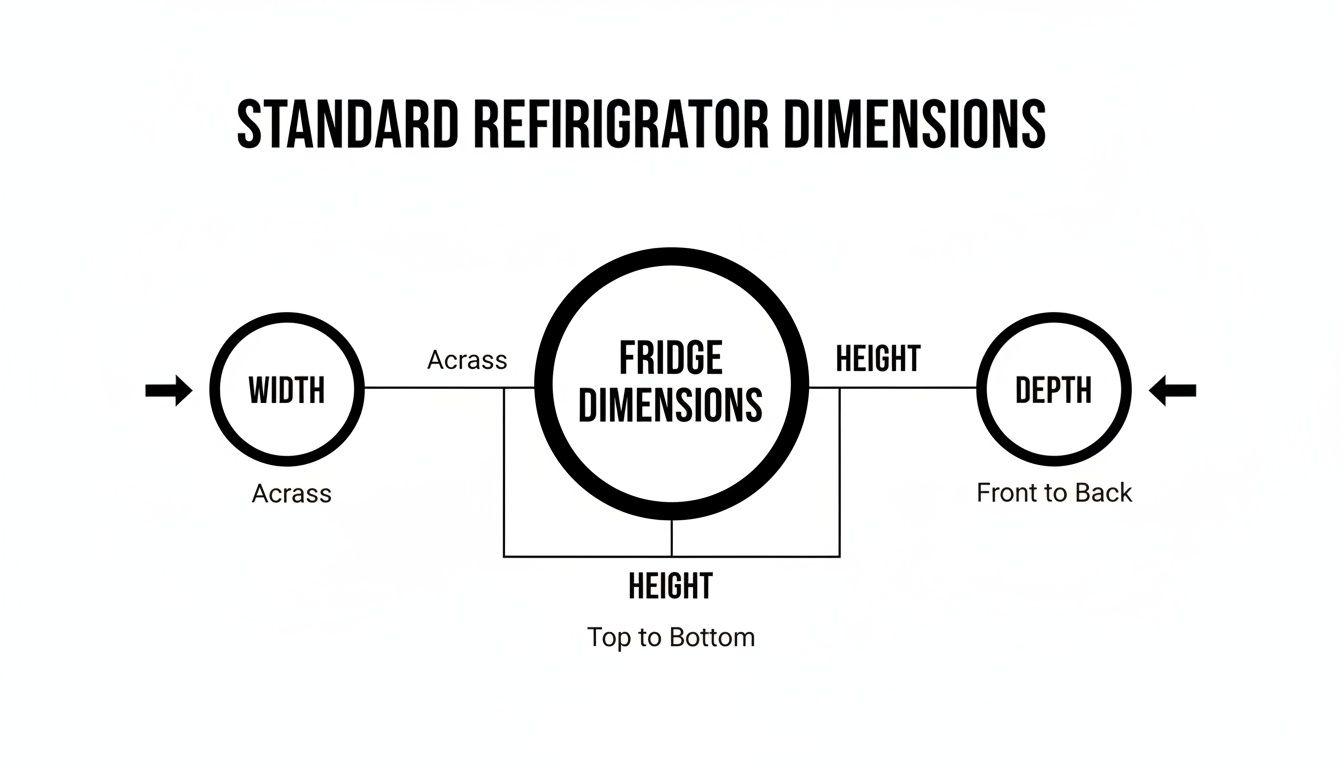
As you can see, width is where you have the most choice, while height and depth stay pretty consistent to guarantee a good fit.
Key Takeaway: The "standard" in undercounter fridge sizes is all about making sure your equipment fits predictably into the established world of commercial kitchen counters. This consistency makes designing your kitchen—and replacing old gear—so much simpler.
Getting a handle on these foundational dimensions is the first step. It ensures that the commercial refrigerators, under counter freezers, or even the specialized bar equipment you pick from Seattle Restaurant Equipment will slot right into your workspace without a headache.
Choosing the Right Size for Your Seattle Business
Knowing the standard dimensions is the first step, but the real work is matching an undercounter fridge to the actual needs of your Seattle-area business. What works for a high-volume restaurant is going to be overkill for a small coffee shop, and vice-versa. Let’s walk through a few real-world scenarios so you can start to picture the perfect fit for your own operation.
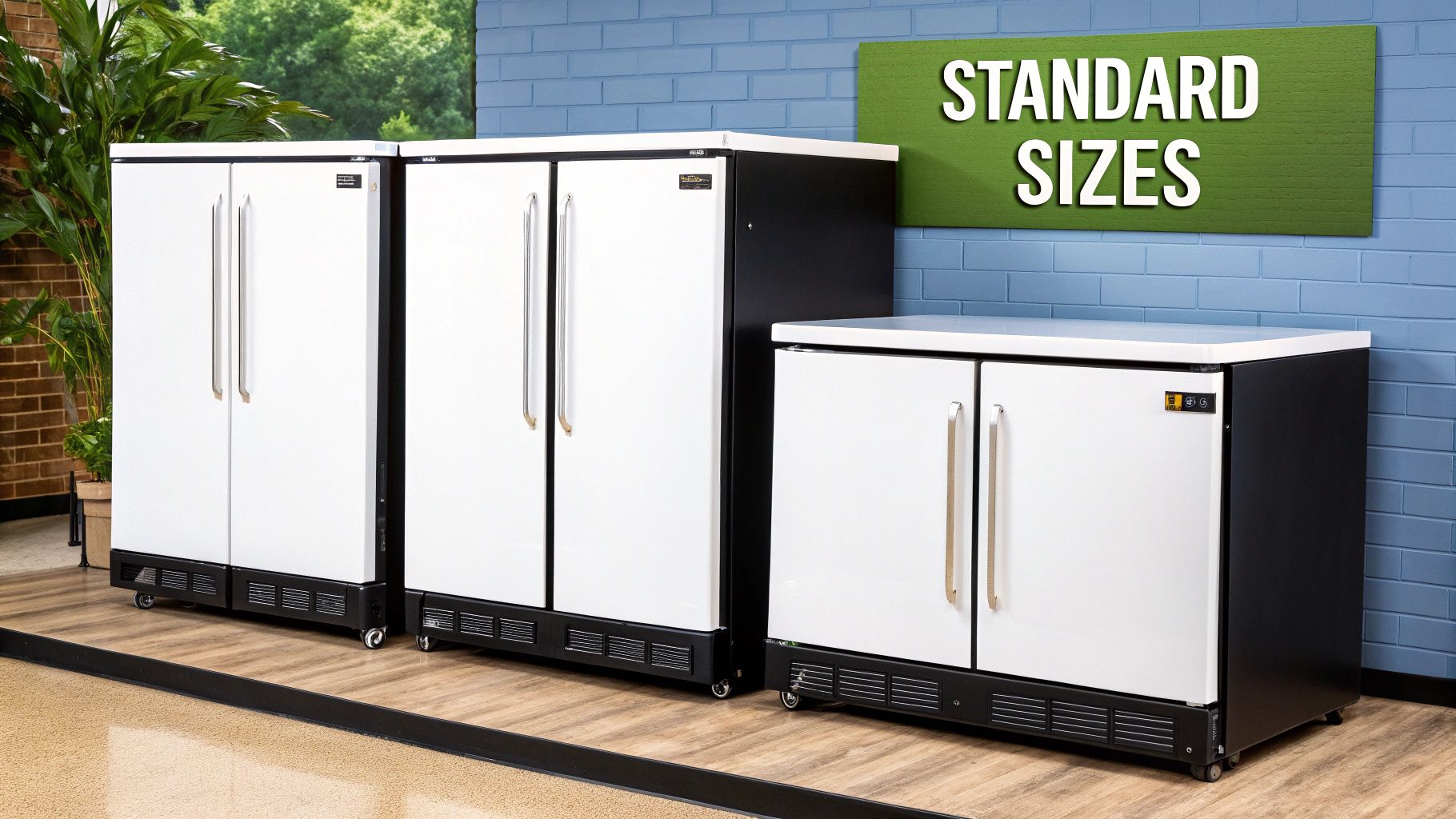
This isn’t just about filling an empty space under the counter; it’s a strategic choice. The right unit supports your menu, your customer flow, and your kitchen layout, becoming a genuine asset that speeds up service and makes life easier for your team.
Scenarios for Seattle Foodservice Businesses
Picture a packed Seattle coffee shop on a Tuesday morning. The line is out the door, and your baristas are in the zone, pulling shots and steaming milk. This is where a compact 24-inch undercounter fridge becomes the unsung hero. A dedicated Seattle coffee shop refrigerator tucks neatly behind the counter, keeping milks, creams, and dairy alternatives perfectly chilled and right at hand, eliminating those awkward, workflow-killing pauses.
Now, think about a busy deli during the lunch rush. Success here is all about speed and freshness. For this kind of place, a wider 48-inch or 60-inch undercounter refrigerator or even a dedicated sandwich prep table is a must. These larger units give you the space to organize all your meats, cheeses, and veggies in pans, right below the prep surface. That simple setup means less running around for staff and a faster, smoother assembly line.
Finally, imagine a trendy bar that needs some specialized Seattle bar equipment. To show off local craft beers or keep white wines at the perfect temperature, a 24-inch or 36-inch glass-door undercounter refrigerator is the way to go. It does the crucial job of cooling while also acting as a merchandiser, letting bartenders grab what they need in a second while tempting customers with a clear view of your best offerings.
By connecting your menu and operational needs to specific under counter fridge sizes, you turn a simple equipment purchase into a smart business decision that directly enhances efficiency and service quality.
From Deep Fryers to Pizza Prep Tables
You can apply this same logic to just about every piece of equipment we sell here at Seattle Restaurant Equipment. Running a bank of deep fryers? Sticking an under counter freezer right next to them for fries and other frozen goods is a total game-changer for your fry station. No more long treks to the walk-in freezer means precious seconds saved on every single order.
It’s the same story for a pizzeria. You need a tough pizza prep table with built-in refrigerated rails and an undercounter base. The size you need—whether it's 48, 60, or even 72 inches—is decided by how complex your menu is and how many pizzas you’re slinging an hour. Each of these specialized units is really just a variation of standard undercounter fridge sizes, but they're tailored for a specific, high-value job. When you think through these practical applications, you'll end up with equipment that actually solves your kitchen's unique problems.
How to Measure Your Space for a Perfect Fit
There’s nothing worse than the delivery truck showing up with your shiny new undercounter unit, only to discover it won’t fit through the kitchen door. It’s a frustrating and surprisingly common mistake that costs time and money.
Getting the right fit goes way beyond just measuring the gap under your counter. You have to think about the unit's entire journey, from the moment it leaves the truck to its final home in your line.
Think of it this way: your new refrigerator needs “breathing room” to work right. Just like an athlete needs space to move, your equipment needs clearance for proper ventilation. If it’s crammed into a tight space, the compressor has to work overtime, jacking up your energy bills and ultimately shortening the life of your investment.
The Three-Step Measurement Checklist
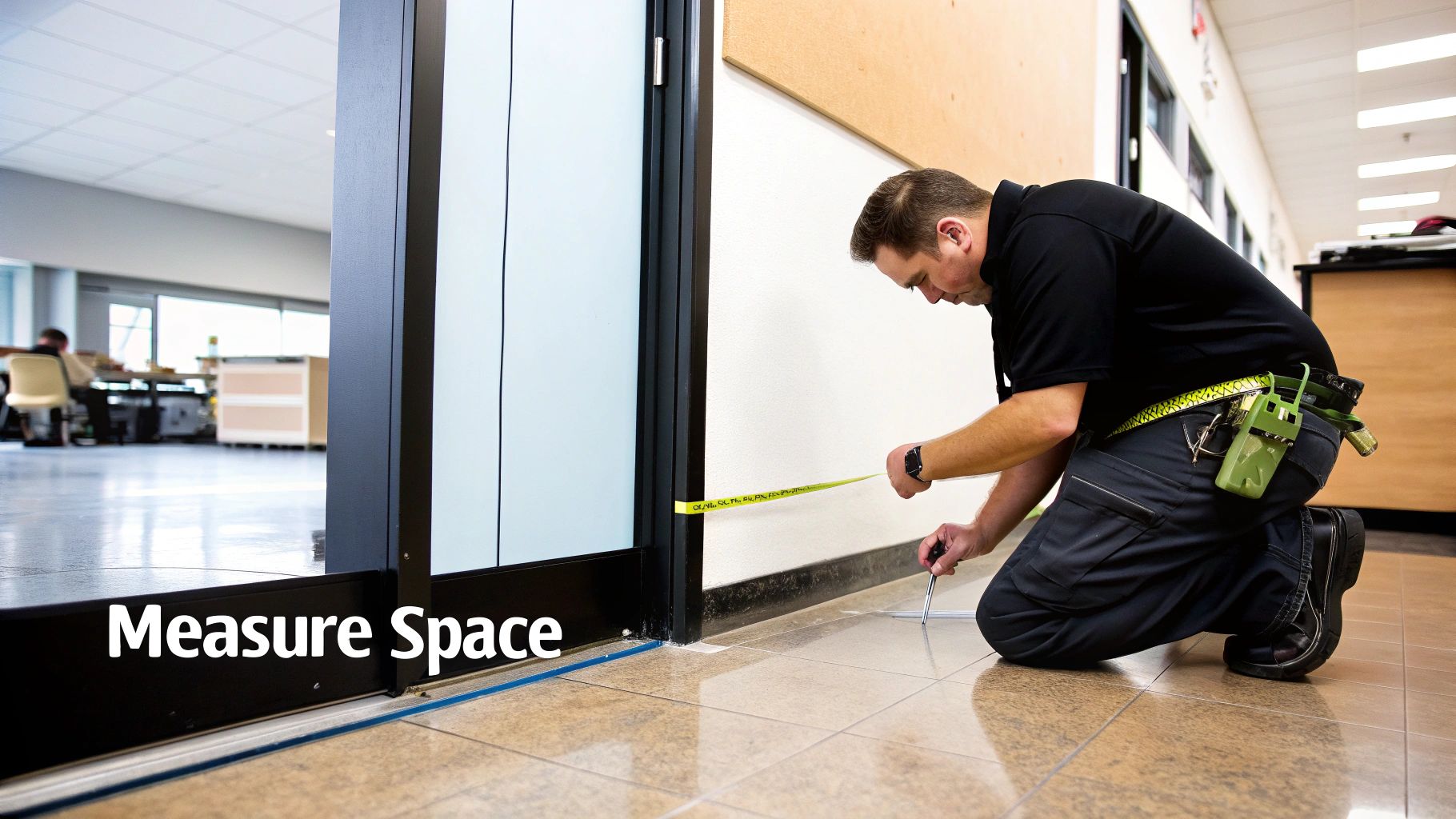
Before you hit "buy" on any commercial refrigerator or freezer, grab a tape measure. Running through these quick checks is the single best way to avoid a major installation headache.
-
Measure the Final Placement Area: Get the exact height, width, and depth of the space where the unit will live. Don't just measure once—check in a few different spots. You'd be surprised how uneven counters and floors can be, and that quarter-inch difference matters.
-
Account for Essential Clearance: This is a big one. Pull up the manufacturer's spec sheet online. Most commercial units need at least 1-2 inches of clearance on the sides and back to let heat escape. Front-venting models are a bit more forgiving, but never just assume. Always, always check the specs.
-
Map the Delivery Path: Now, walk the path the delivery team will take. Measure the width and height of every single doorway, hallway, and tight corner between the loading dock and the final installation spot. Don’t forget to factor in things like door handles or support beams that might stick out and narrow the path.
Proper measurement isn't just about making sure the unit slides into place. It’s about making sure it can be delivered without a struggle and has the room to operate efficiently for years to come. A few minutes with a tape measure now prevents days of delays and unexpected costs later.
Beyond the Tape Measure
Okay, you've confirmed the unit will fit. Just a couple more things to check for a seamless installation.
Look for the electrical outlet. Is it actually close enough for the unit’s power cord to reach? More importantly, can that circuit handle the load? Commercial refrigeration often requires specific amperage, so you need to be sure you won't be tripping a breaker every time the compressor kicks on.
Also, check if your floor is level. A slight slant can prevent the doors from sealing properly. That tiny gap will force the compressor to run nonstop, burning it out way ahead of its time.
Taking these steps is a critical part of any successful kitchen build-out. For a deeper dive into optimizing your entire workspace, check out our complete guide to restaurant kitchen layout design. A little planning up front ensures your new equipment performs flawlessly from day one.
Capacity vs Footprint: Maximizing Your Cold Storage
When you’re trying to pick the right undercounter fridge, it’s easy to get laser-focused on the outside dimensions. You measure the width, height, and depth, making sure it will slide perfectly into your line. But there’s another number that’s just as critical: the internal capacity, measured in cubic feet.
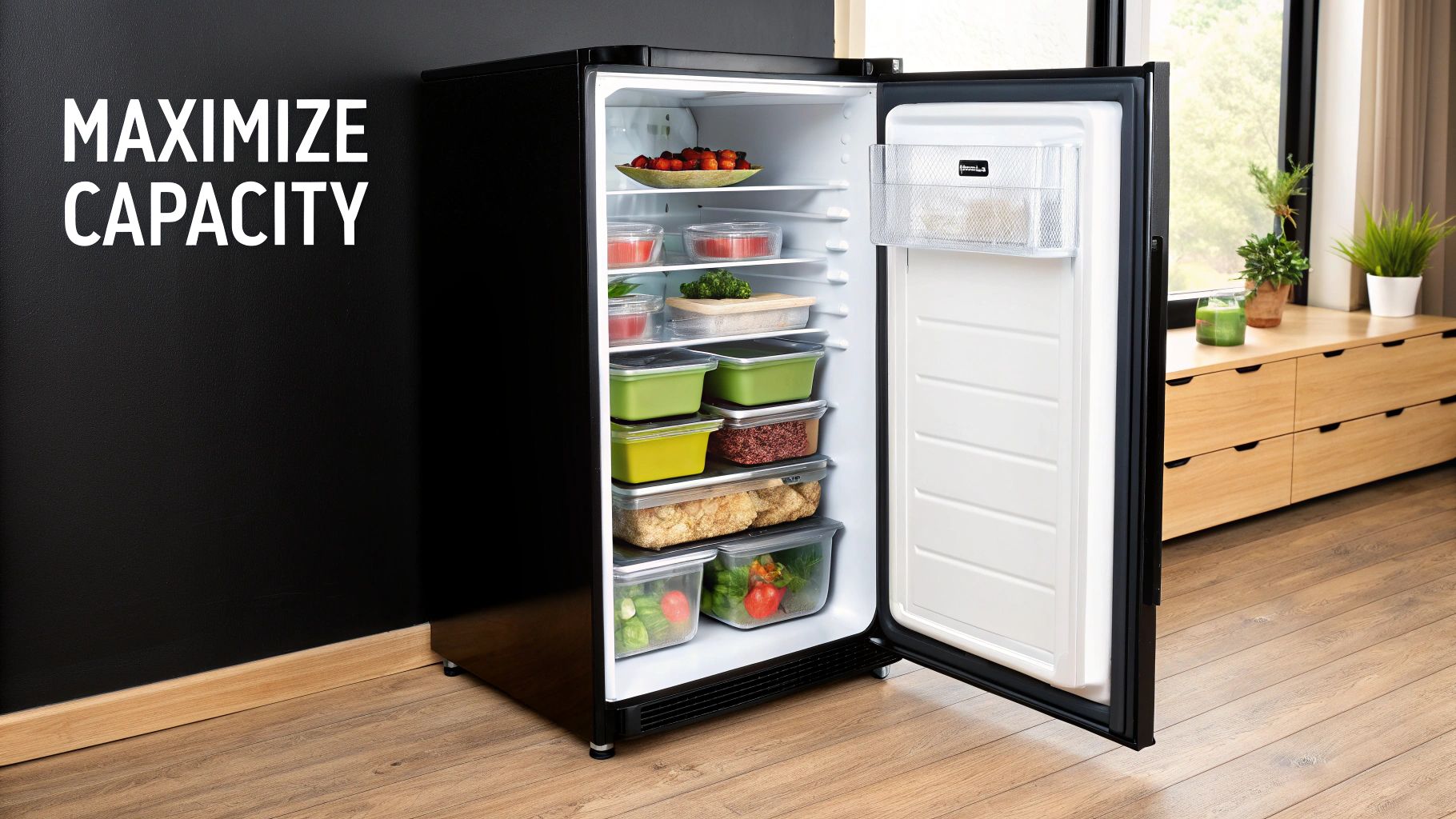
Think of the external size as the unit's footprint in your kitchen. The capacity, on the other hand, is the actual, usable cold storage you get for your money. It’s the difference between a cramped Seattle coffee cart and one with a smart layout—both might take up the same space on the sidewalk, but one is way more efficient.
The Evolution of Internal Space
Modern refrigeration has come a long way, and a lot of the magic has happened with insulation and compressor design. Today’s undercounter units can hold a surprising amount more than older models that have the exact same footprint. Why? Because thinner, more effective insulation frees up precious real estate inside the box.
This is a game-changer for tight Washington kitchens. A decade ago, a standard 27-inch wide undercounter fridge might have given you 5 to 6 cubic feet of space. Now, you can find commercial models with that same 27-inch footprint that offer 7 to 9 cubic feet of storage. That’s a massive 30–40% gain in usable space without stealing a single extra inch of your floor. Learn more about the growth of commercial refrigeration on Credence Research.
The Smart Investment: Choosing a newer model with a high capacity-to-footprint ratio means you're not just buying a box that cools—you're maximizing the storage potential of every square foot in your kitchen. This leads to better organization, less food waste, and a more efficient workflow.
Translating Cubic Feet into Real-World Use
So, what does an extra cubic foot really mean for your daily grind? Let's get practical. Abstract numbers don't help much during a dinner rush, but knowing what fits inside does.
-
For a Sandwich Prep Table: Instead of just looking at cubic feet, ask yourself, "How many standard 1/6-size food pans can this unit actually hold?" A higher capacity might mean you can store backups for all your key ingredients right at the station, killing those time-wasting trips to the walk-in.
-
For Seattle Bar Equipment: If you're looking at a glass-door merchandiser, the real question is, "How many longneck bottles or 16-ounce cans fit on each shelf?" More capacity means a wider selection for customers and less time spent restocking on a busy Friday night.
-
For a Pizza Prep Table: Here, the key metric is how many full-size dough boxes you can stack inside. A unit that fits three boxes instead of two can dramatically boost your kitchen’s pizza output during peak hours.
When you start thinking in terms of pans, bottles, and boxes, you connect undercounter fridge sizes directly to your kitchen's productivity. It empowers you to pick a fridge that doesn't just fit the space, but one that actively makes your operation faster and more profitable.
Finding the Right Tool for the Job
Knowing the standard under counter fridge sizes is a great start, but the real magic happens when you pick specialized units for specific jobs. When you stop thinking "I just need a fridge" and start thinking about your workflow, you can make some serious improvements. The whole idea is to match the tool to the task, putting exactly what you need right where the action is.
This strategy slashes the number of wasted steps your team takes, which is a massive deal in any busy commercial kitchen. Service speeds up and tickets get out the door faster when your crew isn't constantly trekking back and forth to the walk-in cooler. This is where finding the "right size" also means finding the "right type" of unit.
Specialized Units for Peak Performance
Let's break down some of the most popular specialized units we see making a huge difference for our Seattle Restaurant Equipment customers. Each one is a problem-solver, designed to anchor a specific station in your kitchen.
-
Under Counter Freezers: Picture your fry station. Now picture a dedicated under counter freezer tucked right next to the deep fryers. Bags of fries, mozzarella sticks, and onion rings are right there, ready to drop. That simple change can shave precious seconds off every single order.
-
Sandwich and Pizza Prep Tables: These are the ultimate all-in-one workstations. They combine a refrigerated base for bulk storage with a cooled prep rail on top, keeping every topping, sauce, and cheese perfectly chilled and within arm's reach. They come in all sorts of widths, from small models perfect for a tight deli line to massive tables that can anchor a high-volume pizzeria.
-
Chef Bases: You might know them as equipment stands. These are heavy-duty workhorses with refrigerated drawers built tough enough to hold countertop cooking gear like griddles, charbroilers, or fryers. This lets your line cooks keep raw proteins—think burger patties, steaks, and chicken breasts—directly underneath the cooking surface. It doesn't get more efficient than that.
Beyond the Main Kitchen Line
This workflow-first strategy isn't just for the hot line, either. The right undercounter units can completely transform your Seattle bar equipment setup. Glass-door merchandisers put your local craft beer selection on display, while dedicated back-bar coolers keep wines, mixers, and garnishes at the perfect serving temp.
Even a local Seattle coffee shop gets a boost. A small Seattle coffee shop refrigerator at the point of service for milk, cream, and dairy alternatives keeps the morning rush flowing smoothly. When floor space is at a premium, understanding these specialized units is your best bet. For even more ideas on compact solutions, check out our guide on countertop refrigeration options.
The smartest kitchen layouts place cold storage exactly where it's needed most. By choosing specialized undercounter equipment—from freezers to prep tables—you create self-sufficient workstations that boost speed, reduce staff movement, and improve overall kitchen productivity.
Why Getting the Size Right is a Big Deal
Picking the right undercounter fridge isn't just about measuring a space under a counter. It's a strategic move that hits your bottom line, hard. The perfect fit isn't about simply sliding a unit into a gap—it's about making your kitchen workflow smoother, cutting down on food waste, and squeezing every last drop of profit from your valuable kitchen real estate.
Think of this decision as a long-term investment in your kitchen's sanity and efficiency. For a packed Seattle bar, the right glass-door merchandiser means faster drink service. For a coffee shop, it’s the difference between perfectly chilled milk and a lukewarm latte. The right unit pays for itself over and over in saved labor and quicker service.
A Smart Investment in a Crowded Market
This isn't just our opinion; the market trends tell the same story. The global undercounter refrigerator market hit somewhere between $3.42–$4.5 billion in 2024 and is expected to climb towards $7.1 billion by 2033. What's driving this? A huge part of it is the rise of businesses with tight footprints, where operators often have less than 15–20% of their floor space for any kind of cold storage.
This space crunch has supercharged the demand for compact 24- and 27-inch units that pack a punch without eating up the whole kitchen. You can read more about these undercounter market trends and their drivers if you want to dig deeper.
Investing in standardized, reliable commercial refrigerators and freezers isn't just buying equipment. It's aligning your business with industry-wide best practices that prioritize efficiency, durability, and workflow optimization.
At the end of the day, you're not just buying a stainless steel box. You're making a calculated choice that impacts your entire operation. A correctly sized sandwich prep table can make or break your lunch rush. A small under counter freezer tucked next to the deep fryers streamlines the whole fry station.
These choices also have a real effect on your utility bills. Making the right call is fundamental to running a more profitable kitchen, and you can explore this further in our guide on energy-efficient commercial refrigeration.
Common Questions About Undercounter Fridge Sizes
Even after you've got your tape measure out, a few common questions always seem to pop up. Let's walk through some of the final details to make sure you get the perfect fit for your kitchen.
How Much Clearance Does My Commercial Unit Need?
This is a big one, and it's all about letting your equipment breathe. Proper airflow is absolutely essential for keeping your fridge running efficiently for years to come.
Most manufacturers will tell you to leave at least 1-2 inches of open space around the sides and back of the unit. This little bit of breathing room allows the condenser to push heat away from the unit, preventing it from working too hard and burning out. Always, always check the spec sheet for your specific model, as some might need a little more room than others.
Can I Use a Residential Fridge in My Restaurant?
We get this question a lot, and the answer is a hard no. It might seem like a way to save a few bucks upfront, but it's a mistake that will cost you down the line. A professional kitchen is a punishing environment—the heat, the constant opening and closing, the spills. Residential units just aren't built for that kind of abuse.
Commercial-grade refrigerators are designed with powerful compressors and tough stainless steel to handle the daily grind. More importantly, they're NSF-certified, which is a non-negotiable for passing health inspections. Using a home unit in your business can lead to spoiled food, a voided warranty, and a friendly (or not-so-friendly) visit from the health inspector.
Pro Tip: Investing in a commercial-grade unit from the start protects your business. It’s designed for the job, ensuring reliability during your busiest hours and compliance with local health regulations.
What Is the Difference Between Undercounter and Worktop Refrigerators?
The difference is right there in the name—it all comes down to the top surface and how you plan to use it.
- An undercounter refrigerator is meant to slide right under your existing counter, creating a clean, seamless line in your kitchen.
- A worktop refrigerator comes with its own heavy-duty stainless steel top, often with a small backsplash. It’s designed to be a durable prep surface, giving you extra workspace right on top of your cold storage.
Because of that built-in top, worktop models are usually a bit taller. If you're thinking about a worktop unit, make sure you measure your counter height carefully to ensure it will fit properly on your line.
At Seattle Restaurant Equipment, we have the perfect under counter refrigerators, freezers, and prep tables to fit your space and workflow. Explore our complete selection and find the right tool for the job at https://seattlerestaurantequipment.com.