

Picking the right undercounter refrigerator isn't just about what fits—it's about finding the piece that makes your kitchen work. When we talk sizes, the straight answer is that standard commercial widths are 24, 27, 36, 48, 60, and 72 inches. But the best size for you comes down to a gut check on three things: your available space, what you’ll use it for, and how much you need to hold.
Finding the Perfect Fit for Your Kitchen
Choosing an undercounter refrigerator is less about maxing out your space and more about boosting your kitchen’s flow. Go too small, and you’re looking at overstuffed shelves and food that’s not consistently cool. Go too big, and you’re just wasting prime real estate and electricity. It’s all about hitting that sweet spot where your equipment is an asset, not an obstacle.
This is something we see every day across the Washington foodservice scene. A tight 24-inch undercounter might be perfect for a Seattle coffee shop that just needs milk and creamers within arm's reach. On the flip side, a sprawling 72-inch three-door unit is the undisputed workhorse for a high-volume Bellevue restaurant that’s pushing out hundreds of plates on a busy night.
Matching Size to Your Operation
To give you a better idea of how these sizes fit into a real-world kitchen, here’s a quick breakdown of what we typically see.
Common Undercounter Refrigerator Sizes at a Glance
| Width (Inches) | Typical Capacity (Cu. Ft.) | Best For (Example Application) |
|---|---|---|
| 24" | 4.5 - 6.5 | Bar back-up, coffee station, garnishes |
| 27" | 6.5 - 7.5 | Small prep stations, beverage service |
| 36" | 9 - 11 | Sandwich/salad prep lines, moderate ingredient storage |
| 48" | 11 - 14 | Busy prep lines, appetizer stations, high-turnover items |
| 60" | 15 - 18 | High-volume kitchens, main line ingredient storage |
| 72" | 19 - 22 | Large-scale production, central prep areas, bulk storage |
Each size has its place, and finding the right one means you're investing in efficiency, not just a cold box.
At Seattle Restaurant Equipment, we’ve seen how every type of business puts these units to work. We stock everything from heavy-duty undercounter freezers for the main kitchen line to specialized sandwich prep tables that make the lunch rush manageable. We've got the essential Seattle bar equipment and the compact Seattle coffee shop refrigerators that keep small spaces humming.
It’s no surprise that these units are becoming more popular. The global market for undercounter refrigerators hit USD 3.42 billion in 2024 and is expected to jump to USD 6.27 billion by 2033. That growth is fueled by kitchens getting smaller in urban areas—a trend affecting everyone from independent spots in Tacoma to pop-ups all over Washington.
This simple decision tree can help you visualize the process. It's all about figuring out your space, your intended use, and your capacity needs.
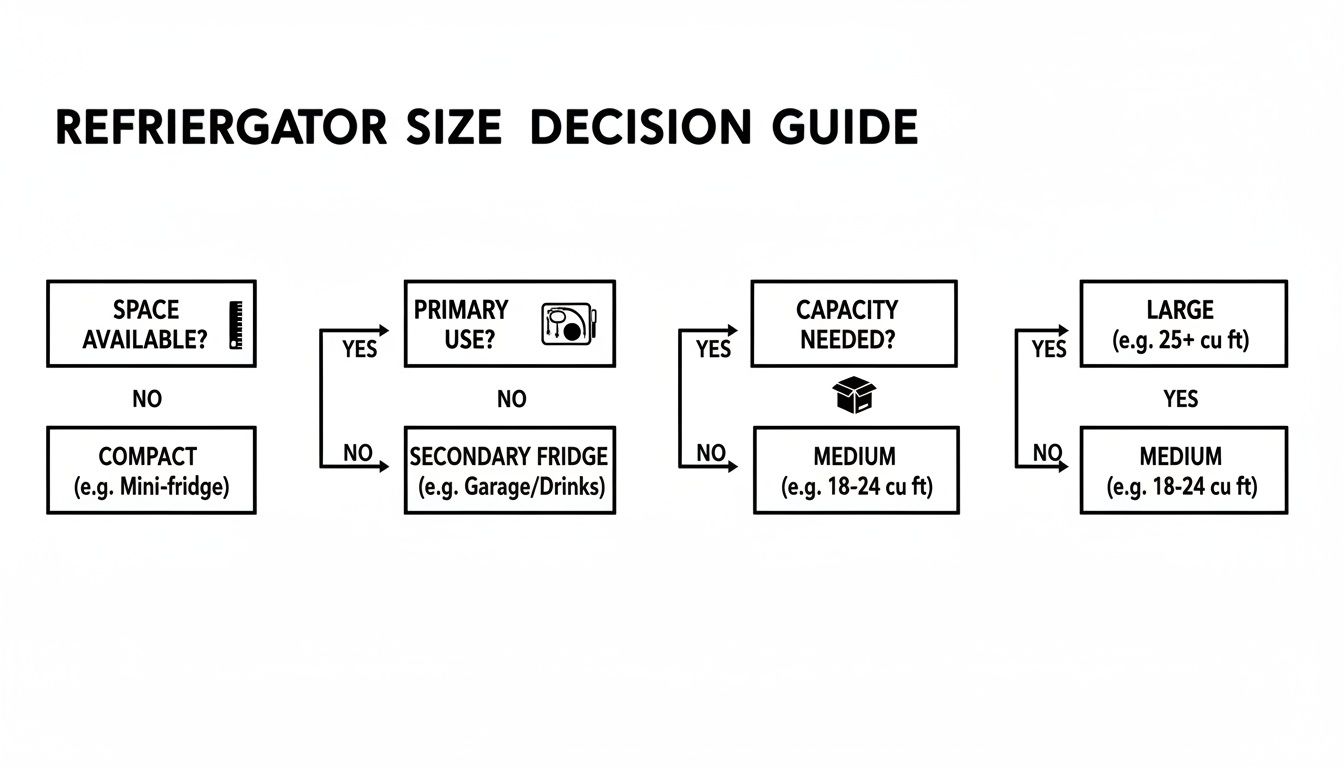
As the chart shows, a smart buy always starts with a tape measure. From there, you match the physical space with the job the unit needs to do and the amount of product it has to hold.
More Than Just a Box
At the end of the day, an undercounter refrigerator is an active part of your kitchen's ecosystem. It has to fit, both physically and functionally. When you think about its specific role—storing bulk ingredients, chilling drinks, or holding prepped items for a pizza prep table—you turn a simple purchase into a strategic investment. The right size will slide right into your kitchen's layout and make the whole operation run smoother. For more on that, you might want to check out our guide on effective restaurant kitchen layout design.
How to Measure Your Space Like a Pro
Before you click "buy" on that shiny new undercounter refrigerator, let's take a minute to make absolutely sure it’s going to fit. Picking the right size is about more than just the basic width, depth, and height. It’s like trying to get a new sofa into a small apartment—you don’t just measure the wall, you measure the doorways, the tight corners, and the space you'll need to actually live around it.
That same logic is critical in your kitchen. A unit that technically slides into a cutout but leaves no room for the door to swing open or for your staff to hustle past is a workflow nightmare waiting to happen. A few extra minutes with a tape measure now will save you from massive installation headaches later.

Beyond the Basic Dimensions
The single biggest mistake we see is forgetting about the space around the unit. A commercial refrigerator isn’t just a cold box; it’s a hard-working machine that generates heat, and it needs room to breathe. Without proper airflow, the compressor has to work overtime, your energy bills will creep up, and the unit’s lifespan will get cut short.
Think of it like an athlete running a marathon. If they can't breathe, they're going to overheat and burn out fast. Your refrigerator is no different.
Proper ventilation is non-negotiable for commercial refrigeration. Most manufacturers call for 1-2 inches of clearance on the back and sides, plus at least 1 inch on top so heat can escape. Skipping this step is the fastest way to kill your new equipment.
Your Pre-Purchase Measurement Checklist
Run through this quick checklist to guarantee a perfect fit. These are the little details that are easy to forget but make all the difference, especially in a cramped Seattle kitchen where every inch is prime real estate.
-
Measure the Cutout Dimensions: Grab a tape measure and get the exact height, width, and depth of the opening. Be sure to measure each dimension in three different spots (like left, middle, and right for width) and always use the smallest measurement. Trust us, cabinet openings are rarely perfectly square.
-
Account for Ventilation Clearance: Now, subtract the required clearance from your cutout numbers. The final figures are the absolute maximum dimensions your new undercounter refrigerator or undercounter freezer can be.
-
Check for Nearby Heat Sources: Is this unit going right next to a deep fryer, a range, or a flat-top griddle? That intense ambient heat forces the fridge to work way harder. If you can’t avoid it, try to leave a little extra space or install a heat shield between them.
-
Confirm Electrical Outlet Placement: Make sure there’s a proper outlet within reach of the unit's power cord. Don't even think about using an extension cord—they’re a fire hazard and often can't supply the steady power commercial equipment needs.
-
Analyze Door Swing and Pathway: Look up the door swing radius on the spec sheet. Will the door be able to open completely without slamming into other equipment, a wall, or—most importantly—blocking a high-traffic path for your staff? This is crucial for everything from a small Seattle coffee shop refrigerator to a wide sandwich prep table.
-
Ensure the Floor is Level: A refrigerator sitting on an uneven floor can have problems with its door seals and drainage. Use a level to check the spot and be ready to adjust the unit’s leveling feet when it arrives.
By thinking through these practical steps, you’re not just buying a piece of equipment. You're making a smart investment in your kitchen’s flow and efficiency. This foresight ensures the unit you choose—whether it’s for Seattle bar equipment or a busy pizza prep table—will slide right into your operation without a hitch.
Decoding Standard Dimensions and What They Mean
It’s one thing to look at the standard dimensions of a commercial undercounter refrigerator, but it’s another thing entirely to know why those sizes exist. These aren’t just random numbers. They’ve been hammered out over decades of real-world use to solve specific problems on a busy kitchen line.
Think of it like grabbing the right wrench from a toolbox. You wouldn’t use a tiny one for a heavy-duty job, and you wouldn't bring a sledgehammer for a delicate task. In the same way, the various undercounter refrigerator sizes are specialized tools. Each one is built for a specific role within your kitchen’s ecosystem.
The Workhorses of the Kitchen Line
Certain sizes have become the industry standard for a simple reason: they just plain work. They strike a perfect balance between footprint, capacity, and ergonomics, making them the go-to choice for thousands of restaurants.
Take the 27-inch undercounter refrigerator. This model is a versatile powerhouse and pretty much the default choice for a single-station prep area. It’s small enough to slide into nearly any kitchen line but gives a single cook just enough space to keep crucial ingredients right at their fingertips. This simple placement stops them from having to run back and forth to the walk-in, saving precious seconds during a chaotic service.
Then you have the 48-inch unit. This is the sweet spot for a lot of operations, especially if you’re using it as the base for a sandwich prep table or a salad station. It delivers a solid 11 to 14 cubic feet of refrigerated space and gives you a work surface wide enough for two people to prep side-by-side without bumping elbows. It’s the perfect blend of a manageable footprint and high-turnover capacity.
A unit's physical dimensions are directly tied to its function. A narrow 24-inch glass door merchandiser is built for display and quick access in a Seattle coffee shop, while a wide 60-inch solid door model is engineered for bulk storage in a large catering kitchen. The size dictates the role.
For kitchens all over Washington, from Spokane to Renton, standard 27-inch, 36-inch, or 48-inch models are game-changers. A typical 36-inch unit packs about 9-11 cubic feet, perfect for holding deli meats and produce, all while meeting NSF sanitation standards. The 27-inch models (6.5-7.5 cubic feet) are ideal for tight spaces like food trucks, while the 48-inch beasts (11+ cubic feet) handle serious commissary needs. You can dig into market data on commercial refrigeration and see just how dominant these sizes are.
When thinking about undercounter cooling, many operators weigh the pros and cons of refrigeration versus freezing. Here’s a quick breakdown to help you decide which is right for your line.
Undercounter Refrigerator vs Freezer Quick Comparison
Choosing between a refrigerator and a freezer for your undercounter space comes down to your menu and workflow. Refrigerators are for fresh, ready-to-use ingredients, while freezers are for long-term storage.
| Feature | Undercounter Refrigerator | Undercounter Freezer |
|---|---|---|
| Primary Use | Chilling fresh ingredients for immediate use (produce, dairy, prepped items) | Long-term storage of frozen goods (meats, desserts, bulk items) |
| Temp Range | 33°F to 38°F | -10°F to 0°F |
| Best For | Prep stations, salad bars, beverage stations, sandwich lines | Ice cream stations, storing bulk proteins, holding frozen appetizers |
| Energy Use | Moderate | Higher (requires more power to maintain sub-zero temps) |
Ultimately, most high-volume kitchens need both. A refrigerator keeps the line moving during service, while a freezer supports your inventory management behind the scenes.
Height and Depth Considerations
Width is just one part of the puzzle. The height and depth are just as critical for making sure a unit actually fits and functions in your space. One of the biggest factors for height is ADA (Americans with Disabilities Act) compliance. To ensure everyone on your team can work comfortably, ADA-compliant units are built to be 34 inches or less, making them accessible for employees in wheelchairs.
Depth is the other key measurement. Most units are either counter-depth or standard-depth.
- Counter-Depth Models: These are usually around 24-25 inches deep. They’re designed to sit perfectly flush with standard commercial counters, giving you that clean, built-in look.
- Standard-Depth Models: These units are deeper, often 30 inches or more. They might stick out a bit, but that extra space gives you a ton more internal storage. This is a must-have for specialty equipment like pizza prep tables where you need the depth to hold full-size sheet pans.
By connecting these dimensions to real-world scenarios in the Seattle foodservice scene, you can see exactly how a certain model will fit into your daily grind. It turns a simple equipment purchase into a smart investment in your kitchen’s efficiency.
Planning Your Capacity Beyond Cubic Feet
It’s easy to get fixated on the cubic feet listed on a spec sheet, but that number can be seriously misleading. Real-world capacity isn't about the total empty space inside; it’s all about the usable space. Getting this right is the difference between a unit that makes your line flow smoothly and one that’s a constant source of frustration.
Think of it like packing two grocery bags of the exact same size. One gets filled with big, awkward boxes, leaving all sorts of weird air pockets. The other is packed with smaller, flexible items that nestle together perfectly. Even with identical bags, what you can actually carry is worlds apart. Your commercial refrigerator is no different.
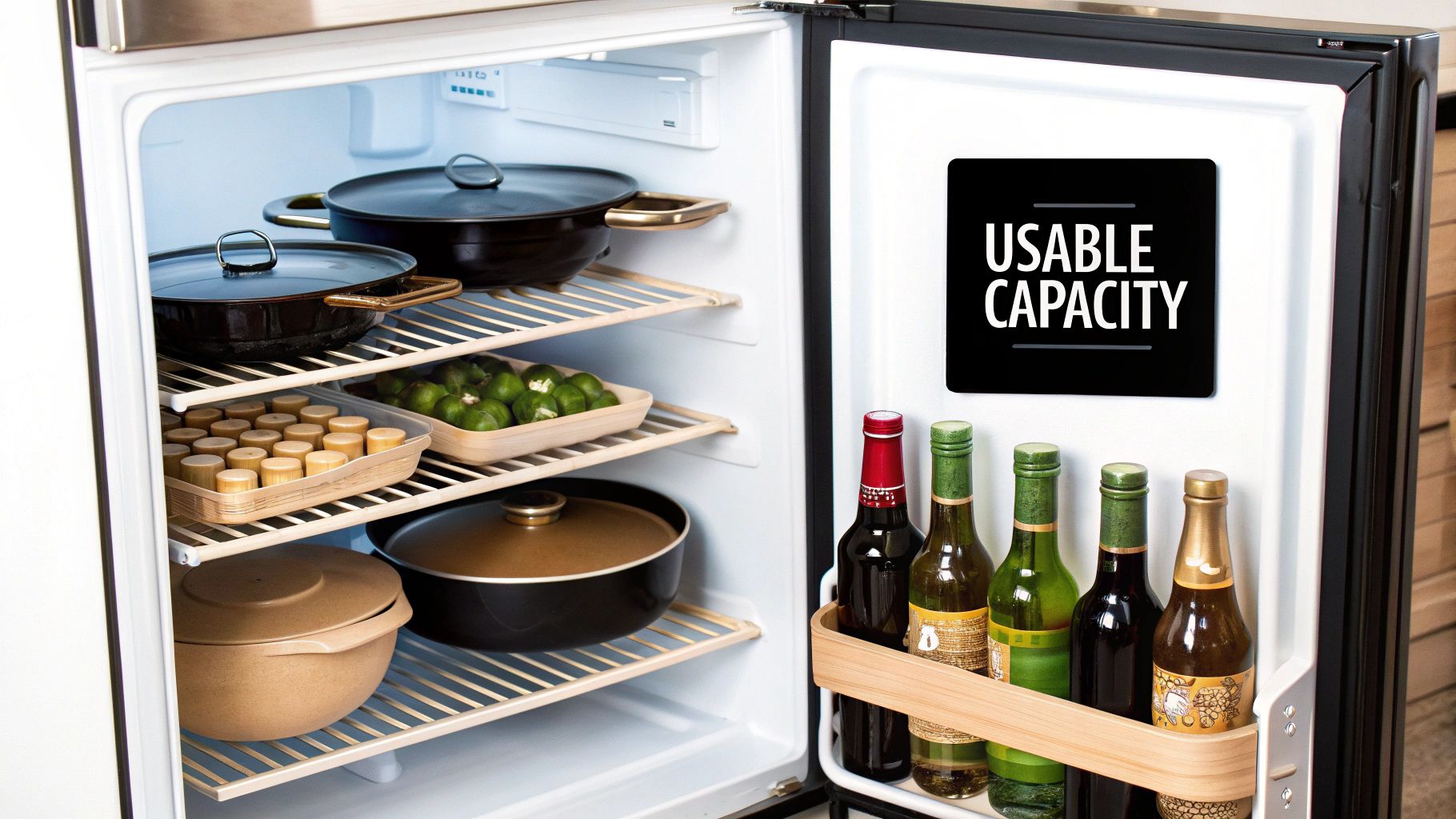
The internal layout—the shelving, drawers, and any blockages from mechanical parts—is what really determines how useful different undercounter refrigerator sizes are. A unit that seems perfect on paper might be a total dud for the specific items you need to store.
How Internal Layout Shapes Usable Space
The inside configuration is what transforms raw cubic footage into a functional storage tool. You can have two models with the same external dimensions that offer completely different storage potential because of how their interiors are designed. This is especially true when you start comparing standard fridges with more specialized gear.
For instance, the compressor housing often creates that annoying "hump" at the bottom of the cabinet. That little bump can stop you from sliding in full-size hotel pans or big prep containers, instantly wiping out a huge chunk of the advertised space for certain jobs.
True capacity isn’t a number on a spec sheet; it's a direct reflection of how well a unit’s internal layout matches your inventory. Before you buy, map out exactly what needs to fit inside, from sixth-pans to beverage bottles, to ensure the configuration works for you.
Let’s break down how specific features affect what you can actually store:
- Adjustable Shelving: This is your most flexible bet. It lets you move things around to accommodate bulky containers, tall bottles, or stacked food pans. A standard undercounter refrigerator with shelves is a great all-around workhorse for general storage.
- Drawers: Drawers are champs for organization and speed. In a sandwich prep table or pizza prep table, they keep portioned ingredients like cheeses and meats sorted and ready to grab. The trade-off? They’re less flexible for oddly shaped items compared to open shelves.
- Door Storage: Some models have shallow bins on the doors, perfect for bottles and condiments. While they help with organization, remember that this space is often baked into the total cubic foot calculation, even though it can’t hold your larger items.
Sizing for Your Seattle Operation's Inventory
To pick the right size and layout, you need to do a quick inventory audit. Forget cubic feet for a minute and start thinking in terms of what you actually use. Ask yourself practical questions about what your daily service looks like in your Seattle-area spot.
A busy pizzeria, for example, lives and dies by its pan capacity. They might choose a 48-inch pizza prep table not for its total volume, but because it can hold 12 third-size pans in the refrigerated rail and still fit full-size sheet pans below.
Likewise, a coffee shop searching for a Seattle coffee shop refrigerator needs to count bottles. How many gallons of milk and cartons of oat milk do they need to survive the morning rush? A compact 24-inch glass door unit might be the perfect fit if its shelves are spaced just right for those tall beverage containers.
For bars, it's all about the bottles and cans. A piece of Seattle bar equipment like a back bar cooler is sized based on how many it can hold. Can it store enough local craft beers and wine bottles to keep things moving on a slammed Friday night? A 60-inch model might be non-negotiable, not for its overall space, but for its ability to hold several hundred bottles.
By mapping out your inventory first, you can choose a unit that fits your operational reality. This ensures the undercounter refrigerator sizes you're looking at will actually handle the demands of your specific business, whether it's a high-volume commercial kitchen or a cozy café.
Sizing Specialty Undercounter Units
While a standard undercounter refrigerator is a workhorse, many Seattle kitchens need equipment designed for a very specific job. Once you move past general cold storage, you get into specialty units like commercial freezers, prep tables, and bar coolers. These all have their own unique sizing rules that directly shape your daily workflow. To pick the right one, you have to look beyond simple cubic feet and really focus on what the unit is built to do.
These specialized units are engineered completely differently from the ground up. It’s like the difference between a chef's knife and a delicate fileting knife. Sure, they both cut, but one is made for a precise task. In the same way, an undercounter freezer isn't just a refrigerator that gets colder; its entire mechanical system is beefier.
Undercounter Freezers And Prep Tables
An undercounter freezer has to have a more powerful compressor and better ventilation to hold those sub-zero temperatures, especially in the heat of a kitchen. When you're sizing one of these, you have to be extra careful about leaving enough clearance for air to circulate. A freezer crammed too tightly under a counter will constantly struggle, which leads to unstable temperatures and, eventually, equipment failure.
Sandwich prep tables and pizza prep tables bring another level of complexity. These units are a hybrid, combining a refrigerated base with a cooled top rail that holds food pans. Sizing them correctly means doing two key calculations:
- Base Capacity: The undercounter section needs to be big enough for your backup ingredients, like bulk cheese or containers of prepped veggies.
- Rail Capacity: The top rail has to hold the right number and size of pans (like sixth-pans or third-pans) to get you through a busy service without having to stop and refill constantly.
The overall depth is also a big deal here. These units are usually deeper than standard models because of the top rail, and that can really eat into your aisle space if you're not careful.
Sizing For Seattle Bar And Coffee Shop Equipment
When you're running a business that's all about beverages, the sizing game changes completely. If you’re choosing Seattle bar equipment or a Seattle coffee shop refrigerator, raw storage volume isn't as important as how that space is set up for bottles, cans, and cartons.
The best specialty unit is one that’s sized for its specific inventory. A back bar cooler's value is measured by how many bottles it can hold, while a prep table’s worth is all about its pan layout. The right size makes the task at hand much easier.
Glass door merchandisers are a go-to for customer-facing areas because everyone can see what's available. For back-of-house storage, though, solid doors are more energy-efficient and usually the better choice. A busy coffee shop might just need a small 24-inch glass door unit for milk and creamers at the bar, but a high-volume tavern is going to need a wide 60-inch or 72-inch back bar cooler to survive the weekend rush. For more ideas on smaller units, check out our guide on choosing the right countertop refrigeration.
For Washington foodservice—from bars in Vancouver to delis in Everett—standard sizes like 24-inch or 34-inch units tend to be the most common, with either glass or stainless doors for merchandising. Market data shows that 'undercounter beverage refrigerators' are a huge part of the market, driven by trends in commercial bars and coffee shops that need widths between 15 and 24 inches. In commercial kitchens, like the ones we equip at Seattle Restaurant Equipment, a 27-inch model gives you about 7 cubic feet at 33-38°F for salads or dairy, while a 48-inch unit offers 12+ cubic feet for your bulk items. You can find more insights about the undercounter refrigerator market on databridgemarketresearch.com. By matching the specialty unit to your specific operational needs—whether it's a deep fryer station that needs frozen storage close by or a bustling prep line—you make sure your equipment is a true asset.
Your Partner in Kitchen Efficiency
Picking the right undercounter refrigerator is a big deal, but it's just one piece of the puzzle when you're building an efficient kitchen. As we've seen, it really boils down to a few simple truths: measure your space twice, think hard about your daily workflow, and always, always plan for proper ventilation. Nail these details from the get-go, and you'll sidestep costly headaches and make sure your new gear is a genuine asset, not a liability.
This is exactly where Seattle Restaurant Equipment comes in. We do more than just move boxes; we're here to make the whole process simpler for food and drink entrepreneurs all over Washington. We get the unique grind of running a kitchen, whether it's a packed Seattle restaurant or a brand-new food truck hitting the streets of Tacoma.
The Seattle Restaurant Equipment Advantage
Our entire game plan is built around your success. We’ve hand-picked a lineup of solid, commercial-grade undercounter units that are built to take a beating in a professional kitchen. You won’t find any flimsy residential models on our site—just durable equipment designed to perform day in and day out. This covers everything from compact undercounter refrigerators and undercounter freezers to specialized sandwich prep tables and pizza prep tables.
We also know that your time and money are your most critical resources. That’s why we do things a little differently:
- Fast, Free Shipping: We ship free on all orders across Washington, from Bellevue to Spokane, getting you what you need without tacking on extra costs.
- Speedy Delivery: With our typical 1-2 day delivery, you can get your kitchen back online or up and running in no time.
- Competitive Pricing: We skip the expensive showrooms and sales commissions. This keeps our prices down, and we pass those savings straight to you.
- Accessible Financing: Our straightforward financing options help you get the essential equipment you need now, without blowing up your budget. To see how the right gear can really impact your numbers, check out our article on the benefits of energy-efficient commercial refrigeration.
We're not just a supplier; we're a dedicated partner in your kitchen's success. We combine a carefully chosen product selection with real-world expertise to help you build an efficient and profitable operation, one piece of equipment at a time.
At the end of the day, it's the human connection that truly sets us apart. Expert help is always just a call, email, or chat away. Need some advice on sizing Seattle bar equipment? Trying to find the perfect Seattle coffee shop refrigerator? Or maybe you're stuck choosing between a standard unit and a deep fryer worktop model? Our team is here to give you practical, knowledgeable support. We’re committed to being your go-to partner in building a smarter, more profitable kitchen.
Answering Your Undercounter Refrigerator Questions
When you're fitting a new undercounter refrigerator into your Seattle kitchen, a few questions always pop up. Getting the answers right is the key to making sure your new equipment slides in perfectly and runs like a dream. Here are the most common things we get asked about.
What’s the Standard Height for a Commercial Undercounter Refrigerator?
Most of the time, a commercial undercounter refrigerator will stand about 36 inches tall. This isn't an accident—it's designed to fit neatly under a standard commercial countertop, giving you a clean, seamless prep line.
If you need to meet specific accessibility standards, look for ADA-compliant models. These are built to be 34 inches high or less, making them accessible for every member of your team. Before you buy anything, always measure your counter height and double-check the unit's spec sheet to ensure a perfect fit.
How Much Breathing Room Does an Undercounter Unit Need?
Giving your equipment proper ventilation is the single most important thing you can do for its health and longevity. It doesn't matter if it's an undercounter freezer or a prep table; overheating is the quickest way to kill a compressor.
As a rule of thumb, manufacturers will tell you to leave at least 1-2 inches of open space on the sides and back of the unit. This little bit of clearance gives it the airflow it needs so the compressor doesn't have to struggle.
Tight on space? Look for a front-breathing unit. These are a lifesaver in cramped kitchens because they pull in and push out air from a grate on the front. That means you can build them right into a crowded prep line with almost no side or back clearance needed.
Should I Get Drawers or Solid Doors?
This one comes down to how your kitchen works and what you’re storing. There's no single "better" option—they're just different tools for different tasks.
- Drawers: Perfect for organizing small, portioned ingredients you need to grab fast. This is why they're the go-to choice for high-speed sandwich prep tables and pizza prep tables.
- Solid Doors: If you need flexible storage for bigger things, doors are your friend. A unit with doors and adjustable shelves can easily hold bulky food pans, boxes of produce, or cases of bottles.
For a fast-paced line where every second counts, drawers will boost your efficiency. For general-purpose storage in a Seattle coffee shop refrigerator or a back bar, shelves give you more versatility.
Can I Put a Fryer on Top of My Undercounter Refrigerator?
We get this question a lot, and the answer is a hard no. You should never place heat-producing equipment like deep fryers or griddles directly on an undercounter refrigerator. All that ambient heat forces the compressor to work overtime just to keep the inside cool.
This constant strain sends your energy bills through the roof and will dramatically shorten the life of your refrigerator. Always use a proper, separate equipment stand for your cooking gear. It’s the best way to make sure every piece of equipment in your kitchen runs safely and lasts for years to come.
Ready to find the perfect undercounter unit for your Washington foodservice business? At Seattle Restaurant Equipment, we offer a curated selection of commercial refrigerators, commercial freezers, and prep tables designed for professional kitchens. Explore our inventory online and get fast, free shipping anywhere in the state. Find your ideal fit today at https://seattlerestaurantequipment.com.