

So, what exactly is a convection oven, and why do you see them in almost every busy commercial kitchen?
Simply put, a convection oven uses a fan and exhaust system to circulate hot air. This constant movement of air cooks food more evenly and up to 25% faster than a conventional oven, where the heat just sits there. This simple addition of a fan completely eliminates hot spots, meaning you get perfectly consistent results whether you're baking pastries or roasting a tray of vegetables.
The Secret to Faster, Even Cooking
Think about the difference between a still, hot summer day and a windy, hot day. That moving air on the windy day makes you feel the heat a lot more intensely, right? That's the exact same principle at work inside a convection oven. The fan ensures that every inch of the oven cavity gets the same blast of heat.
For a busy Seattle restaurant, this isn't just a minor feature—it's a total game-changer. Faster cooking directly translates to faster ticket times and happier customers. Consistent results mean fewer mistakes and less waste. And because it's more efficient, it can even help trim your energy bills. Pairing a convection oven with Seattle Restaurant Equipment’s selection of commercial refrigerators, commercial freezers, undercounter fridges and freezers, sandwich and pizza prep tables, bar equipment, coffee shop refrigerators, and deep fryers ensures your kitchen is fully outfitted for efficiency from start to finish.
This boost in performance is what makes convection ovens essential in a commercial kitchen, where speed and reliability are everything. It doesn't matter if you're a high-volume pizzeria with busy pizza prep tables or a cozy coffee shop needing to bake muffins alongside your Seattle coffee shop refrigerators; a convection oven just makes the whole operation run smoother. Every single tray comes out perfectly browned and evenly cooked, every single time.
A convection oven’s fan acts like an air circulator, ensuring every corner of the oven cavity receives the same amount of heat. This eliminates the need to constantly rotate pans, saving valuable time and labor during a busy service.
The benefits go way beyond just speed. The consistent heat makes it a reliable workhorse that supports the rest of your kitchen lineup. It works seamlessly with other essential equipment you’ll find at Seattle Restaurant Equipment, such as:
- Commercial Refrigerators & Freezers (including walk-ins, undercounter refrigerators, and undercounter freezers) that keep ingredients at peak freshness.
- Prep Tables—from sandwich prep tables to specialized pizza prep tables—designed for efficient assembly.
- Bar & Coffee Shop Essentials, featuring Seattle bar equipment and Seattle coffee shop refrigerators.
- Cooking Line Workhorses like deep fryers, griddles, and ranges.
At the end of the day, understanding what a convection oven is means seeing it for what it truly is: a core piece of equipment that boosts your kitchen's overall efficiency.
Convection Oven vs Conventional Oven at a Glance
To make it even clearer, let's break down the key differences between these two types of ovens. While both have their place, understanding their strengths helps you decide what's right for your kitchen.
| Feature | Convection Oven | Conventional Oven |
|---|---|---|
| Heat Distribution | Fan circulates hot air for even heat | Relies on radiant heat from elements |
| Cooking Speed | Cooks 25-30% faster on average | Slower, standard cooking times |
| Best For | Roasting, baking, browning, toasting | Delicate items like custards or soufflés |
| Results | Crispier, evenly browned exteriors | Can have hot/cold spots, requiring rotation |
As you can see, for the vast majority of tasks in a commercial kitchen—roasting, baking, browning—the convection oven's technology provides a clear advantage in both speed and quality.
How Convection Cooking Creates Better Food Faster
So, what's really going on inside a convection oven? The secret isn't some space-age technology; it's a fan. That's it. This fan is the game-changer, constantly pushing hot air all around the oven cavity, and it makes all the difference in the world.
Think about your standard oven at home. It has heating elements that just sit there, radiating heat. This creates pockets of hotter and cooler air, leading to those infamous "hot spots." It's why you pull out a tray of cookies and find some are perfectly golden while others are practically burnt on one side. The convection fan gets rid of that problem completely.
Achieving Perfect Consistency and Speed
By keeping that hot air in constant motion, a convection oven guarantees that every corner of the interior is the same temperature. This even heat distribution means you can load up multiple racks at once and trust that everything will cook evenly, without you having to constantly pull out trays and rotate them.
Picture a busy Seattle bakery trying to keep up with the morning rush. They've got three full sheet pans of croissants ready to go. In a conventional oven, that’s a nightmare of shuffling pans around to prevent burning. But with convection? All three trays bake to a perfect, uniform golden brown. That saves a ton of labor and ensures every customer gets a perfect product.
The constant airflow in a convection oven does more than just heat food evenly; it also strips away the cold air bubble that naturally surrounds food, allowing heat to penetrate faster and more efficiently.
This simple animation shows you exactly what we're talking about. The fan is the engine that drives faster, more consistent cooking.
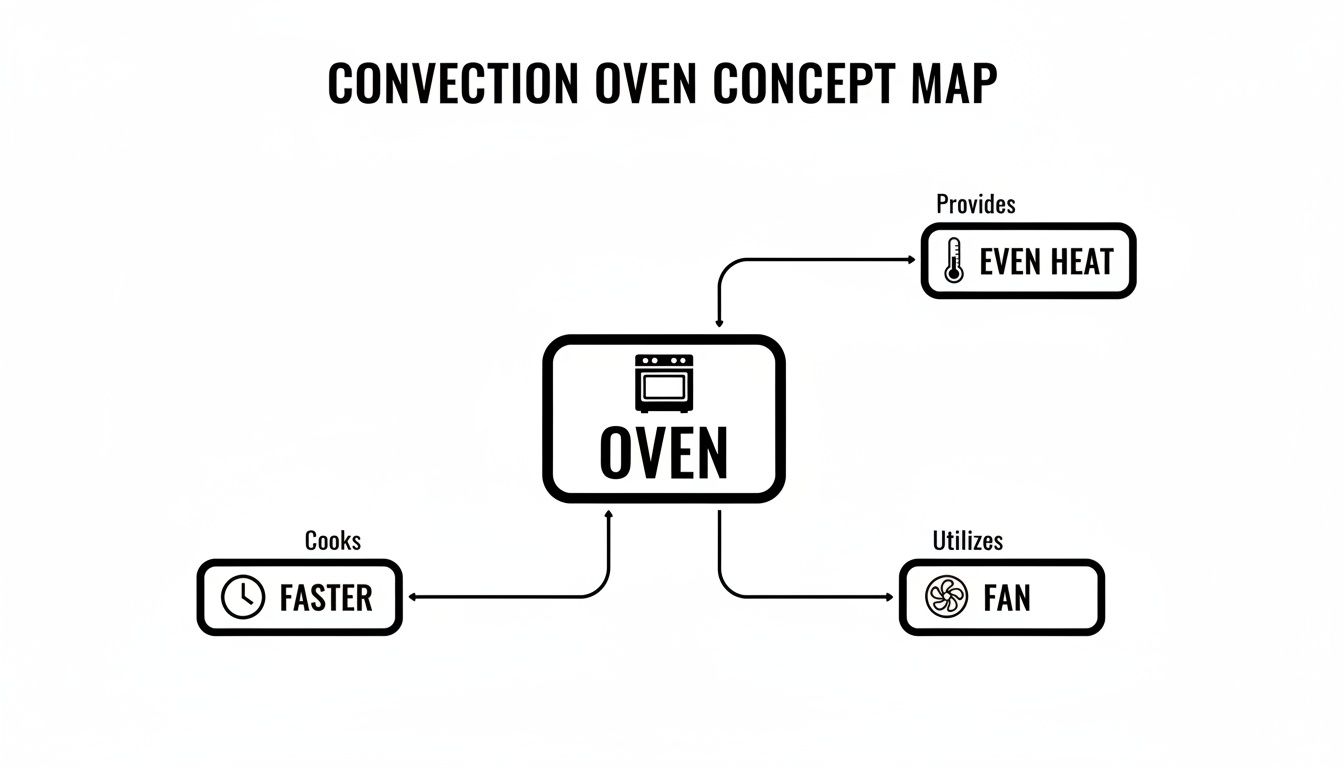
This efficiency isn't just a nice feature—it directly impacts your bottom line by cutting down on food waste and getting orders out to happy customers that much faster.
The Impact on Commercial Kitchens
This technology has been the backbone of efficient kitchens for decades. Convection ovens cook food anywhere from 25-35% faster than their conventional cousins. For any high-volume Washington restaurant, that's a massive advantage. We're talking about pizzerias with slammed pizza prep tables and food trucks where every single second counts.
That speed, combined with energy savings that can reach 20-30%, means many operators see a return on their investment in less than a year just from lower utility bills and labor costs. Want to dig deeper into the specifics? Check out our full guide comparing convection vs regular ovens.
The results speak for themselves: perfectly browned roasts, pastries that are golden from edge to edge, and crispier crusts on everything from pizza to roasted vegetables. Whether you're running compact undercounter refrigerators or massive commercial freezers, a reliable convection oven is the key to a truly efficient kitchen workflow.
Choosing the Right Type of Convection Oven
Picking the right convection oven isn't a one-size-fits-all deal. The perfect model for your kitchen really depends on matching its size, power, and features to what you actually do day-in and day-out. The needs of a new food truck are wildly different from a high-volume Bellevue restaurant, and your oven should reflect that.
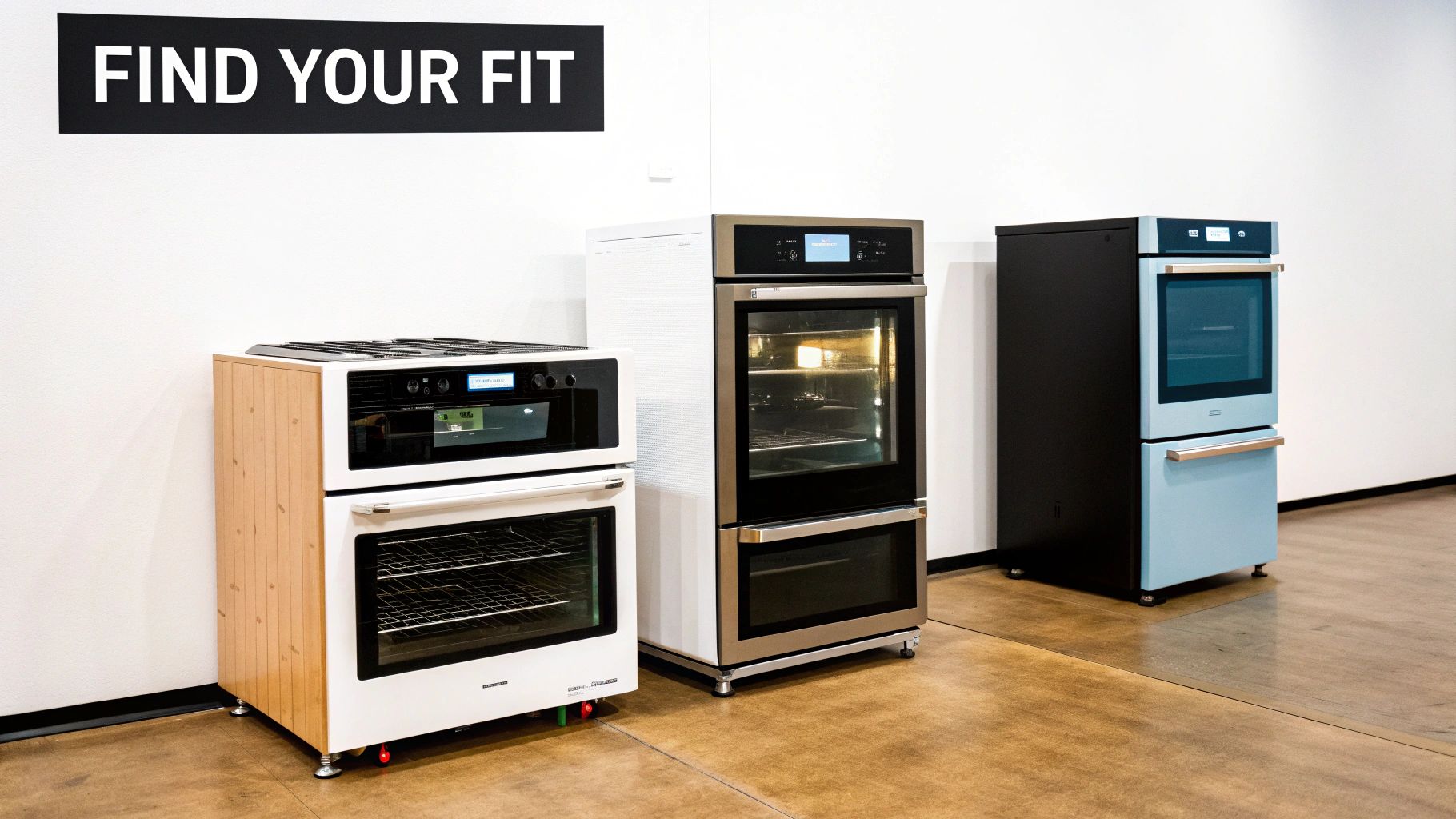
First things first, let's talk size. Commercial convection ovens generally fall into three camps, each built for different kitchens and different jobs.
- Countertop Models: These are the compact champs. They're a lifesaver for businesses squeezed for space, like a food truck, a cozy cafe, or even as a backup oven in a bigger kitchen. They're perfect for knocking out small batches of baked goods or reheating orders on the fly.
- Half-Size Ovens: A step up from the countertop models, these ovens give you more breathing room and flexibility. The best part? You can often stack them, doubling your cooking power without eating up more floor space. It's a smart move for any business that's growing.
- Full-Size Ovens: These are the absolute workhorses of the industry. Built to handle multiple full-size sheet pans at once, they're the backbone of busy bakeries, large-scale restaurants, and catering companies that need to push out serious volume.
Gas Versus Electric Ovens
Once you've settled on the right size, your next big decision is the power source. Both gas and electric have their die-hard fans, and the right choice usually comes down to your kitchen's existing utility hookups and what's on your menu.
A gas convection oven is all about raw power and speed. They preheat incredibly fast and recover temperature quickly, which is why you’ll see them in fast-paced spots like pizzerias where the oven door is constantly opening. Just remember, you'll need a proper gas line and ventilation, so installation is a key part of the equation.
On the other side of the coin, an electric convection oven tends to offer more precise, consistent temperature control. This makes it the go-to for bakeries and coffee shops that need that perfectly even heat for delicate pastries. For installation, you'll need to make sure your electrical setup can handle the voltage and phasing requirements.
Key Takeaway: Think of it this way: Gas ovens bring the heat and speed for high-volume roasting and cooking. Electric ovens deliver the finesse and consistency needed for delicate baking where a perfect, even brown is everything.
Understanding True Convection
If your business lives and dies by the quality of its baked goods, you need to know about true convection. Sometimes called European convection, this technology kicks things up a notch by adding a third heating element right around the fan itself.
This design is a game-changer because it heats the air before it gets blown around the oven, leading to incredibly even heat distribution. It’s a non-negotiable feature for specialty bakeries where the color and texture of a croissant or macaron have to be flawless. It means everything on every rack bakes perfectly, with no frustrating hot spots to worry about.
Making the right call is all about balancing size, power, and technology with your daily workflow. Whether it’s a compact unit for a tight spot or a full-size beast for maximum output, there's an oven built for you. For a deeper dive into smaller units, check out our guide on finding the right commercial countertop convection oven.
Getting to Know Your Oven: Key Features and Installation Needs
Once you’ve settled on the right type and size of convection oven for your kitchen, it's time to dig into the details that truly make a difference in your day-to-day grind. These are the features that separate a decent oven from the one that feels like it was made just for your restaurant.
One of the biggest factors is capacity, which is just a fancy way of asking how many full-size sheet pans it can hold.
A cozy little cafe might get by just fine with a three-rack model. But if you’re running a high-volume bakery, you’ll need an oven that can handle five or more pans at once to keep up. Just picture your busiest Friday night—how much are you trying to cook at the same time? Answering that question will tell you exactly what capacity you need to keep things moving and avoid a dreaded kitchen bottleneck.
Another important spec is the temperature range. Most commercial convection ovens will get you anywhere from 150°F to 550°F, which is plenty for almost any roasting or baking job you can throw at it. The real game-changer, though, often comes down to the controls.
Controls and Power Requirements
The control panel is your oven’s cockpit. It’s where you’ll be pushing buttons and turning dials all day long, and they come in a few different flavors.
- Manual Dials: These are the old-school, tough-as-nails controls for temperature and time. They’re perfect for kitchens with straightforward recipes where a few degrees here or there won't ruin the dish. Simple and reliable.
- Digital Controls: This is a big step up in precision. Digital panels let you lock in exact temperatures and cooking times, which is huge for getting the same great results every single time.
- Programmable Controls: For kitchens that live and die by precision, programmable controls are a must-have. You can pre-load complex, multi-stage cooking cycles. This ensures every croissant or batch of cookies comes out perfectly, no matter who’s running the oven.
Properly matching your oven's electrical needs to your facility's power supply is non-negotiable. An oversight here can lead to performance issues, tripped breakers, or even equipment damage.
Beyond the bells and whistles, you have to get serious about power. Commercial ovens are hungry for electricity, and they typically run on either single-phase or three-phase power. Single-phase is common in smaller operations, but three-phase delivers the stable, efficient power needed for bigger, more demanding equipment.
Not sure what you have? Our team at Seattle Restaurant Equipment can help you figure out what your kitchen in Everett or Renton is wired for, making sure your new oven works perfectly right out of the box.
Installation and Ventilation
Getting your oven installed correctly isn't just a good idea—it's critical for safety and performance. This means getting the ventilation right, especially for gas models, to meet local health and safety codes. A professional setup guarantees your oven is perfectly level, hooked up to utilities the right way, and vented safely.
A proper installation ensures your new oven plays nicely with the rest of your kitchen lineup. Whether it’s a baking workhorse or sitting next to your deep fryers, it needs to fit right in. A well-installed oven works in harmony with your commercial refrigerators, sandwich prep tables, and undercounter freezers to create a kitchen that’s not just efficient, but safe.
Essential Cleaning and Maintenance Tips
Your commercial convection oven is a huge investment. It’s the workhorse of your kitchen, and you need to protect it. Just like any high-performance machine, a little regular care goes a long way.
Consistent maintenance prevents small issues from turning into costly downtime. It keeps your Seattle restaurant or food truck kitchen humming along at peak efficiency.
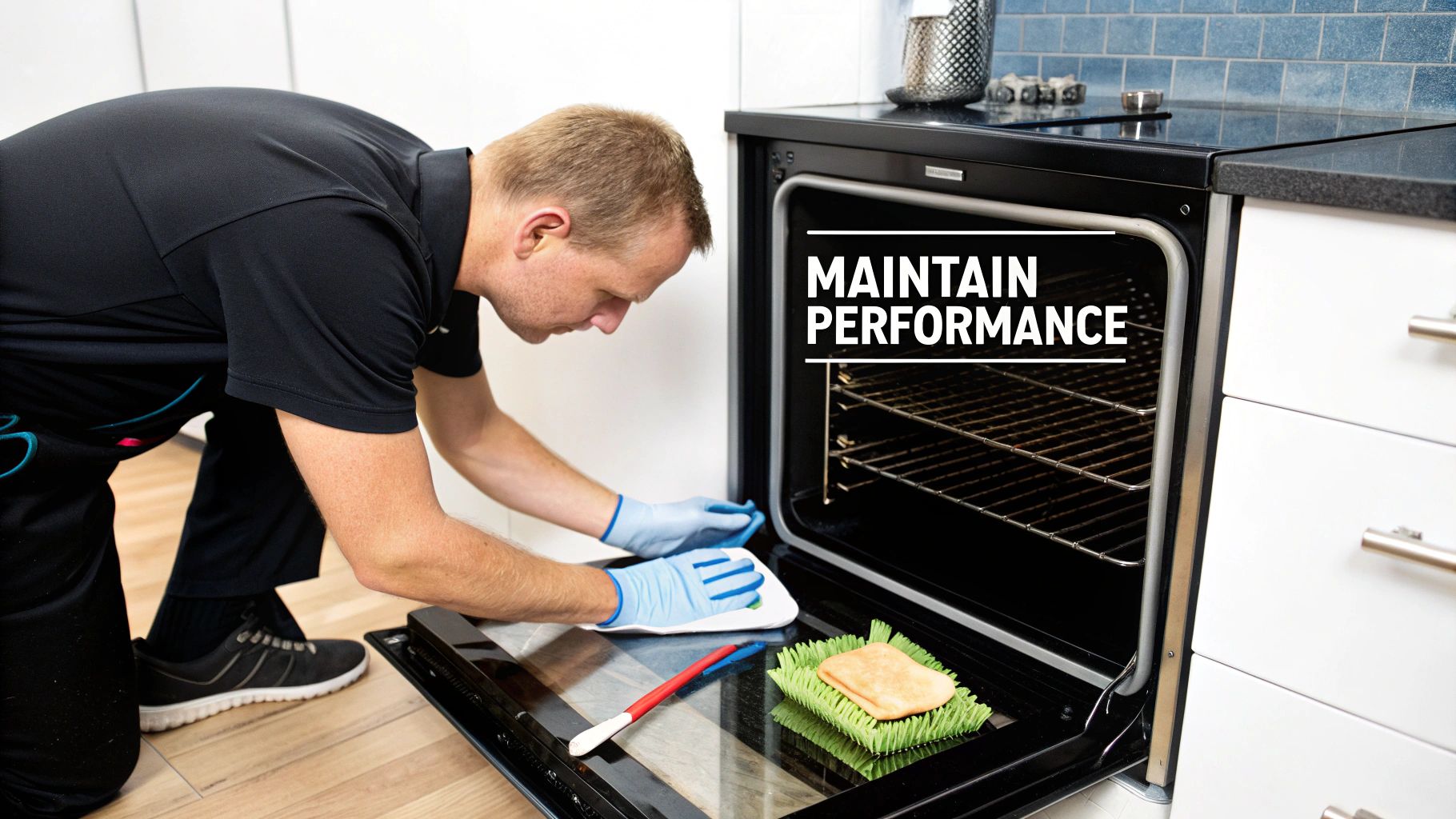
When you let grease and food scraps build up, you’re asking for trouble. That gunk can actually insulate the heating elements and block the fan. This forces the oven to work way harder, which leads to uneven cooking and higher energy bills. Even worse, a heavy grease buildup is a serious fire hazard.
Creating a Cleaning Routine
A structured cleaning schedule is your best defense. If you break the tasks down into daily, weekly, and monthly jobs, keeping your oven in top shape becomes totally manageable—and really effective.
Daily Tasks (5-10 minutes):
- Wipe Down Surfaces: At the end of service, just give the oven door and exterior a quick wipe with a damp cloth. This gets rid of spills and fingerprints before they bake on.
- Clear Debris: Check the oven floor for any large food particles and get them out. This stops them from burning to a crisp during the next service.
Weekly Tasks (20-30 minutes):
- Deep Clean Interior: Once the oven is cool, pull the racks out and wash them separately. Use a food-safe, non-abrasive oven cleaner to scrub the interior walls, floor, and ceiling.
- Inspect and Clean Fan: Gently wipe down the fan blades to get rid of any built-up grease. This simple step ensures the air is flowing evenly for perfect cooking results.
A clean fan is absolutely critical to what makes a convection oven work so well. When grease coats those blades, it throws off the precise air circulation, leading to the very same hot spots you bought a convection oven to avoid in the first place.
Monthly Maintenance Checks
Beyond just cleaning, a quick monthly inspection can help you spot wear and tear before it causes a major breakdown.
First, check the door gasket—that’s the rubber seal around the door. If you see cracks or it feels brittle, heat is escaping. That wastes energy and messes up your cook times.
Next, just listen to your oven. Do you hear any new rattling or grinding noises coming from the fan? That could be a sign of a motor problem.
Finally, if you notice dishes are consistently taking longer to cook or baking unevenly even after you've cleaned the fan, you might have a thermostat issue. Catching these little things early can save you from a complete meltdown in the middle of a busy service.
Why Choose Us for Your Commercial Kitchen Equipment?
Picking the right equipment supplier is just as important as picking the right convection oven. Here at Seattle Restaurant Equipment, we’re not just another vendor. We're a partner to Washington's amazing foodservice scene, from bustling Seattle cafes to Spokane pizzerias and Vancouver food trucks. We get the local challenges you face because we're right here with you.
Our whole business is built to help you succeed. We skip the expensive showrooms and focus on what actually matters: quality equipment and direct support. This simple approach lets us offer better prices on everything you need to build a kitchen that works as hard as you do.
Your Local Partner for Kitchen Success
We stock a huge inventory of the essential gear you need, not just ovens. Whether you're building out a new bar or just upgrading your cooking line, we’ve got you covered with reliable equipment that comes with a real warranty.
Our selection includes:
- Commercial Refrigerators & Freezers: From walk-ins to compact undercounter refrigerators and undercounter freezers.
- Prep Tables: Specialized pizza prep tables and versatile sandwich prep stations.
- Bar & Coffee Shop Essentials: Including Seattle bar equipment and Seattle coffee shop refrigerators.
- Cooking Line Workhorses: High-performance deep fryers, griddles, and ranges built for the daily grind.
The fan-driven convection oven first showed up way back in 1914, a massive leap from the old cast-iron stoves of the 1700s. By 1945, models like the Maxson Whirlwind were cooking food up to 35% faster—a total game-changer for commercial kitchens. It's no wonder that today, over 60% of U.S. professional kitchens count on them, enjoying energy savings of 20-30%. You can learn more about the long history of oven innovations.
We're committed to helping your business thrive. That means providing not just the equipment, but the support, speed, and financing you need to grow and succeed in a competitive market.
We make getting your equipment easy with flexible financing options, and we stand behind everything we sell with solid warranties. Plus, with free 1-2 day shipping to Seattle, Bellevue, and across Washington, you get what you need fast, so you can get back to cooking.
Take a look at our full range of commercial convection ovens available in Seattle and let us help you build a better, more efficient kitchen.
Your Top Convection Oven Questions, Answered
Got questions about commercial convection ovens? You're not alone. Here are some of the most common things we hear from kitchen managers and restaurant owners, with clear, no-nonsense answers.
Do I Need to Adjust My Recipes for a Convection Oven?
Yes, you definitely will. The fan circulating all that hot air is the magic behind a convection oven, but it also means things cook about 25% faster than in a conventional oven. You’ll need to make a couple of simple tweaks to your go-to recipes.
The easiest rule of thumb is to either drop the temperature by 25°F or start checking for doneness when you're about three-quarters of the way through the original cook time. So, if a recipe calls for 40 minutes at 375°F, try setting your convection oven to 350°F and peeking in around the 30-minute mark. Always keep a close eye on things the first time you convert a recipe.
Can I Use a Convection Oven for Any Type of Food?
A convection oven is a true workhorse and handles most cooking tasks beautifully. It's a rockstar for roasting meats, toasting, and getting that perfect golden-brown, crispy finish on things like cookies and pastries.
However, that powerful fan can sometimes be a bit much for really delicate items.
For fragile foods like soufflés, custards, or super-light cakes, the constant airflow can make them cook unevenly or dry out before they have a chance to set properly.
That's exactly why most commercial convection ovens have a setting to turn the fan off. This lets you switch to a standard "conventional" mode when you need it, giving you the best of both worlds in one machine.
Is a Gas or Electric Convection Oven Better for My Restaurant?
That's a fantastic question, and the honest answer is: it completely depends on your kitchen, your menu, and your budget. There’s no single "best" choice, just the right choice for your Seattle business.
- Gas Ovens: These units typically preheat faster and can be cheaper to run over the long haul, which is why they’re a go-to for busy pizzerias with demanding pizza prep tables.
- Electric Ovens: These models are known for delivering incredibly precise and even heat. This makes them ideal for bakeries and shops using Seattle coffee shop refrigerators that need picture-perfect results every time.
Our team at Seattle Restaurant Equipment can walk you through the pros and cons for your specific situation. We'll look at your utility hookups, your menu, and your workflow to find the most efficient and cost-effective fit. A great convection oven is a cornerstone of your kitchen, working right alongside your commercial refrigerators, sandwich prep tables, and deep fryers to keep things running smoothly.
At Seattle Restaurant Equipment, we provide the high-quality, reliable equipment you need to build a successful kitchen. Explore our full range of commercial ovens and kitchen supplies at https://seattlerestaurantequipment.com.