

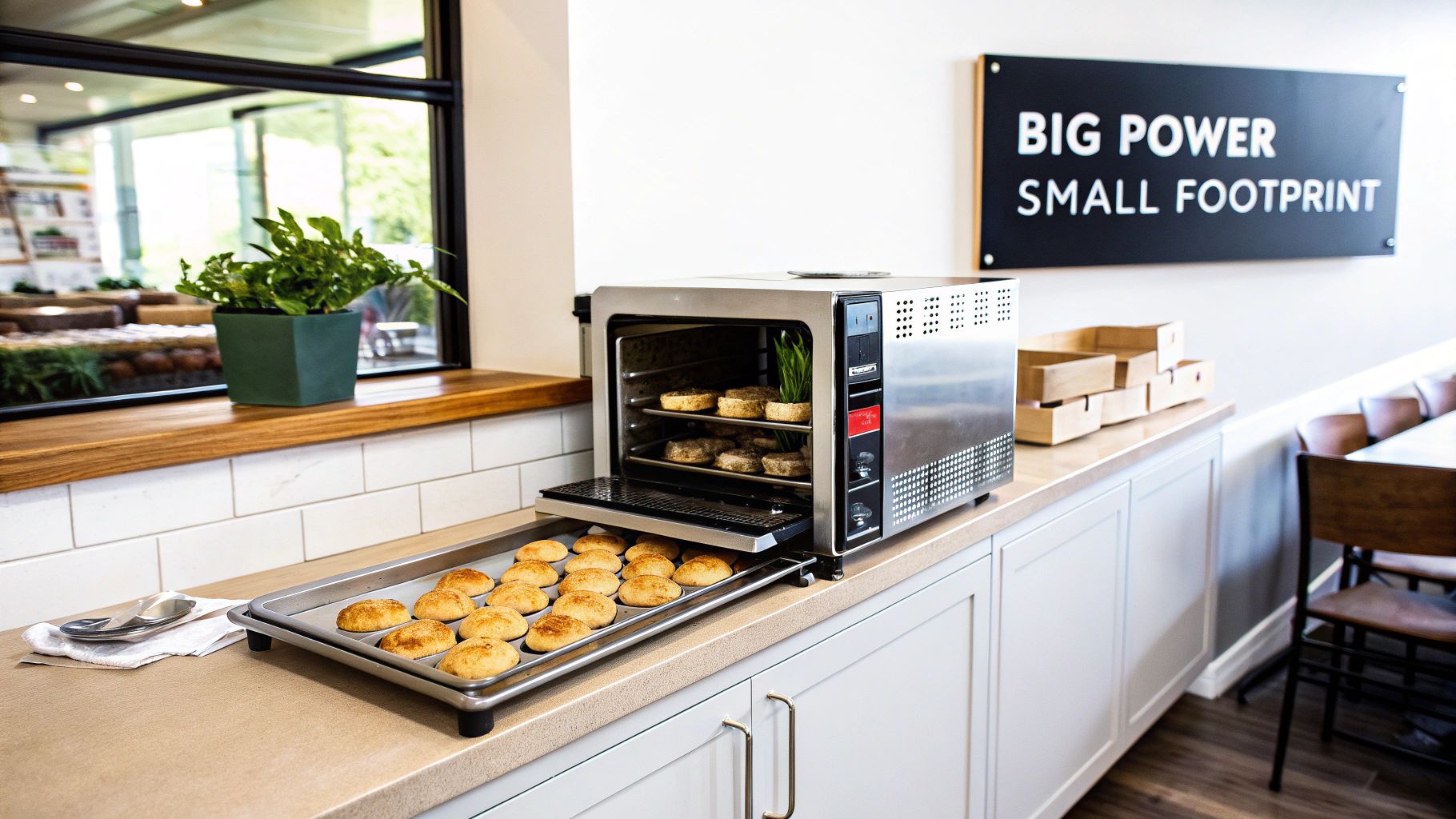
Picture this: the raw power of a full-size commercial oven, but shrunk down into a compact, hyper-efficient unit that fits right on your counter. That’s exactly what you get with commercial countertop convection ovens. For any busy Washington kitchen where every square inch of counter space is prime real estate, these ovens are a secret weapon.
Why Countertop Ovens Are a Kitchen Game Changer
Think of it like swapping a big, clumsy sedan for a nimble sports car. You get all the performance you need in a much smaller, more agile package. This is a huge deal for a bustling Seattle coffee shop, a cramped Tacoma food truck, or a stylish Bellevue bar.
This small footprint means you can suddenly expand your menu—think fresh-baked pastries, roasted chicken, or perfectly finished appetizers—without ripping out your existing kitchen layout. Being able to add that much cooking power without sacrificing precious prep space is a massive win for any operator.
Let’s dive into what makes these workhorse appliances so valuable and how they can seriously boost your efficiency and bottom line.
Unlocking Menu Potential and Profitability
A commercial countertop convection oven is so much more than just another piece of equipment; it's a direct path to growth. It gives you the power to diversify your menu, which is absolutely critical for staying ahead of the competition. Instead of relying on pre-made cold items or outsourcing your baked goods, you can bring that production—and that profit—in-house.
- Seattle Coffee Shops: Imagine adding a profitable line of fresh-baked scones, muffins, and breakfast sandwiches to go with your Seattle coffee shop refrigerators. Your average ticket price will thank you.
- Bars and Breweries: You can easily move beyond the deep fryers and offer killer flatbreads, toasted sandwiches, and baked wings. This is the perfect complement to your existing Seattle bar equipment.
- Delis and Sandwich Shops: This is how you perfect your hot sandwich game. Position the oven next to your sandwich prep tables and under counter refrigerators for that perfectly melted cheese and crispy toasted bread every single time.
By adding just one piece of equipment, you can literally create several new streams of revenue. The ROI isn't just about the oven's cooking efficiency; it's about all the new menu items you can now sell.
Integrating with Your Existing Kitchen Flow
One of the best things about these ovens is how easily they slide into your current kitchen workflow. They aren't meant to be standalone islands; they’re designed to be part of a smooth, efficient workstation.
For example, placing one right next to your commercial refrigerators or commercial freezers creates a seamless path from cold storage to finished product. This simple setup cuts down on how much your staff has to run around, which means faster ticket times—a lifesaver during the dinner rush. You can get a deeper look at the core technology in our guide explaining what is a convection oven and how it all works.
This kind of synergy works everywhere. A pizzeria can use it to finish pasta bakes or toast appetizers, adding capacity without messing with the flow around their main pizza prep tables. Whether your kitchen relies on under counter freezers or massive walk-ins, this little oven becomes a flexible, powerful tool for finishing, baking, and roasting just about anything.
How Convection Technology Delivers Perfect Results
So, what's the magic behind a countertop convection oven's speed and consistency? It’s actually pretty simple: moving air. A regular oven just sits there, cooking with static heat. A convection oven, on the other hand, has a fan inside that actively pushes hot air all around the cooking chamber.
Think about the difference between a still, hot day and one with a nice breeze. The breeze makes everything feel hotter and dry things out faster, right? That’s exactly what's happening inside your oven. This constant, forced airflow is the real secret to better cooking in a professional kitchen.
Eliminating Hot and Cold Spots
You know how in a traditional oven, the back corner gets scorching hot while the front stays lukewarm? That’s because the heat just rises from the bottom, creating uneven pockets of air. This leads to endless frustration—burnt cookies in the back, raw ones in the front. A convection fan totally solves this.
By keeping the air moving, it gets rid of those hot and cold spots, creating a perfectly uniform cooking environment. Every single item on every rack gets hit with the same amount of heat. Whether you're baking delicate pastries or roasting a chicken, everything cooks evenly from edge to center. For any food business, that kind of reliability is a game-changer.
This technology also means you can cook at a lower temperature, usually about 25 degrees less, and still get things done faster. Not only does this save on your energy bill, but it also helps meats and poultry hold onto their moisture, giving you a juicier, more flavorful final product.
A huge plus of this even heat is better yield. Meats cooked in a convection oven shrink less. The fat renders and the skin browns more quickly, which seals in all those juices. The end result is more product you can actually sell.
Achieving Superior Browning and Crisping
That perfect golden-brown crust on bread or the crispy skin on a roast chicken? You can thank convection for that. The moving air speeds up the Maillard reaction, which is the chemical process that creates all that delicious browning and complex flavor.
As the fan blows hot air over the food, it whisks away the cool, moist air that naturally forms around it. This lets the surface dry out quicker, which leads to faster, more even browning and that amazing crisp texture. If you want to get deeper into the science, check out our article comparing convection vs regular ovens.
This is exactly why these countertop convection ovens are a must-have for businesses that depend on a perfect finish.
- Coffee Shops & Bakeries: Get that ideal crispiness on croissants and a beautiful, even color on your muffins, every single time.
- Bars & Pubs: Crisp up appetizers like chicken wings and potato skins without needing a deep fryer, letting you add more variety to your bar menu.
- Delis & Pizzerias: Perfectly toast sandwiches and finish off pasta bakes with beautifully melted cheese and crisp bread, complementing your sandwich and pizza prep tables.
At the end of the day, the fan in a countertop convection oven does way more than just heat things up. It actively manages the cooking process to give you faster, more consistent, and higher-quality food, making it an essential tool for any kitchen trying to boost output and keep customers happy.
Evaluating the Key Features for Your Business Needs
Picking the right commercial countertop convection oven isn't about finding the "best" one on the market. It's about finding the right one for your kitchen. Think of it like grabbing a tool from a toolbox; you wouldn't use a sledgehammer to hang a picture. The features you need should line up perfectly with your menu, your space, and how your team works day-to-day.
Let's break down the specs that really matter. This is your guide to making a smart investment that pays off, whether you're running a busy Seattle coffee shop or a growing Kent food truck. Every feature we cover hits your bottom line, from cooking consistency to your monthly utility bills.
This visual decision tree is a great starting point, showing the basic choice between oven types based on what you cook most often.
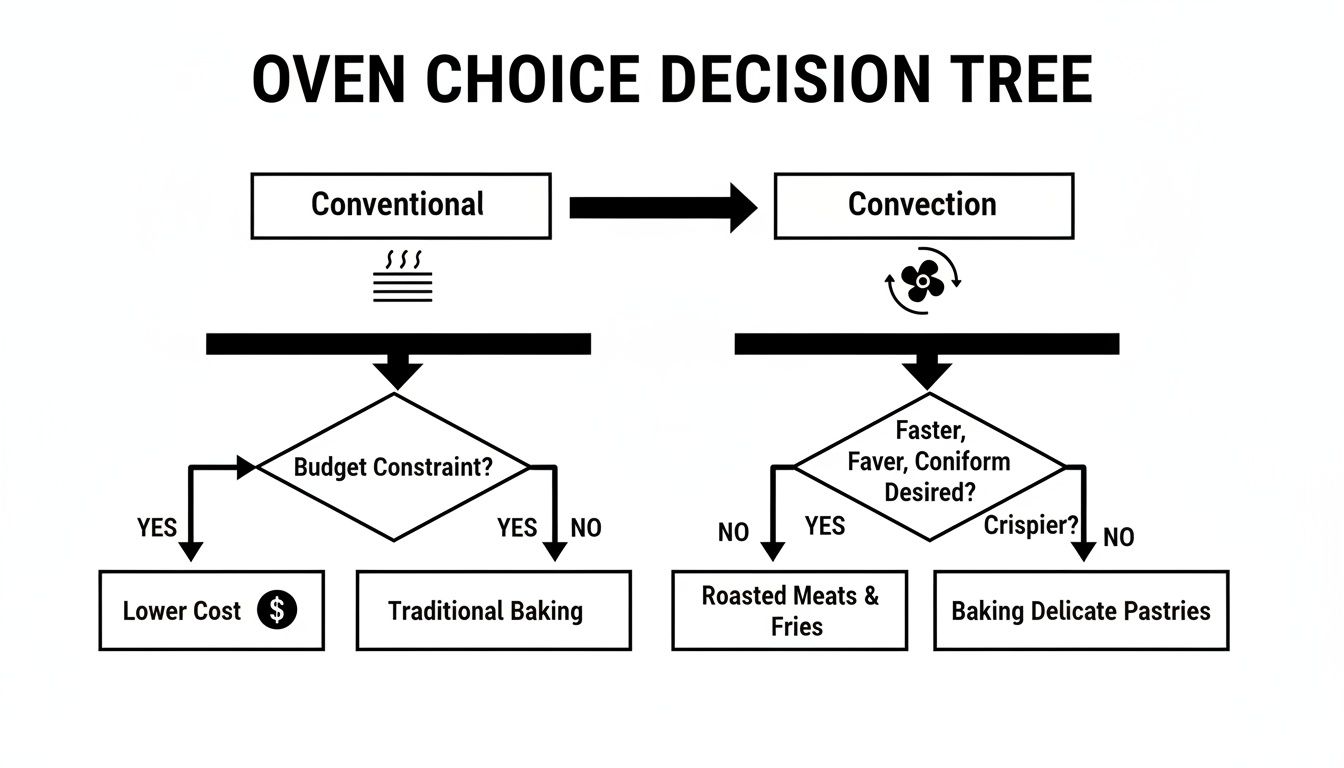
The main thing to remember is that convection—with its circulating fan—is all about speed and even results. In a commercial kitchen, that’s gold.
Size Footprint and Pan Capacity
The first two questions any operator needs to ask are simple: "Where will it fit?" and "How much can it cook?" A countertop convection oven is built for smaller spots, but you still have to measure your counter's depth and width. Don't forget to leave enough room around it for proper ventilation.
Capacity is all about sheet pans. It's that simple.
- Quarter-Size Ovens: These are your most compact options. They're perfect for tight squeezes like food trucks or small cafes. You'll use them for reheating, finishing off appetizers, or baking a few cookies at a time.
- Half-Size Ovens: This is the crowd favorite and for good reason. A half-size oven gives you a serious capacity boost, fitting standard 18" x 13" half-sheet pans. It's the workhorse for most bakeries, delis, and restaurants.
Think about how this new oven will fit into your kitchen's flow. Placing a half-size model next to your sandwich prep tables or pizza prep tables creates a super-efficient station for finishing orders. Having it close to your under counter refrigerators and under counter freezers also shaves precious seconds off every ticket.
Gas vs. Electric Power Sources
What your kitchen is already set up for will probably make this decision for you. Both gas and electric countertop convection ovens cook beautifully, but they come with different perks and requirements.
This table breaks down the key differences to help you decide which power source makes the most sense for your operation.
Comparing Electric vs Gas Countertop Ovens
| Feature | Electric Ovens | Gas Ovens | Best For |
|---|---|---|---|
| Installation | Simple plug-and-play setup | Requires professional gas line connection | Electric is best for mobile setups or kitchens without gas lines. |
| Heating | Exceptionally even and consistent heat | Heats up very quickly and recovers temperature fast | Electric is great for delicate baking; Gas is ideal for high-volume roasting. |
| Operating Cost | Can be higher depending on local electricity rates | Often lower long-term operating costs | Gas may be more economical for kitchens that run the oven all day. |
| Ventilation | Some ventless models are available | Almost always requires a ventilation hood | Check local codes, but electric offers more flexibility. |
Ultimately, Electric Ovens are often much easier to install—just find the right outlet. This makes them the obvious choice for food trucks, pop-ups, and kitchens where adding a gas line is a non-starter. They also provide incredibly even heat, which is a dream for delicate pastries and baked goods.
Gas Ovens, on the other hand, tend to heat up faster and can have lower operating costs over time, depending on your local utility prices. They are a favorite in high-volume kitchens because they recover temperature so quickly after the door is opened. Just remember, they require a professional gas line hookup and usually still need electricity for the fan and controls.
A critical note on ventilation: Gas ovens almost always need a proper ventilation hood to get rid of combustion fumes safely. While some ventless electric models exist, you must always check with your local Washington health department for compliance before you buy anything.
Manual Dials vs. Digital Controls
How your staff uses the oven is another big piece of the puzzle. The choice between simple knobs and a digital screen often comes down to your menu and your team's experience level.
Manual Dials: These are the definition of simple and sturdy. With knobs for temperature and time, they're practically bulletproof and require almost no training. This makes them perfect for straightforward tasks where absolute precision isn't critical, like reheating or simple roasting. Imagine a busy bar kitchen using it to finish appetizers alongside their deep fryers.
Digital Controls: If you need pinpoint accuracy, digital controls are a must. For a Bellevue bakery or a high-end cafe, they are non-negotiable. They let you set exact temperatures and program cooking cycles, ensuring a recipe comes out perfectly every single time, no matter who's on shift. Many models can even store dozens of recipes, making consistency a breeze.
The move toward digital controls and energy-efficient designs is a huge benefit for smaller food businesses. In fact, the convection ovens market is expected to grow from USD 4.8 billion to USD 8.2 billion by 2033, mostly because operators want smarter, more versatile kitchen equipment. This trend includes ovens with cool features like air frying, which can add a ton of new items to your menu. You can read more about where the market is headed in this convection ovens market analysis.
How Washington Restaurants are Cashing In
Let's move past the technical talk and get down to brass tacks. The real magic of a commercial countertop convection oven isn't found on a spec sheet—it's in how it solves everyday problems for busy Washington food operators. From a packed Seattle coffee shop to a bustling Everett food truck, this piece of gear is quietly making businesses more money and simplifying their operations.
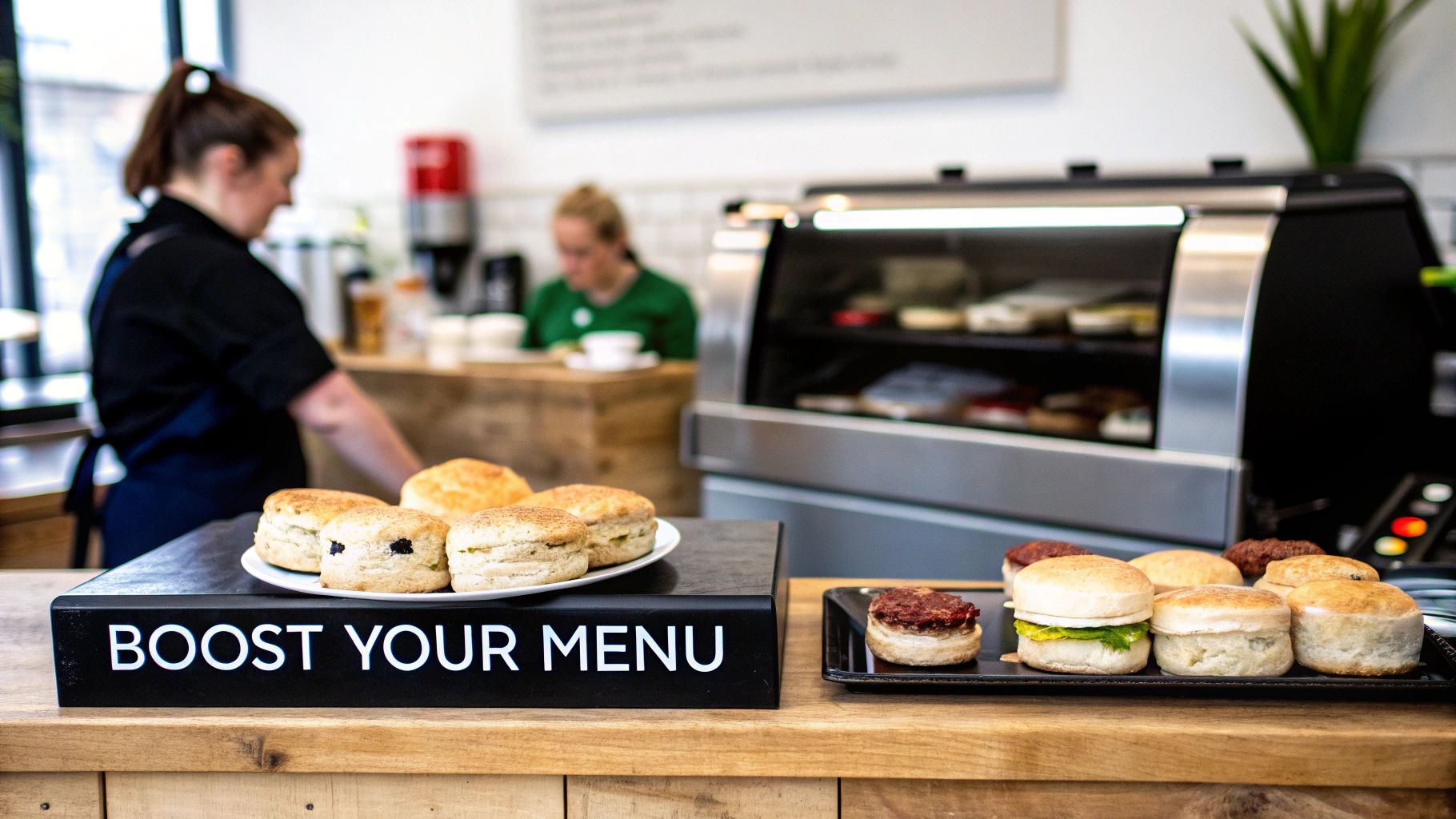
Think of these ovens not just as a purchase, but as a strategic move. Their small footprint and incredible speed let you do more with less space, which is a massive advantage when every square foot of your kitchen counts.
The Seattle Coffee Shop Turnaround
Picture a small, independent coffee shop on Capitol Hill. They're making most of their money on drinks, slinging espresso shots and steaming milk next to their Seattle coffee shop refrigerators. The food menu? Just a few pre-packaged pastries with razor-thin profit margins. It's uninspired, to say the least.
Then, they add a half-size countertop convection oven. Everything changes.
Suddenly, they're baking their own scones, muffins, and warm breakfast sandwiches right there in the shop. The smell of fresh baking alone pulls people in off the street, and the new, higher-margin food items give their average ticket a serious boost. That single piece of equipment just turned them from a simple coffee stop into a must-visit morning spot.
Making an Everett Food Truck Faster
Now, let's head up to Everett and imagine a popular food truck slammed with a lunch rush. Space is at a premium, and speed is the name of the game. They build their tacos and bowls with proteins that were cooked hours ago.
They manage to squeeze a quarter-size countertop convection oven onto their line. Now, they can roast fresh chicken, carnitas, and vegetables right on the truck. The quality and freshness of their food goes through the roof, instantly setting them apart from the competition. And because the oven is so fast, it easily keeps up with the rush. No customer waits any longer than they have to.
This ability to roast on-demand lets a food truck serve a much better product without slowing down service one bit. The fan-forced, even heat guarantees perfectly juicy, evenly cooked proteins every single time—a level of consistency that’s nearly impossible to get with other compact cooking gear.
It's no surprise that commercial kitchens have adopted this technology so widely. The professional sector is the undisputed king of the countertop oven market, making up a whopping 74.9% of all revenue in 2023. That number tells you just how vital these ovens have become for kitchens trying to get a leg up. You can learn more about the growth of the countertop oven market and see for yourself.
Beefing Up Menus in Renton and Beyond
The beauty of these ovens is their versatility. Every type of restaurant finds a different way to put one to work, but the goal is always the same: add more to the menu without having to rip out the entire kitchen.
Here are a few more real-world examples:
- A Renton Pizzeria: Their main deck oven is all about the pies. By tucking a countertop unit next to their pizza prep tables, they can now bang out perfectly finished pasta bakes, toasted subs, and garlic bread without messing up the pizza workflow. That simple addition opens them up to a whole new customer base.
- A Tacoma Bar: To keep up with the gastropubs, a local watering hole needs better food than what their deep fryers can handle. A countertop oven lets them roll out a killer menu of flatbreads, baked wings, and nachos, which fits right in with their existing Seattle bar equipment and drives up food sales.
- A Bellevue Deli: This spot uses its oven right next to the sandwich prep tables to create incredible hot sandwiches. The circulating air melts cheese perfectly and gives the bread that ideal crispiness, turning a basic sandwich into a premium item they can charge more for.
In every one of these cases, the commercial countertop convection oven is the hero. It gives businesses the power to adapt, innovate, and grow by making the absolute most of the space and resources they already have. Whether you're baking, roasting, finishing, or just reheating, the possibilities are as diverse as the Washington restaurants putting them to work.
Building Your Complete Kitchen Workstation
A commercial countertop convection oven is a powerful tool, no doubt. But its real magic happens when it's part of a complete, efficient workstation. This isn't just about plugging in a new appliance; it's about making your entire kitchen flow better. By pairing your oven with the right equipment from Seattle Restaurant Equipment, you can build a seamless production line that saves time, cuts down on wasted steps, and cranks up your output.
Think of it like building a high-performance engine. The oven is a key part, but it needs to be perfectly connected to everything else to really roar. That kind of synergy turns a kitchen from a simple collection of tools into a fine-tuned system built for productivity.
Creating the Perfect Sandwich and Salad Station
For delis, cafes, and restaurants, the sandwich and salad line is the heart of the lunch rush. Dropping a countertop convection oven right into this station is a game-changer. Picture your oven sitting right next to one of our stainless steel sandwich prep tables. Now you've got an incredibly slick workflow for hot sandwiches, paninis, and toasted subs.
Your staff can pull cold ingredients from the refrigerated rail, assemble the sandwich, and slide it just a few inches over to the oven for toasting. From there, it goes to the finishing station. Everything happens in one tight, efficient space.
To really complete this setup, an under counter refrigerator or under counter freezer is a must. Tucking one of these units directly beneath the prep table gives your crew instant access to backup ingredients, from extra meats and cheeses to frozen bread. No more time-killing trips to the walk-in cooler. This keeps the line pumping at full speed, even when things get crazy.
The Pizzeria and Appetizer Powerhouse
Pizzerias can get a massive boost from a countertop convection oven, too. While your big deck oven is busy firing pies, a smaller convection unit can become your dedicated station for appetizers and sides. This frees up your main oven for its most important job and smashes any potential bottlenecks.
Imagine a setup like this:
- Pizza Prep Tables: Your crew is here, slinging pizzas and prepping items like calzones and strombolis.
- Countertop Convection Oven: Positioned just feet away, this oven is perfect for finishing off baked pasta dishes, toasting up garlic bread, or getting those chicken wings perfectly crispy.
- Deep Fryers: For a truly killer menu, adding a deep fryer to the same area lets you offer classics like fries and mozzarella sticks, creating a complete appetizer command center.
This kind of arrangement allows you to expand your menu without having to rip up your whole kitchen. Our detailed guide on setting up a commercial kitchen has even more ideas for optimizing your space.
Supporting Your Entire Operation
Beyond specific stations, your countertop convection oven needs a solid support system. It all starts with reliable cold storage. Our range of commercial refrigerators and commercial freezers makes sure every ingredient—from fresh produce you plan to roast to frozen pastries ready for baking—is stored safely and is easy to grab. That’s the true backbone of any kitchen that runs like a well-oiled machine.
There's a reason the market for these compact ovens is booming. As of this year, the global commercial countertop convection oven market was valued at around USD 2.51 billion. And it's not slowing down; experts predict it will hit USD 3.5 billion by 2035. That's a clear signal that more and more businesses are catching on to the value of compact, high-efficiency cooking. By thoughtfully combining your oven with the right gear, you're not just buying equipment—you're building a kitchen designed for profit.
Frequently Asked Questions About Countertop Ovens
Investing in a new commercial countertop convection oven is a big step, and it's totally normal to have questions. Getting straight answers is the only way to make a smart purchase that actually helps your kitchen's flow and your bottom line.
Here are the most common questions we get from restaurant operators right here in Washington.
Do I Need a Special Ventilation Hood for This Oven?
This is one of the most important questions, and the answer really depends on your oven's power source and, crucially, your local health codes. As a general rule, gas-powered ovens almost always require a professional ventilation hood to get rid of combustion fumes safely.
Many electric models, on the other hand, are designed to be "ventless." This makes them a great, flexible option if installing a full hood system is out of the question. But—and this is a big but—you must always confirm with your local Washington health department before you buy anything. They have the final say on what you need to stay safe and compliant.
What Kind of Electrical Outlet Will I Need?
Don't gloss over the power requirements. While some smaller, quarter-size countertop ovens might plug into a standard 120V outlet, most of the more powerful half-size models need a dedicated 208/240V connection. This is the same heavy-duty outlet you'd use for a big commercial fridge or deep fryer.
Before you even think about buying, dig into the product's spec sheet to find its voltage and amperage. We always tell our customers to talk to a licensed electrician first. It’s a simple step that ensures your kitchen’s wiring can handle the new oven, preventing major headaches and surprise costs down the road.
How Do I Clean and Maintain My Commercial Oven?
Good maintenance is the secret to getting a long, productive life out of your oven. Keeping it clean prevents performance issues and is non-negotiable for food safety.
Here’s a simple checklist to follow:
- Daily: Wipe down the inside to get rid of any spills and crumbs. Clean the glass door so you can see what’s cooking without letting all the heat out.
- Weekly: Pull the racks out and give them a good soak in a commercial-grade degreaser. Do a deep clean of the interior, especially the corners where grease loves to hide.
- Monthly: Take a look at the fan to make sure nothing is blocking it. Check the door gaskets to ensure you have a tight seal, which stops heat from escaping.
A little bit of consistent care keeps your oven running like a champ and protects your investment.
A well-maintained oven not only cooks better but also uses less energy. A clean fan circulates air more effectively, and a tight door seal means the oven doesn’t have to work as hard to maintain its temperature, saving you money on utility bills.
Can I Just Use a Residential Oven in My Cafe?
Absolutely not. Putting a home oven in a commercial kitchen is a huge mistake for a few big reasons. First, it’s a direct violation of health and safety codes and it will fail inspection, guaranteed. Residential appliances don't have the NSF certification that's required for any foodservice business.
Second, they just aren't built for the grind of a commercial kitchen. A home oven will break down fast under the constant use of a busy service. Lastly, using a residential model for your business instantly voids its warranty, leaving you high and dry when it inevitably fails. A commercial-grade unit is the only real choice for your operation.
Ready to build a more efficient and profitable kitchen? Seattle Restaurant Equipment has the commercial countertop convection ovens and supporting gear—from under counter freezers to pizza prep tables—to get your workflow dialed in. Check out our full catalog and get free, fast shipping anywhere in Washington.