

Ever find yourself in a kitchen space where running traditional ductwork is a non-starter? Maybe it's a historic building in Pioneer Square, a high-rise downtown, or even a nimble food cart. This is where a commercial ventless hood becomes your best friend.
Think of it as a powerful, self-contained air purification system made specifically for the realities of a commercial kitchen. Instead of punching a massive, expensive hole through your roof or wall, this technology grabs all the smoke, grease, and cooking fumes right at the source. It then runs them through a sophisticated, multi-stage filtration process before sending clean, breathable air right back into your kitchen.
For many Washington food businesses, this isn't just a convenience—it's what makes their concept possible. It opens up locations that were previously off-limits due to venting restrictions.
How Does it Actually Clean the Air?
The real magic of a ventless hood is in its layered defense against kitchen emissions. It's like having a highly specialized security team for your air quality, where each filter has a specific job. The system methodically strips contaminants from the air in a sequence designed for maximum effectiveness.
This diagram shows the typical three-step process in action.
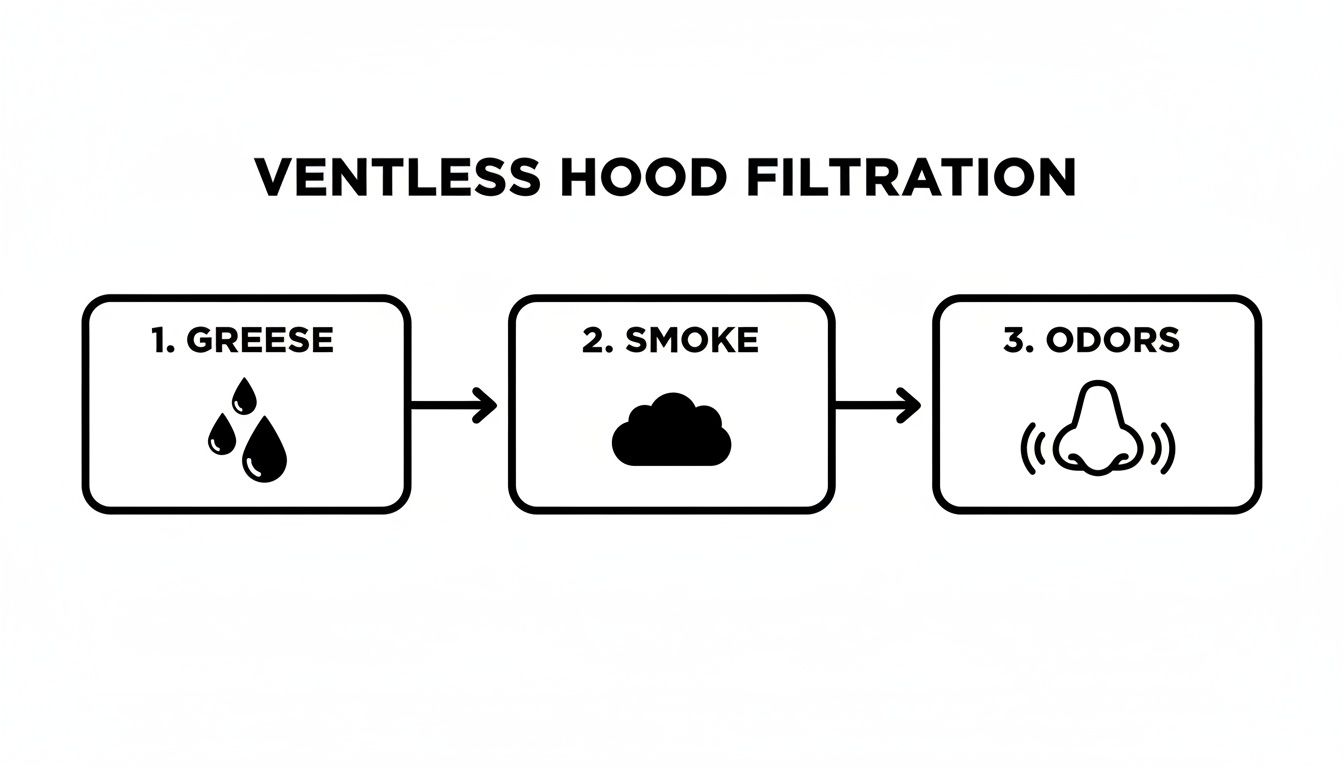
As you can see, the system first tackles the heavy grease particles, then goes after the fine smoke, and finally neutralizes any stubborn odors. This ensures only clean air is returned to your kitchen.
Let's break down each stage:
- Grease Capture: The first line of defense is usually a set of baffle filters. These stainless steel grids are designed to trap the heavy, greasy vapor coming off equipment like deep fryers. By catching the grease first, the system keeps the more sensitive filters downstream from getting clogged up and failing.
- Smoke and Particulate Removal: Next, the air moves through a finer filter, often an electrostatic precipitator or another type of advanced media. This stage uses an electrical charge to zap the tiny smoke and oil droplets that snuck past the first filter, clearing that visible haze from the air.
- Odor Elimination: The final step involves activated carbon filters. These filters are incredibly porous and act like a giant sponge, absorbing and neutralizing any lingering cooking smells before the air is sent back out.
For a quick breakdown, here’s how ventless and traditional hoods stack up for busy Washington operators.
Ventless Hoods vs Traditional Vented Hoods at a Glance
| Feature | Commercial Ventless Hood | Traditional Vented Hood |
|---|---|---|
| Installation | Simple "plug-and-play." No ductwork needed, saving time and money. | Complex and costly. Requires roof/wall penetration and extensive ducting. |
| Location Flexibility | Extremely high. Can be used in historic buildings, basements, and mobile setups. | Limited by building structure. Cannot be used where ducting is impossible. |
| Upfront Cost | Hood unit may be more expensive, but overall cost is often lower without ductwork. | Hood unit may be cheaper, but installation and ductwork can be very expensive. |
| Maintenance | Requires regular filter cleaning and replacement, which is a recurring operational cost. | Requires professional duct cleaning to prevent fire hazards and ensure airflow. |
Ultimately, the choice comes down to your specific location, budget, and operational needs.
A Smart Solution for a Growing Market
The demand for this kind of flexible kitchen tech is absolutely booming. The global ventless hood systems market recently hit a valuation of $2.1 billion and is projected to more than double to $4.3 billion by 2033. That’s a powerful compound annual growth rate (CAGR) of 8.2%.
Right now, North America accounts for a massive 38% of the total market value. This is driven by our mature food industry, strict kitchen safety codes, and the explosion of quick-service restaurants and food trucks that depend on the easy installation ventless tech provides. You can read the full research about the ventless hood systems market and its growth for a deeper dive.
Unlocking Your Kitchen's Potential with Ventless Technology
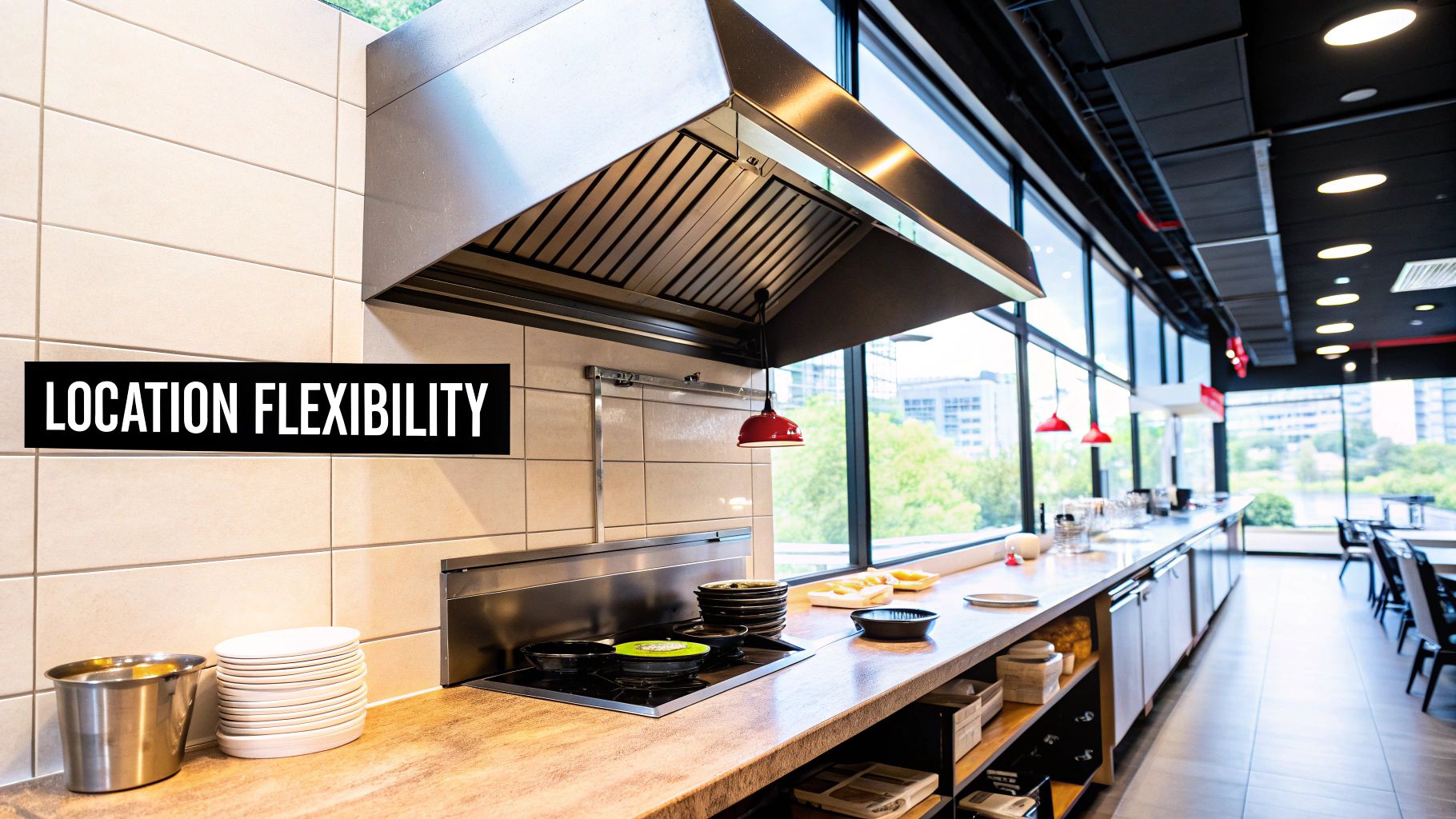
Choosing a commercial ventless hood isn't just about finding an alternative to traditional venting. It's a strategic move that can completely reshape your business, starting with some serious upfront cost savings. A conventional vented hood kicks off a chain reaction of expensive work: duct installation, major changes to your building's structure, and fighting through a maze of permits.
By sidestepping all that, ventless technology opens up a whole new world of location possibilities. Suddenly, that prime spot in a downtown Seattle office building is a real option for your café. You can set up a pop-up in a Bellevue retail space or outfit a food truck in Everett where running ductwork is simply out of the question. For Washington entrepreneurs, that kind of flexibility is a true game-changer.
Boosting Efficiency and Menu Flexibility
The savings don't stop after installation. A commercial ventless hood helps lower your day-to-day operational costs. Instead of just dumping your kitchen's heated or cooled air outside, these systems scrub it clean and send it right back into the room. This takes a huge load off your HVAC system, which you'll see reflected in lower monthly energy bills—a welcome sight for any business owner.
This efficiency also gives you incredible menu flexibility. Imagine wanting to add a deep fryer to meet customer demand without tearing your kitchen apart for a costly overhaul. A ventless system makes it happen, letting you adapt your menu on the fly.
Ventless hoods empower operators to place cooking equipment where it makes the most operational sense, not just where the ducts happen to be. This unlocks tremendous freedom in kitchen design and can drastically lower buildout costs.
This strategic placement is key. You can position your new cooking station right next to your existing sandwich prep tables or commercial refrigerators to create a workflow that just makes sense. To get a better handle on planning your space, take a look at our in-depth guide to restaurant kitchen layout design.
Seamless Integration with Your Equipment
There's a common myth that going ventless limits your choice of equipment. The truth is, modern systems are built to work with a huge range of electric appliances, letting you create a powerful, compact cooking line.
This opens the door to creating specialized stations that might have been impossible before.
- Coffee Shop & Bar Expansion: Easily add a small oven or cooktop to your Seattle coffee shop or bar. This setup fits perfectly next to your Seattle bar equipment or under counter refrigerators, letting you introduce a hot food menu without a major renovation.
- Specialty Food Stations: Build a dedicated station for a high-demand item. You can place a ventless hood over a fryer next to your pizza prep tables or under counter freezers, streamlining your production line for faster service.
- Optimized Cold and Hot Lines: Position your ventless cooking equipment directly adjacent to your cold storage, like commercial freezers and Seattle coffee shop refrigerators, to minimize steps for your staff and improve ticket times.
On top of that, many commercial ventless hoods come with their own integrated fire suppression systems. This gives you a critical layer of safety right out of the box, protecting the specific appliances underneath and offering peace of mind as you build or expand your dream kitchen.
Navigating Washington State and Local Compliance Codes
Before you even think about adding a commercial ventless hood to your cart, there's a critical first step. It can make or break your entire project: understanding the local codes. Here in Washington, from Seattle to Spokane, these regulations aren't just a suggestion. They're the very foundation of a legal and safe kitchen.
Think of it like building a house—you wouldn't start without a blueprint. In this case, compliance is your blueprint. Get it right, and your installation will go smoothly.
Your Most Important Contact: The AHJ
The whole process really boils down to your relationship with one key person: the Authority Having Jurisdiction, or AHJ. This isn't a single person but a title for the local official in charge of approvals. It's usually the fire marshal or a building code inspector. They have the final say on what's allowed in your specific spot, whether you're running a pizzeria in Kent or a bar in Tacoma.
The golden rule here is incredibly simple: talk to your AHJ before you buy anything. This one conversation can save you thousands of dollars and a world of headaches by making sure the system you want will actually get approved.
Decoding Key Certifications
When you show your AHJ the spec sheet for a ventless hood, their eyes will immediately scan for a few important logos. These certifications are like a universal language for safety and performance. They tell inspectors that the equipment has been put through its paces by a third party and meets tough national standards.
Here are the big ones you'll see:
- UL (Underwriters Laboratories): This is a non-negotiable safety certification. A UL mark means the hood's electrical parts and overall build have been tested to prevent fire and shock hazards.
- ANSI (American National Standards Institute): ANSI is the organization that oversees national standards for all sorts of products. For kitchen gear, it ensures that performance testing is uniform and reliable.
- NSF (National Sanitation Foundation): This one is all about public health. An NSF listing guarantees that the equipment is built with food-safe materials and is designed to be cleaned easily, which helps prevent foodborne illness.
A hood with these logos shows you’re serious about safety and quality, which makes the approval process with your local inspector a whole lot easier.
Matching the Hood to Your Equipment
A common mistake is thinking any ventless hood can handle any cooking appliance. That's not how it works. Local authorities classify equipment based on what it puts out—grease, smoke, and heat. This is why a hood’s certification is tied to specific types of appliances.
For instance, a light-duty hood certified for a small oven in a Seattle coffee shop is absolutely not approved for a high-volume deep fryer. The fryer creates far more greasy vapor and needs a much more powerful filtration system and a specific UL listing to go with it. Using the wrong hood isn't just a code violation; it’s a major fire hazard. This is why it is so important to properly plan all aspects when setting up a commercial kitchen.
Before you buy, you must confirm that the ventless hood’s UL certification explicitly lists the make and model of the cooking appliances you plan to use it with. An inspector will check this, and if they don't match, your inspection will fail.
This means you need to map out your entire cooking line—from commercial refrigerators and sandwich prep tables to the fryer itself—before you settle on a hood. By doing your homework and working closely with your local AHJ, you can confidently invest in a ventless system that’s safe, effective, and fully compliant with Washington state rules.
How to Choose the Right Commercial Ventless Hood
Picking out a commercial ventless hood is a big deal. It’s not just another piece of equipment; it's a decision that directly affects how your kitchen runs, its safety, and whether you're up to code. This guide will walk you through the most important factors so you can find a system that’s a perfect match for your kitchen and the gear you already have.
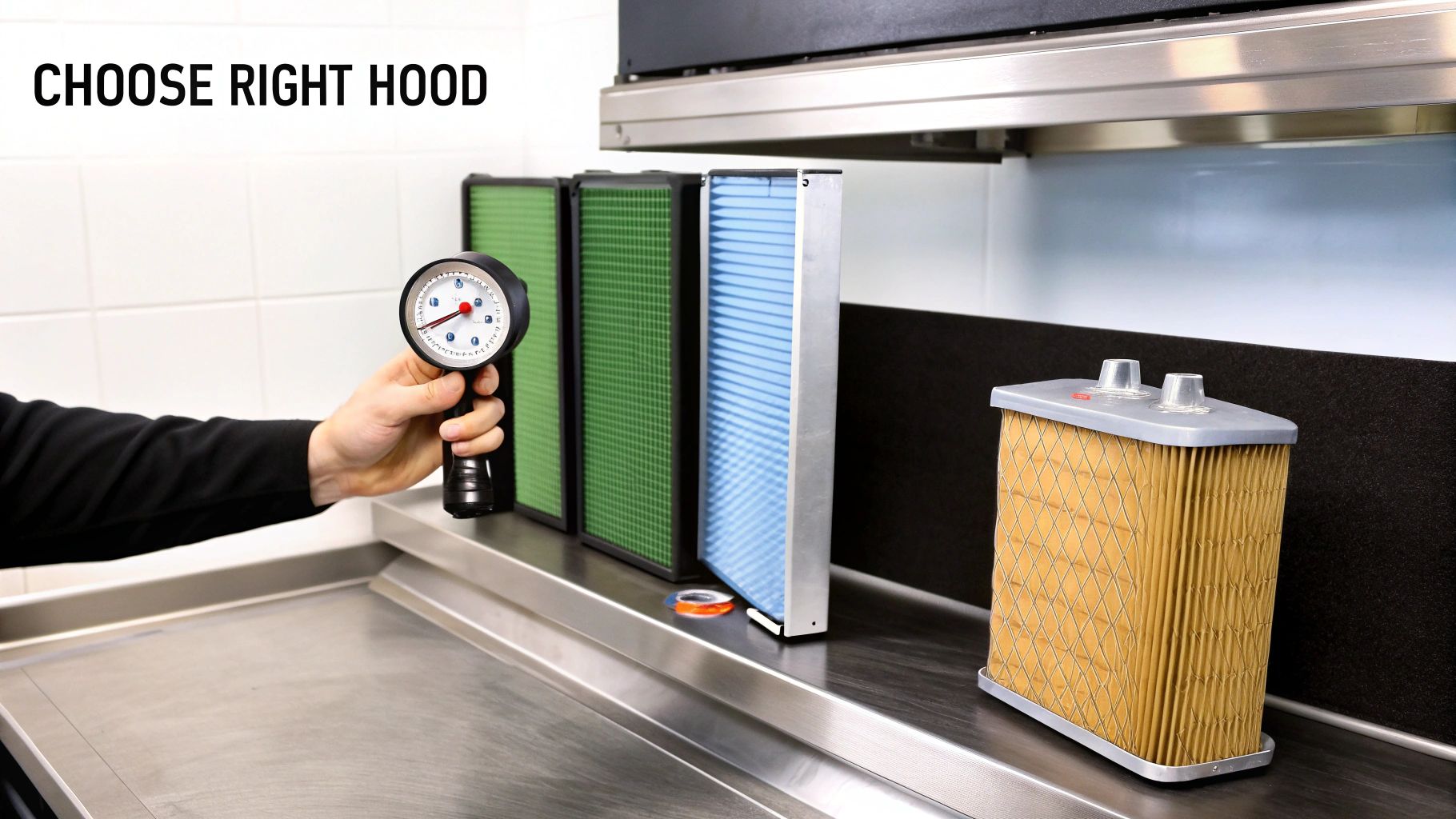
The very first thing you need to do is a simple audit. Take a good look at the cooking equipment you want to put under the hood. You have to make sure the hood's power and certifications are a match for what it’s serving, whether that’s a powerful deep fryer or a simple countertop oven.
Matching Your Hood to Your Cooking Lineup
Getting the right ventless hood starts with understanding what your cooking equipment is putting out. This isn't a one-size-fits-all situation. The hood needs to be powerful enough and certified for the specific type of cooking you're doing.
Below is a table to help you match your appliances to the right kind of ventless system.
Matching Your Ventless Hood to Your Cooking Equipment
| Appliance Type | Typical Grease/Vapor Output | Required Hood Certification (Example) | Seattle Restaurant Equipment Product Match |
|---|---|---|---|
| Convection Ovens, Toasters, Panini Grills | Low | Type 2 (UL KNLZ) | Giles/Chester Ventless Hoods |
| Combi Ovens, Rotisseries | Moderate | Type 1 or Type 2, depending on use | Wells Universal Hoods |
| Griddles, Charbroilers (Light-Duty) | Moderate to High | Type 1 (UL 710B / ANSI/UL 197) | Giles WVF-4 Ventless Hood |
| Deep Fryers, Woks | High | Type 1 with integrated fire suppression | Giles OVH-10 Ventless Fry Hood |
This table gives you a starting point. Always double-check the manufacturer's specs for both your cooking equipment and the hood to ensure they are compatible and meet local codes.
The ductless segment of the commercial kitchen hood market is growing fast, set to climb at a 6.71% CAGR, which is quicker than the overall market's 5.71% growth. The whole sector was valued at $2.66 billion and is expected to hit $4.14 billion, but it’s these ventless models that are really making a difference for food trucks and pop-ups where space is everything. Discover more insights about the commercial kitchen fume hoods market on snsinsider.com.
Filtration Systems and Long-Term Costs
The real magic of a ventless hood happens in its filtration system. Different models use different tech, and your choice here will have a direct impact on your daily maintenance and long-term budget. Most hoods use a multi-step process, starting with baffle filters for grease, then electrostatic cells for smoke, and finally carbon filters to knock out odors.
You have to be realistic about the upkeep. Baffle filters need a wash daily or weekly. Carbon filters, on the other hand, need to be replaced, usually every 12 to 18 months, depending on how hard you're running the kitchen. When you’re figuring out the total cost, don’t forget to add in the price of these replacement filters.
A ventless hood is only as good as its filters. If you slack on maintenance, you're not just hurting your air quality—you're creating a serious fire hazard from all that grease buildup.
Physical Size and Kitchen Workflow
Last but not least, you need to think about how the hood will actually fit into your kitchen. Get out the tape measure and check the available space. Remember to account for the hood's size plus the clearance you'll need around it for safety and maintenance. The goal is to make it feel like it was always meant to be there.
Your ventless hood should make your kitchen flow better, not create a new obstacle course. It needs to sit comfortably over your appliances without getting in the way of your under counter refrigerators or pizza prep tables. Good placement means your team can move smoothly from the commercial freezers to the fryer line without bumping into each other. Here at Seattle Restaurant Equipment, we can help you find a unit that fits right in with your sandwich prep tables and other Seattle bar equipment, creating a kitchen that’s both efficient and safe.
Mastering Installation and Long-Term Maintenance
Getting a new commercial ventless hood is a smart move for your kitchen's flexibility and efficiency. But to make sure that investment pays off, you need to nail two things: a proper installation and a consistent maintenance routine.
Lots of these systems are sold as ‘plug-and-play,’ but that can be a bit misleading. You really want a professional to set it up. They'll make sure the unit has its own dedicated circuit, is grounded correctly to handle the power draw from both the hood and your cooking gear (like deep fryers), and is placed just right to meet local fire codes. Getting this right from the start saves you a ton of headaches down the road.
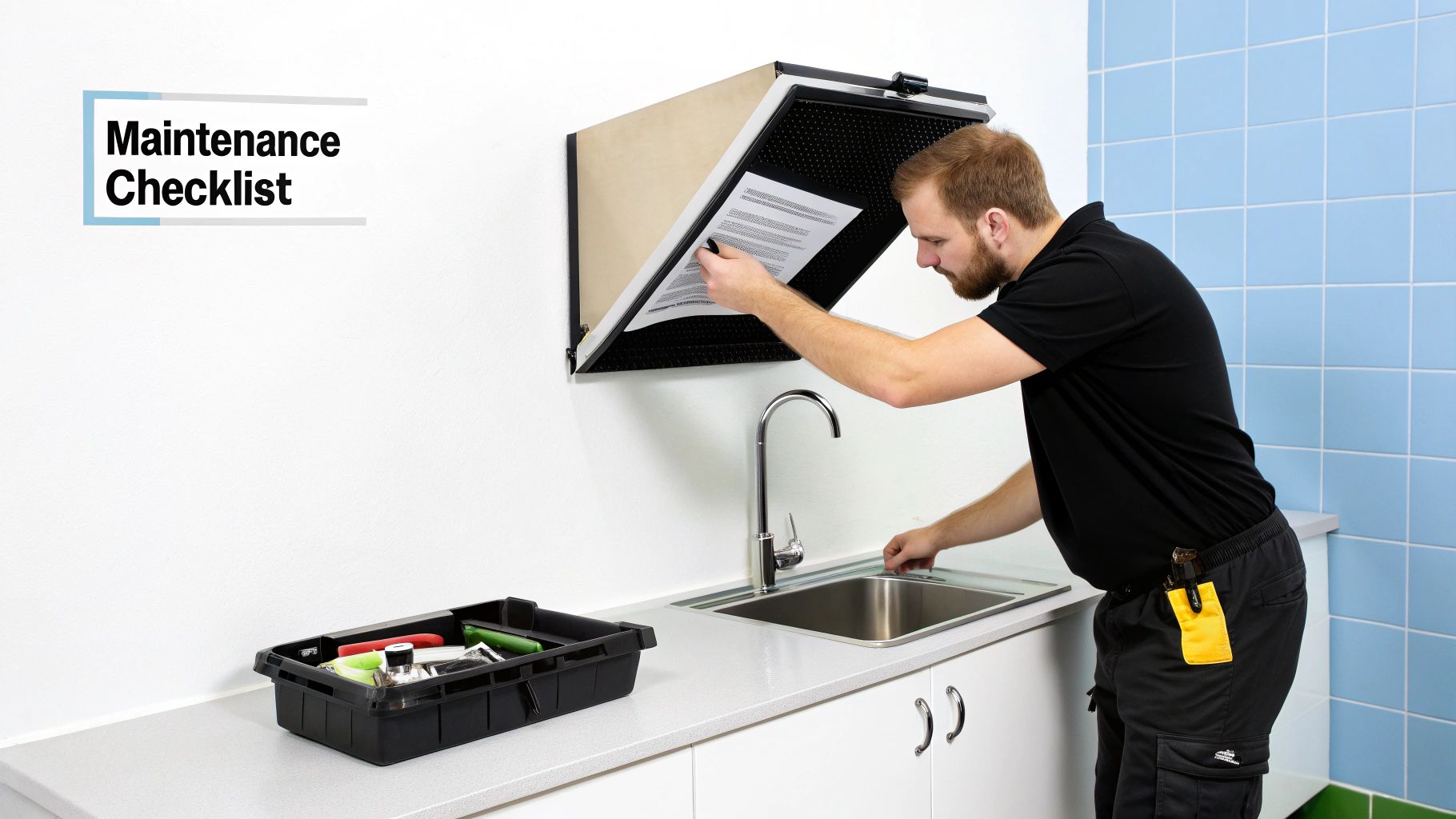
Creating Your Maintenance Rhythm
Think of maintenance less like a chore and more like a simple rhythm that keeps your kitchen humming. The filtration system is the heart of a commercial ventless hood, and keeping those filters clean is something you just can't skip. A clogged system doesn't just work poorly—it's a real fire hazard.
A ventless hood is only as effective as its cleanest filter. If you let it go, you'll get poor airflow, grease won't get captured, and you'll put a huge strain on the motor. That leads to expensive repairs and maybe even a code violation.
Since popping up in the early 2000s, ventless cooking systems have grown into a $1.38 billion global market. Codes like NFPA 96 have started favoring designs with electrostatic precipitators, which can slash energy use by up to 40% compared to traditional ducted systems. Nowadays, you'll find them in 15-20% of new food trucks in the U.S., which makes knowing how to maintain them more important than ever. Learn more about the ventless hood cooking systems market and its evolution on dataintelo.com.
An Actionable Maintenance Checklist
To get the most out of your hood and keep it running without a hitch, it helps to follow a simple schedule. This routine protects all the sensitive parts inside and makes sure the air being pushed back into your kitchen is actually clean. The easiest way to stay on top of it is to build these steps right into your daily closing duties.
Daily Tasks (5-10 Minutes):
- Wipe Down Surfaces: Give the inside and outside of the hood a quick clean with a food-safe degreaser.
- Empty Grease Tray: Carefully pull out the grease collection tray and empty it. A full tray is a major fire risk.
- Inspect Baffle Filters: Take a quick look at the stainless steel baffle filters for any heavy grease buildup.
Weekly Tasks (15-20 Minutes):
- Deep Clean Baffle Filters: Take the baffle filters out and give them a good wash. Most can go right in the dishwasher, but letting them soak in a degreasing solution works great, too.
- Check System Alerts: Glance at the control panel for any indicator lights telling you it's time to change a filter or that service is needed.
- Clear Air Inlets/Outlets: Make sure nothing is blocking the air vents. This is a big one if the unit is crammed next to other equipment like under counter freezers or sandwich prep tables.
Monthly & Long-Term Tasks:
- Inspect Pre-Filters: Check the disposable pre-filters. If they look dirty, it's time to replace them (usually every 1-3 months).
- Schedule Professional Service: Follow the manufacturer's timeline for replacing the main HEPA and carbon filters, which is typically every 12-18 months.
- Review Grease Management: Keeping your kitchen safe goes beyond the hood. For a deeper dive into managing grease, take a look at our complete guide on grease trap sizing.
By sticking to this simple plan, you'll make sure your commercial ventless hood stays a dependable part of your kitchen for years to come.
Putting It All Together with Seattle Restaurant Equipment
We've covered a lot of ground on how a commercial ventless hood can be a game-changer for food businesses here in Washington. Now for the fun part: let's talk about getting this incredible technology into your own kitchen. At Seattle Restaurant Equipment, we're here to make that happen.
We don't just sell boxes; we offer a hand-picked selection of high-performance ventless hoods. These aren't just standalone units—they're designed to be the heart of a complete kitchen solution, working perfectly with everything from your cold storage to your highest-output cooking gear.
Your Kitchen, All in One Place
Building a kitchen that's both compliant and efficient is about making sure all the pieces fit together. That’s why we’ve chosen our inventory to help you create a smooth, productive workflow, no matter what kind of food you're serving.
- Your Main Cooking Line: Think about pairing your new commercial ventless hood with our bulletproof deep fryers, workhorse griddles, or convection ovens. Suddenly, you have a powerful, self-contained cooking station you can place almost anywhere.
- Seamless Prep and Storage: We'll help you figure out the best way to place your ventless system alongside essentials like our commercial refrigerators, sandwich prep tables, or pizza prep tables to keep your kitchen flowing smoothly.
- Specialty Setups: Need to outfit a new coffee shop or a tight bar space? We've got you. Our lineup includes everything from Seattle bar equipment and Seattle coffee shop refrigerators to compact under counter refrigerators and under counter freezers that make the most of every square inch.
We're More Than Just an Equipment Supplier
Look, our job doesn't end when the truck pulls away. We see ourselves as your partner, and we’re genuinely invested in seeing your business succeed from day one. We know how tough it is to run a food business in Washington, so we've built our support to give you real value and peace of mind.
Building a great kitchen shouldn't be a headache or break the bank. Our whole goal is to give you the equipment, the support, and the financial breathing room you need to create a kitchen that's compliant, efficient, and affordable—so you can focus on your success.
This partnership isn't just a slogan. It means you get consistently low prices, solid warranties on everything we sell, and fast, free shipping across the entire state, whether you're in downtown Seattle or over in Spokane.
We also offer straightforward financing options to make your investment manageable from the start. Our team is hands-on and ready to help you sort through your options to find the perfect fit for your menu and your space. Take a look at our selection online or give us a call to get started on building the ventless kitchen you've been dreaming of.
Common Questions About Commercial Ventless Hoods
When you start looking into ventless technology, a few key questions always pop up. Getting straight answers is crucial before you decide if a commercial ventless hood is the right move for your kitchen here in Washington. We’ve pulled together the most common things people ask to help you feel confident in your choice.
Can I Use a Ventless Hood with My Gas Deep Fryer?
This is probably the number one question we hear, and the answer is almost always a hard no. Ventless hoods are overwhelmingly designed and certified to work with electric appliances only. Gas equipment, especially something that cranks out heat like a deep fryer or a charbroiler, creates combustion byproducts and a level of heat that ventless filtration systems just aren't built for.
You have to stick to the hood's UL listing. It will spell out exactly which electric appliances are approved for use underneath it. Trying to pair a ventless hood with a gas unit isn't just a code violation—it's a serious fire hazard.
How Often Do I Really Need to Change the Filters?
Think of filter maintenance as the most important chore you'll have with a ventless hood. The schedule isn't one-size-fits-all; it completely depends on how much you're cooking and what's on the menu.
- Baffle Filters: These are the metal grease traps. They need to be cleaned every single day. The good news is that many are dishwasher-safe, so it can just be part of your closing routine.
- Pre-Filters: These usually need to be swapped out every 1-3 months.
- Carbon/HEPA Filters: These are the workhorses that handle smoke and odors. Expect them to last anywhere from 12 to 18 months.
It's best to see filter replacement as a predictable operating cost, just like your power bill. Sticking to the schedule is non-negotiable if you want the hood to work safely and effectively.
Does the Hood's Fire Suppression System Cover My Whole Kitchen?
No, and this is a really important safety point to understand. The fire suppression system built into a ventless hood is a self-contained, localized unit. It's designed to protect only the specific appliances sitting directly under it, like the fryer next to your sandwich prep tables.
Your building still needs its own separate, main fire suppression system to meet local and state fire codes. The hood's system is an added layer of targeted protection, but it absolutely does not replace the primary fire safety setup for your entire kitchen.
At Seattle Restaurant Equipment, we can walk you through all these questions and help match the right ventless system with our huge selection of compatible electric equipment, from fryers to ovens. Explore our full range of commercial kitchen solutions and let's get you set up with a safe, efficient, and compliant kitchen.