

Before you even think about buying a truck or tasting a single recipe, the real work begins. Starting a food truck comes down to three crucial stages: dreaming up a killer concept, doing some serious on-the-ground research, and then getting real with the numbers. This initial legwork is your foundation—it guides every single decision you'll make and ultimately decides if you'll thrive on the streets of Seattle.
Crafting Your Food Truck Business Plan
Look, a business plan isn't just some boring document you throw together for a bank loan. It’s your roadmap. It’s the playbook that keeps your mobile kitchen from driving off a cliff. This is where you get brutally honest about your brand, who you're selling to, and how you’ll actually make money. Answering the tough questions now ensures your passion project has a profitable, sustainable path forward.
And it’s a great path to be on. The food truck scene is exploding. The global market hit USD 5.8 billion in 2025 and is projected to climb to USD 10.9 billion by 2035, growing at a steady 6.4% clip each year. Right here in the U.S., the industry pulled in $2.8 billion by 2025, with an incredible 13.2% annualized growth rate over the past five years. You can dig into more of these industry trends over at Future Market Insights.
This breaks down the essential first steps for getting your food truck journey started.
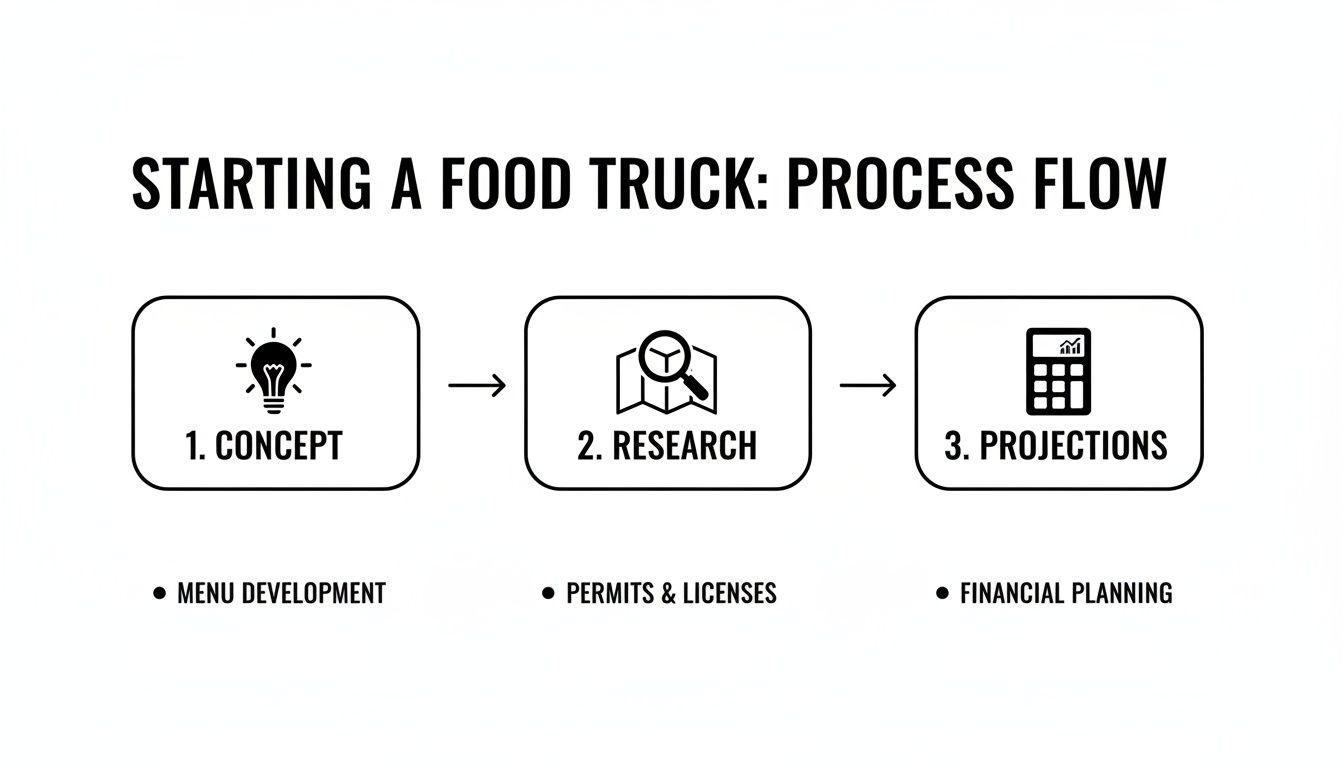
As you can see, a successful launch starts long before you turn on the ignition. It all begins with a solid concept and a clear financial picture.
Defining Your Killer Concept
So, what makes your food truck special? In a food-obsessed city like Seattle, "tacos" isn't a concept—it's just a menu item. Your concept is your entire identity. It dictates your menu, the look of your truck, your brand, and who lines up for your food.
You need a niche that fills a void. Think beyond the obvious.
- Gourmet Grilled Cheese: Take a childhood classic and blow it up with artisanal bread, local cheeses, and crazy fillings like fig jam or braised short rib. A top-quality sandwich prep table is crucial for this.
- Artisanal Coffee & Pastries: Serve the morning and afternoon crowds with killer espresso and locally baked goods. A rock-solid Seattle coffee shop refrigerator is non-negotiable for this.
- Hyper-Local Sliders: Go all-in on Washington-sourced ingredients, building a menu that changes with the seasons.
Whatever you choose, it needs to be practical for a tiny, moving kitchen. Complicated dishes with long prep times will crush you during a busy lunch rush. The goal is a menu that's both amazing and efficient to pump out.
Conducting Meaningful Market Research
Once you’ve got an idea, it’s time to hit the pavement. Guesswork is the fastest way to fail. You need to know your competition and, more importantly, your future customers.
Spend a few weekends out where the trucks gather—think South Lake Union, farmers' markets, and local breweries. Don't just grab a bite; be a detective.
- Who's buying? Is it office workers on a lunch break, families, or the late-night crowd?
- What are the prices like?
- How long are people waiting, and how fast is the line moving?
- What’s their branding and social media game like?
This kind of hands-on intel is worth more than any online report. It helps you tweak your concept, pinpoint potential spots, and figure out what Seattleites will actually open their wallets for.
Pro Tip: Go talk to other food truck owners. Seriously. Most are happy to share some wisdom with a newcomer. Ask about their biggest headaches, best-ever locations, and what they wish they knew on day one. Their real-world advice is gold.
Building Realistic Financial Projections
Alright, time to face the numbers. This is the most important part of your business plan. It’s where you map out every single cost and figure out your path to actually making money.
Be meticulous. Be realistic. Your budget should cover everything:
- Startup Costs: The truck itself, the kitchen build-out (deep fryers, commercial refrigerators, sandwich prep tables), your first big food order, branding, and all those permits and fees.
- Fixed Monthly Costs: The bills you pay no matter what—insurance, commissary kitchen rent, and any loan payments.
- Variable Costs: These move with your sales volume, like food costs, packaging, and fuel.
- Revenue Projections: Use your research to estimate sales. It’s smart to map out best-case, worst-case, and realistic scenarios.
Before you start pricing out equipment, it helps to have a baseline. Here’s a rough idea of what it takes to get a food truck rolling in the Pacific Northwest.
Initial Food Truck Startup Costs In Washington
A realistic look at estimated startup costs to help you build an accurate budget for launching your food truck in the Pacific Northwest.
| Expense Category | Low-End Estimate | High-End Estimate |
|---|---|---|
| Used Food Truck (Basic) | $40,000 | $80,000 |
| New Food Truck (Custom) | $100,000 | $200,000+ |
| Kitchen Equipment | $10,000 | $50,000 |
| Permits & Licensing | $1,000 | $5,000 |
| Initial Food & Supply Inventory | $2,000 | $5,000 |
| Branding & Truck Wrap | $2,500 | $7,000 |
| Point-of-Sale (POS) System | $500 | $1,500 |
| Initial Marketing & Launch | $1,000 | $3,000 |
| Contingency Fund (3-6 Months) | $10,000 | $25,000 |
| Total Estimated Range | $67,000 | $176,500+ |
As you can see, the numbers can vary wildly based on whether you buy used or new and how fancy you get with the equipment. A detailed budget keeps you grounded and shows potential lenders you’ve done your homework. A solid financial plan is what turns a delicious idea into a legitimate business.
Navigating Washington State Food Truck Regulations
You’ve got a killer concept and a solid business plan. Now for the fun part: untangling the web of permits, licenses, and health codes that stand between you and your first customer.
This is, without a doubt, the stage where many aspiring food truckers get bogged down. It can feel like a mountain of paperwork, but getting this right from day one is non-negotiable. It’s what protects you from hefty fines, sudden shutdowns, and the kind of rookie mistakes that can doom a business before it even serves its first taco.

This legal groundwork isn't just about checking a box; it’s about survival. The number of food trucks in the U.S. is expected to hit 92,257 by 2025, but the hard truth is that nearly 30% fail within their first year, often due to permit snags or compliance issues. In Washington, you’re looking at an initial Mobile Food Unit permit that can run between $500 and $1,000 a year, and that’s just the start. You can get the full industry picture in the latest report from IBISWorld.
Securing Your Essential Permits
Here in Washington, your journey begins with the Department of Health (DOH) and their Mobile Food Unit (MFU) permit. The most important thing to know is that you must submit a detailed plan review application before you start building or modifying your truck. This plan needs to cover everything—your menu, where you source ingredients, the exact layout of your equipment, even your plumbing schematics.
Once the DOH gives you the green light, you’ll start collecting your local licenses. These can vary a bit depending on where you want to sling food, but you’ll almost certainly need:
- A Washington State Business License: This officially registers your business with the state.
- A City Business License: You'll need one for every city you operate in, whether it’s Seattle, Bellevue, Tacoma, or beyond.
- A Local Health Permit: King County Public Health, for instance, has its own inspection process and permit to operate within its boundaries.
- Fire Department Permit: Your truck’s fire suppression system and propane setup will need to pass a thorough fire safety inspection.
We've put together a more detailed breakdown of the paperwork and process in our guide to Washington's food truck permit requirements.
Insider Tip: Seriously, do not start your truck build until your DOH plan is approved. We’ve seen people have to rip out brand-new equipment because an inspector demanded a different layout. Following the proper sequence will save you thousands of dollars and weeks of headaches.
Passing Your Health Code Inspection
The health inspection is where the rubber meets the road. An inspector will go over your mobile kitchen with a fine-toothed comb, and they are looking for more than just a clean floor. They’re verifying your truck is a legitimate commercial kitchen on wheels.
Your truck must be equipped with:
- A Three-Compartment Sink: It's absolutely mandatory for washing, rinsing, and sanitizing all your dishes and utensils.
- A Separate Handwashing Sink: This sink is for hands only and must have hot and cold running water, soap, and paper towels at all times.
- Adequate Hot Water: You need a system that can reliably produce enough hot water to meet sanitation demands during a busy service.
- Commercial-Grade Equipment: Everything from your commercial refrigerators to your sandwich prep tables must be NSF-certified (or equivalent). That consumer-grade fridge from a big-box store? It’s an instant fail.
Inspectors will also want to see your food temperature logs, your crew's food handler permits, and your overall grasp of food safety. This is where your investment in reliable commercial freezers and refrigeration truly proves its worth.
The Critical Role of a Commissary Kitchen
In Washington, your food truck can't just be parked in your driveway overnight. State and local codes require you to operate out of a licensed commissary kitchen, which serves as your operational home base.
Think of the commissary as your mission control. Your agreement with them covers several essential, legally required functions:
- Fresh and Waste Water: This is where you’ll fill your fresh water tanks and, just as importantly, properly dispose of your gray water.
- Food Prep and Storage: Many complex prep tasks are simply not feasible in the tight confines of a truck. You'll also rely on the commissary's walk-in coolers and freezers for your bulk ingredient storage.
- Cleaning: It’s your designated spot for the heavy-duty deep cleaning your truck and equipment require.
- Overnight Parking: Most places, including Seattle, mandate that your truck is parked at its designated commissary when it's not in service.
Finding the right commissary can be tough, so start this search early. Monthly fees can range from a few hundred dollars to well over a grand, depending on the services you need. This partnership isn't just a suggestion; it's a fundamental piece of your operational and legal puzzle.
Equipping Your Mobile Kitchen For Success
The truck itself is just the shell. The real heart of your business—the part that actually makes you money—is the kitchen inside. Outfitting this tiny space isn't like setting up a kitchen at home. You need tough, commercial-grade equipment that can handle the bumps in the road, the non-stop pace of service, and the watchful eye of a health inspector. Every single piece you choose will define your workflow, the quality of your food, and how fast you can get orders out the window.
Making smart investments here is non-negotiable. The right gear will be a reliable partner for years. The wrong choices? They lead to expensive breakdowns, lost business, and failed inspections. This is your engine room; build it right from day one.
The Foundation of Food Safety: Refrigeration
Let’s be perfectly clear: your refrigeration and freezer units are the single most important pieces of equipment you will buy. Period. Without solid, reliable cold storage, you’re gambling with foodborne illness, throwing away money on spoiled inventory, and risking an immediate shutdown from the health department. A fridge from a big-box store won't cut it—they can’t recover temperature fast enough in a hot truck and are an automatic red flag for any inspector.
You absolutely need commercial refrigerators and commercial freezers built for the foodservice grind. They have powerful compressors and heavy-duty insulation to hold safe temps, even when you're opening the door every 30 seconds during a lunch rush. In a food truck, every inch counts, which is why so many Seattle operators rely on clever, space-saving designs.
- Under Counter Refrigerators: These slide right under your prep surfaces, giving you maximum workspace while keeping key ingredients like produce, sauces, and cheese right where you need them.
- Under Counter Freezers: Just like their refrigerated cousins, these give you crucial frozen storage for proteins, fries, or pre-made items without gobbling up precious vertical real estate.
There's no shortcut here. Proper cold storage is the bedrock of a safe, legal, and professional mobile kitchen.
Streamlining Your Workflow with Prep Tables
In a food truck, speed is everything. You've got a limited time to serve a long line of hungry people, so every second is gold. This is where specialized prep tables become your best friend, designed to shave precious moments off every single order.
A sandwich prep table is an absolute game-changer for any menu with sandwiches, salads, bowls, or tacos. It combines a refrigerated rail on top—holding pans of fresh, cold ingredients—with a cutting board right in front and more refrigerated storage below. This means you can build an order from start to finish without ever taking a step.
If your menu is more specific, like pizza, a pizza prep table offers the same killer efficiency but with a wider, deeper rail designed for dough trays and all your toppings. It centralizes your entire production line into one powerhouse station.
Selecting Your Cooking Powerhouses
Once you have your cold storage and prep stations locked down, it's time to bring the heat. The cooking equipment you choose will be dictated entirely by your menu, but the main principle is the same: get durable, commercial-grade appliances that can take a beating.
One of the most common workhorses is the deep fryer. Whether it's for classic french fries, crispy wings, or fresh donuts, a commercial gas fryer delivers the high, steady heat you need. Look for models with built-in safety features and oil wells that are easy to clean—you'll thank yourself later.
Now, let's talk numbers. Equipment costs can be a huge part of your startup budget, but you have to be smart about it. Tariffs on imported parts have pushed U.S. mobile kitchen costs up by 10-15% recently. A basic truck build-out can run anywhere from $40,000 to $100,000, with the kitchen gear alone making up $15,000 to $40,000 of that. And here's a scary stat: nearly 20% of food trucks fail their initial health inspection. Avoid that fate by buying NSF-certified equipment from the start. You can dive deeper into these costs and trends in this global market report.
Choosing the right equipment from the start is about more than just cooking food. It's about building a reliable, compliant, and profitable business. A well-equipped truck is a dependable truck, and dependability is what keeps you on the road and making money.
If you're launching a coffee truck or mobile bar, your focus will naturally shift. High-quality Seattle coffee shop refrigerators are vital for milk and syrups, while Seattle bar equipment like back bar coolers and ice bins become the stars of the show. The key is to map your menu directly to your equipment list. This ensures you have exactly what you need to execute your vision without wasting an inch of space or a dollar of your budget. For more specific ideas, check out our detailed guide on essential equipment for food truck kitchens.
Essential Food Truck Equipment And Functions
Understanding how each piece of equipment contributes to your daily operation is crucial for building an efficient mobile kitchen. This table breaks down the core components, their roles, and why they're so vital for success on the road.
| Equipment Category | Specific Item Examples | Key Function In a Food Truck |
|---|---|---|
| Refrigeration | Under Counter Refrigerator, Sandwich Prep Table | Maintains safe food temperatures (below 41°F); prevents spoilage and foodborne illness; essential for health code compliance. |
| Cooking | Commercial Deep Fryer, Gas Griddle, Convection Oven | The primary engine for your menu; provides consistent, high-volume heat for cooking food quickly and to the proper temperature. |
| Food Preparation | Stainless Steel Work Tables, Commercial Slicers | Provides a clean, durable, and legally required surface for chopping, mixing, and assembling orders. Maximizes workflow. |
| Warewashing | 3-Compartment Sink, Handwashing Sink | Critical for sanitation and health department regulations; used for washing, rinsing, and sanitizing all utensils and smallwares. |
| Safety & Ventilation | Commercial Hood Vent, Fire Suppression System | Removes smoke, grease, and heat from the kitchen; mandatory for fire safety and required by the Fire Marshal. |
Ultimately, each item in your truck should have a clear purpose. Investing in quality, compliant equipment isn't just an expense—it's the foundation of a safe, efficient, and profitable food truck business.
Finding And Financing Your Food Truck
Your truck is more than just a vehicle—it's the heart of your business and probably the biggest single check you'll write. This isn't just about finding some wheels; it’s about choosing a reliable partner for your culinary dream. Getting this choice right, and lining up the right funding, is what separates the trucks that thrive from those that stall out.
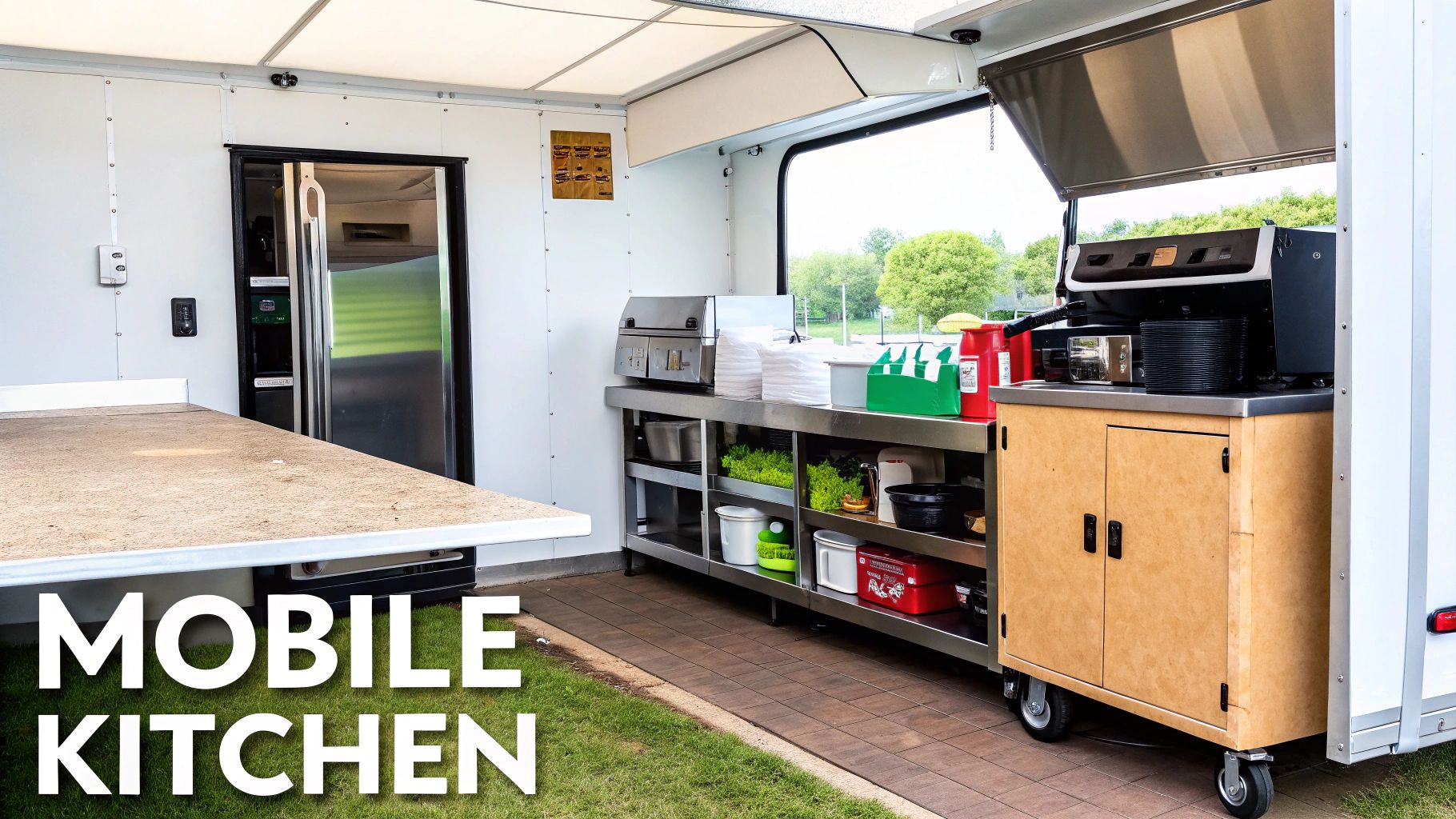
Let's talk numbers. The initial cost can be a real gut-punch. A shiny new, custom-built truck can easily set you back $100,000 to over $175,000. On the flip side, a used vehicle might land you in the $40,000 to $80,000 range. This decision is going to shape your startup budget and how you approach financing.
New Vs Used Trucks: Which Is Right For You?
Going for a brand-new truck has some pretty sweet perks. You get a warranty, a kitchen layout built exactly to your specs, and the confidence that comes with a fresh engine and equipment. The downside? That massive price tag and the long wait times for the build-out can be a serious hurdle for a new business.
A used truck, however, gets you in the game much faster and with a lot less debt hanging over your head. The trade-off is the risk you inherit. You're buying its entire history, including every mechanical quirk and beat-up piece of equipment. A thorough inspection isn't just a good idea; it's non-negotiable.
Critical Inspection Checklist: Don't even think about buying used without hiring a certified mechanic to check the engine, transmission, and brakes. Then, you need to personally vet every single piece of kitchen gear. Are the commercial refrigerators and under counter freezers actually holding temp? Does the deep fryer fire up on the first try, every time? Hunt for rust, leaks, and any sign of sloppy maintenance.
Real-World Financing Options
Okay, so you've picked a truck. Now, how do you pay for it? Very few people are walking around with enough cash to buy a food truck outright, which means you’ll be looking at financing options built for small businesses like yours.
- SBA Loans: These are backed by the Small Business Administration, which means they often come with better terms and lower interest rates. The catch is you'll need a rock-solid business plan and good personal credit.
- Traditional Bank Loans: If you've got a good relationship with your bank and your financials are in order, this can be a direct path. Just know that banks can be pretty cautious about lending to new food ventures.
- Equipment Leasing: This is a seriously smart move for kitting out your kitchen without draining your startup cash. You can lease everything from your sandwich prep table to your Seattle bar equipment, keeping your capital free for things like inventory and marketing.
For a lot of new owners, mixing and matching these is the way to go. You might get a loan for the truck itself but lease all the equipment that goes inside it.
Crafting A Winning Loan Proposal
Think of your loan proposal as your big pitch to the bank. It has to be sharp, detailed, and completely convincing. You need to prove you’ve done the research and that your food truck isn't just a passion project—it's a profitable business waiting to happen.
Your proposal has to include:
- A Polished Business Plan: This is your foundation. It needs to cover your concept, your market, and your team.
- Detailed Financial Projections: Lenders want to see realistic revenue forecasts. Show them you know your numbers, from startup costs to day-to-day operational expenses.
- A Specific Funding Request: Be direct. State exactly how much money you need, what you'll use it for (truck, equipment, working capital), and how you plan to pay it back.
Figuring out the money side of things is a huge step. For a closer look at your options, you can learn more about how to finance restaurant equipment in our detailed guide. Nailing down the right financial backing is what finally turns that dream truck into a road-ready reality.
Time to Launch: Your Go-To-Market Strategy
You've got a fully-outfitted truck and a stack of permits. The hard part's over, right? Now the real fun begins. It's time to stop planning and start cooking. A killer launch isn't just about a great first day; it’s about building the kind of momentum that will carry your business for months, even years. This is where you put it all together: smart location scouting, a grand opening that gets people talking, and a social media game that builds a loyal following from the get-go.
A solid launch strategy is what turns your kitchen on wheels into a brand people recognize and seek out. It’s all about being in the right place at the right time—and making sure everyone knows you’re there.
Scout Your Prime Locations
In the food truck world, your location is everything. The freedom to move is amazing, but it also means you have to constantly hunt for profitable spots to park. The goal is simple: find places with tons of foot traffic and hungry people ready to buy. Don't just pull up a map and guess; you need to get out there and do some real-world recon.
Spend a few days just observing potential spots at different times.
- Corporate Parks: Picture the lunch rush in South Lake Union or the big office complexes in Bellevue. You’ve got a captive audience of workers on a tight schedule. That's a golden opportunity.
- Breweries & Taprooms: This is a classic partnership for a reason. Most breweries don't have kitchens, making your truck the perfect answer for their hungry patrons. Start building relationships with local brewery owners now.
- Farmers' Markets: These spots are magnets for food lovers who are already in the mood to spend money on quality, local eats.
- Local Events & Festivals: From neighborhood block parties to big city festivals like Seafair, these can be incredibly lucrative. Just be aware that they often come with higher fees to participate.
Track the foot traffic, see who your competition is, and actually talk to people. Ask them what kind of food they wish they could find nearby. This kind of on-the-ground intel is priceless.
Plan a Grand Opening That Creates Buzz
Think of your grand opening as your first big marketing event. The whole point is to generate as much buzz as possible and start day one with a line of eager customers. A well-played launch really sets the tone for your entire business.
Don't just roll up, open the window, and hope for the best. Plan a real event.
- Run a Launch Day Special: Something simple like a "buy one, get one" deal or a free side with every order is a powerful way to get people to try your food for the first time.
- Team Up with a Local Business: Partner with a nearby brewery, coffee shop, or popular store. You can cross-promote the event to both of your audiences, instantly doubling your reach.
- Invite Local Food Bloggers & Influencers: A little free food can go a very long way. Reach out to some local tastemakers on Instagram and offer them a complimentary meal in exchange for a post. Their stamp of approval can bring in a flood of new faces.
A strong grand opening isn't just a party. It's a strategic move to cement your brand, get immediate customer feedback, and create all the social media content you'll need to fuel your marketing for weeks. Make it an event people talk about.
Master Your Social Media Game
For a food truck, social media—especially Instagram and Facebook—is not optional. It's your main line of communication. It’s how you tell everyone where you are each day, show off your incredible food, and build a real community around your brand.
You have to make social media a daily habit.
- Post Your Location. Every. Single. Day. This is non-negotiable. Post it clearly, every morning, on all your platforms. Use Instagram Stories for real-time updates if you sell out early or decide to move.
- High-Quality Food Photos Are a Must: People eat with their eyes first. Seriously, take the time to learn how to take great photos of your food. Natural light is your best friend. Show off the texture, the vibrant colors, and what makes your dishes special.
- Engage with Your Followers: When someone tags you in a post, share it to your story! When people leave comments, write back. This isn't a billboard; it’s a conversation. Building those relationships is how you turn first-time customers into die-hard fans.
Your social media is your digital storefront. It tells your brand’s story, drives people to your window, and keeps your truck top-of-mind. Give it the same care and attention you give your menu.
Common Food Truck Questions Answered
As you start putting the final touches on your mobile kitchen, a whole new set of questions will pop up. Don't worry, that's completely normal. Nailing these last-minute details is what makes the difference between a smooth launch and a stressful one.
We’ve pulled together some of the most common questions we hear from new food truck owners in the Seattle area to give you clear, straight-up answers. Think of this as your final checklist to move forward with confidence and hit the ground running.
How Much Does a Seattle Food Truck Really Cost to Start?
You should plan on a startup budget somewhere between $75,000 and $150,000 for a food truck in the Seattle area. That's a wide range, but it covers everything from the truck itself and a full commercial kitchen build-out to permits, branding, and enough cash in the bank to get you through the first few months.
A huge chunk of that total comes down to your equipment. A top-tier sandwich prep table, dependable commercial refrigerators, and a high-volume deep fryer will be a big part of your budget. Sourcing smart and locking in good financing can make a massive difference in your final number.
What Is the Most Critical Piece of Kitchen Equipment?
Your refrigeration. No question about it. A high-quality, commercial-grade refrigerator isn't just a good idea—it's non-negotiable for food safety and the first thing a health inspector will scrutinize.
Those consumer models you see at big-box stores can't handle the intense heat inside a truck or the constant wear and tear of a commercial kitchen. Investing in reliable commercial freezers and an under counter refrigerator from the start means your ingredients always stay at safe temperatures. This protects your customers, your reputation, and your business.
A food truck's success is built on reliability. Your refrigeration is the bedrock of that reliability. It's the one area where you absolutely cannot afford to cut corners; it’s the heart of your operation and the key to passing your inspections.
Is a Commissary Kitchen Mandatory in Washington?
Yes, in most parts of Washington, including Seattle and King County, the law requires you to operate out of a licensed commissary kitchen. It's a fundamental part of your license to operate, and health departments are strict about it.
Even if your truck is a self-contained beast, you still need a home base. The commissary is where you’ll do a lot of your food prep, legally dispose of waste and greywater, refill your fresh water tanks, and often, park your truck overnight.
Which Equipment Choices Are Best for Specific Menus?
Let your menu be your guide. A coffee truck is going to pour its money into a high-end espresso machine and proper Seattle coffee shop refrigerators for milks. A mobile bar's workflow will be built around Seattle bar equipment like ice bins and back bar coolers.
If you’re slinging pizzas, a specialized pizza prep table is a game-changer. For a burger or taco concept, a classic sandwich prep table and a few under counter freezers will be your workhorses. The key to a smooth, profitable operation is mapping every item on your menu back to the specific, efficient equipment needed to make it.
At Seattle Restaurant Equipment, we specialize in providing the durable, commercial-grade equipment you need to build a successful mobile kitchen. From essential refrigeration to specialized prep tables, we have the reliable gear that powers Seattle's best food trucks. Explore our full selection of new kitchen equipment and get a free quote today at https://seattlerestaurantequipment.com.