

The big question for any kitchen is how you're going to fuel it. When it comes to gas, the choice usually boils down to two options: LP gas (propane) or natural gas. The fundamental difference is simple: LP gas is a high-energy fuel you store in portable tanks, making it the go-to for food trucks and mobile caterers. On the other hand, natural gas is piped directly to your building, offering a steady, convenient, and often cheaper supply for a fixed restaurant. This decision will directly shape your equipment choices and operating budget for everything from commercial refrigerators and commercial freezers to high-output deep fryers.
Foundational Fuel Choices for Washington Kitchens
Picking between LP and natural gas isn't just a technical detail; it's a core business decision for any Washington foodservice operation. It affects which high-output deep fryers you can buy, what your monthly utility bills look like, and how your kitchen operates day-to-day. Getting this right from the start saves a lot of headaches down the road.
Natural gas is the "set it and forget it" option. It flows into your building through an underground utility line, giving you an uninterrupted supply. Propane is the opposite—it’s stored in tanks right on your property, which means you're responsible for keeping them filled. This one distinction really defines where each fuel shines.
Quick Comparison: LP Gas vs Natural Gas at a Glance
To make sense of it all, here’s a quick breakdown of the key differences. This table cuts through the noise and gives you a high-level view to help guide your decision.
| Attribute | LP Gas (Propane) | Natural Gas |
|---|---|---|
| Delivery Method | Stored in on-site tanks; requires refilling | Delivered continuously via utility pipeline |
| Energy Density | High (approx. 2,500 BTU/cubic foot) | Lower (approx. 1,000 BTU/cubic foot) |
| Best Use Case | Mobile kitchens, food trucks, remote locations | Fixed-location restaurants, bars, cafes |
| Infrastructure | Portable tanks, requires storage space | Permanent connection to a gas main |
Ultimately, a busy Seattle restaurant with a permanent address will almost always benefit from a natural gas hookup. But for a food truck hitting events in Spokane or a caterer setting up in Bellevue, the portability of LP gas is absolutely essential.
"The choice between propane and natural gas fundamentally shapes a kitchen's workflow. One offers mobility and high heat, while the other provides unmatched convenience and stability for high-volume operations."
On a global scale, the infrastructure for natural gas is massive and growing. The liquefied natural gas (LNG) market is expected to balloon from $122.55 billion in 2024 to $363.15 billion by 2034, which shows just how widespread and reliable this utility has become. That stability is why it's the standard for outfitting kitchens with stationary workhorses like pizza prep tables and under counter freezers. As you can learn from recent market research, this infrastructure isn't going anywhere. This guide will give you the clarity needed to make the right call for your business.
Comparing Energy Density and Cooking Performance
When the dinner rush hits, the real test of your kitchen's fuel isn't just about having a flame—it's about raw cooking power. That power is measured in British Thermal Units (BTUs), and in the lp gas vs natural gas debate, there’s a clear winner in the energy department. This difference directly impacts your kitchen’s speed and output.
LP gas, or propane, simply packs a heavier punch. A single cubic foot of propane delivers roughly 2,500 BTUs of heat energy. Natural gas, on the other hand, comes in at around 1,000 BTUs per cubic foot. This means propane offers more than double the firepower for the same volume, a critical advantage for high-demand kitchens.
This isn't just a number on a spec sheet; it's a real-world performance boost you can feel on the line. For a busy Seattle restaurant, that extra energy means faster preheating and quicker recovery times, especially for equipment that’s constantly losing heat.
The BTU Advantage in Action
Think about a commercial deep fryer, a workhorse in most kitchens. You drop a basket of frozen fries into hot oil, and the temperature immediately tanks. A fryer hooked up to high-BTU LP gas will bring that oil back to temperature much faster than one running on natural gas. That speed is what keeps food crisp, not greasy, and ensures you’re turning out consistent quality during your busiest hours.
The same idea applies to your other core equipment. A convection oven on propane will hit its target temperature quicker, and a charbroiler will maintain a more consistent, aggressive sear even when the grill is loaded. This efficiency boost can be the difference-maker, shortening ticket times and letting your kitchen handle more orders.
The performance gap is stark: LP gas’s higher energy density—over twice that of natural gas—is the key to rapid temperature recovery in high-volume settings, ensuring equipment like deep fryers and griddles keep up with demand.
This higher energy output is exactly why LP gas and natural gas aren't interchangeable without some work. Each fuel needs specifically sized orifices (or jets) inside the appliance to control the gas flow and get a clean, efficient burn. Using the wrong one will lead to weak flames, soot buildup, and serious safety issues.
How This Affects Your Seattle Restaurant Equipment
Understanding this performance difference is crucial when you're outfitting your Washington establishment. For a high-volume Bellevue bar needing its Seattle bar equipment to fire on all cylinders on a Friday night, the quick recovery of an LP gas fryer is a game-changer. Likewise, a food truck with a tight footprint has to squeeze every bit of power from its fuel source.
Here’s how the fuel choice can ripple through your kitchen:
- Commercial Refrigerators & Freezers: While not gas-powered themselves, your cooking line’s performance impacts your cold storage. Faster cooking means quicker inventory turnover, which affects how often you're opening your commercial refrigerators and under counter freezers.
- Sandwich & Pizza Prep Tables: For operations built around a sandwich prep table or pizza prep table, the ovens and griddles nearby have to keep up. The intense heat of LP gas can help a conveyor pizza oven hold its temperature, even as you load it continuously.
- Coffee Shop & Bar Refrigeration: Even a Seattle coffee shop refrigerator or an under counter refrigerator in a bar feels the indirect effects. More efficient cooking appliances can reduce the ambient heat in the kitchen, lessening the workload on your refrigeration units and saving a bit on the electric bill.
Ultimately, your decision in the lp gas vs natural gas showdown directly shapes your kitchen's rhythm. LP gas brings superior power for speed and recovery, making it the go-to for demanding, fast-paced environments. Natural gas offers reliable, steady heat that works well for many applications, but it just can't compete with propane's raw thermal energy when things get heated.
Analyzing Cost, Availability, and Infrastructure
Beyond the BTUs, the real-world logistics of cost and availability are what will truly shape your decision between LP gas vs natural gas. For any foodservice business in Washington, this choice boils down to a classic trade-off: upfront investment, long-term running costs, and the simple reality of where your kitchen is located. The right fuel isn't just about cooking power; it's about what makes sense for your bank account and your business model.
The fundamental difference comes down to infrastructure. Natural gas is a utility, plain and simple. It’s delivered through a permanent, underground grid. For restaurants in dense areas like Seattle or Tacoma, this is incredibly convenient. Once you're hooked up, the supply is constant, and you get a predictable bill just like you do for power and water.
LP gas, or propane, is a whole different ballgame. It’s all about portable tanks that you either get refilled or swap out with a supplier. This gives you amazing flexibility, which is why it's the go-to—and often only—option for mobile businesses like food trucks or for kitchens in rural spots far from any gas mains.
Natural Gas: The Brick-and-Mortar Choice
For a fixed-location restaurant, tapping into a natural gas line is almost always the most cost-effective move for the long haul. The cost per unit (a therm) is usually cheaper than the per-gallon price of propane once you account for the energy you get out of it. This makes budgeting a lot easier for busy kitchens where equipment like ranges and deep fryers are running all day.
But, getting started can be a major hurdle. You need to think about:
- Connection Fees: If your building isn't already piped for gas, the cost to run a new line from the street can be a real shock. We're talking potentially thousands of dollars, depending on how far they have to dig.
- Monthly Service Charges: Just like any utility, you’ll pay a fixed monthly fee on top of what you use.
- Geographic Limitations: This is the biggest deal-breaker. If you're outside the service area of a gas utility, natural gas is simply off the table.
LP Gas: The Price of Portability
LP gas flips the script: you trade potentially higher fuel costs for the freedom to operate anywhere. The price per gallon of propane can swing a lot more based on the season and what's happening in global energy markets. For a food truck, that's just the cost of doing business—a necessary expense for the freedom to go where the customers are.
Managing propane means you're in charge of your own supply:
- Tank Installation or Rental: You’ll need to buy or lease storage tanks, which have their own setup rules and take up physical space.
- Refill Scheduling: This is on you. Unlike the endless flow of natural gas, you have to watch your fuel levels and schedule refills. Running out of gas mid-service is a kitchen nightmare you want to avoid at all costs.
- Supplier Contracts: Finding a reliable propane supplier and locking in a good contract is key to keeping costs in check and ensuring they show up when you need them.
It really boils down to permanence versus portability. Natural gas is an investment in stable, long-term infrastructure for a permanent spot. LP gas is the ticket to agility for any business on wheels.
A look at the global energy market confirms this. The liquefied petroleum gas (LPG) market was valued at about USD 123.14 billion in 2024 and is expected to see steady growth. In contrast, the liquefied natural gas (LNG) market, while valued similarly now, is projected to explode to USD 363.15 billion by 2034, mostly because of its role in larger clean energy plans. For a restaurant owner in Washington, this means natural gas infrastructure is a solid, stable bet for a high-volume stationary kitchen, while LPG's well-established supply chain keeps it the king of portable power. You can dig deeper into these trends in this comprehensive industry analysis.
For food trucks, the choice is already made. The entire business model is built on the flexibility that only propane tanks can offer. If you're planning a mobile kitchen, getting a handle on these specific needs is the first step. You can learn more by checking out our guide on essential food truck cooking equipment. Ultimately, when you frame the lp gas vs natural gas debate around cost and infrastructure, you see the best choice is tied directly to your location, your mobility, and your financial game plan.
Understanding Appliance Conversion and Pressure Regulators
Choosing between LP gas and natural gas is a bigger deal than just cost and availability—it completely changes how your equipment works. You absolutely cannot just hook up a natural gas range to a propane tank and hope for the best. It won't work, and it's incredibly dangerous. The technical differences in gas pressure and energy density mean every single appliance needs a precise conversion, handled by a professional.
This process is non-negotiable for every piece of gas-powered equipment in your kitchen, from your biggest range down to the smallest hot plate. Getting this right is about safety, efficiency, and staying on the right side of the law.
The Critical Role of Pressure and Regulators
At the heart of any gas conversion is managing the pressure. Natural gas comes into your building from the utility line at a very low pressure, usually around 3.5 inches of water column (WC). LP gas, on the other hand, is stored as a liquid under intense pressure in a tank and gets stepped down to about 11 inches WC for your appliances. That's a massive difference, and equipment is only built to handle one or the other.
A pressure regulator is the device that safely steps down the gas pressure to a level your equipment can actually use. Each fuel type needs its own specific regulator.
- Natural Gas Regulator: Designed for low-pressure input from a utility line.
- LP Gas (Propane) Regulator: Built tough to handle the high pressure from a propane tank and bring it down to the right level for your deep fryers or ranges.
If you try to run a natural gas appliance on propane's high pressure without the right regulator, you're asking for trouble. You'll get dangerously large flames, ruined equipment, and a serious fire hazard.
Orifice Swaps: The Key to a Proper Burn
Besides the regulator, the most important part of the conversion is swapping out the orifices. You might also hear them called jets or spuds. These are just small brass fittings with a precisely drilled hole that controls how much gas gets to the burner. Since LP gas has more than twice the energy of natural gas, it needs a much smaller hole to flow through.
Think of it like a garden hose nozzle. A wide-open setting (like a natural gas orifice) lets a large volume of low-pressure gas pass through. A narrow, jet-like setting (the LP gas orifice) restricts the flow, delivering a smaller amount of high-pressure, high-energy fuel. Getting this right is how you achieve that perfect, efficient blue flame. The wrong orifice will lead to terrible performance, black soot everywhere, and the creation of deadly carbon monoxide.
Professional conversion isn't just a friendly suggestion; it's a hard requirement for safety, keeping your warranty valid, and passing inspections. An incorrectly converted appliance is a ticking time bomb in any commercial kitchen.
For Seattle restaurants buying new gear, this is a conversation you need to have upfront. Whether you're installing a new sandwich prep table with a built-in griddle or a full setup of Seattle bar equipment, the fuel type has to be decided from the start. Most modern equipment ships ready for natural gas but includes a conversion kit for LP.
Why Certified Technicians Are Essential
Even though a conversion kit might look simple, this is definitely not a DIY job. You need a licensed and certified gas technician to handle it for a few critical reasons:
- Safety: A pro has the right tools to test for gas leaks and check that pressure levels are exact, which eliminates the risk of a fire or explosion.
- Warranty Protection: Most manufacturers will instantly void the warranty on your expensive deep fryers if the conversion wasn't done by a certified technician.
- Code Compliance: Local codes right here in Washington state demand that any modifications to gas appliances are done by licensed professionals to pass inspection.
Whether you're outfitting a high-volume restaurant or a small Seattle coffee shop, understanding these technical details is key. For a step-by-step look at what's involved, you can learn more about converting a natural gas range to propane in our guide. Making the right call in the LP gas vs. natural gas debate means making sure your equipment is powerful, safe, and correctly set up from day one.
Navigating Safety Codes and Washington Regulations
Safety is the absolute bedrock of any commercial kitchen. When you're dealing with gas, there are no shortcuts, period. The whole LP vs. natural gas debate goes way beyond just performance and cost—it dives straight into the critical world of safety codes and Washington state regulations. The first step to a safe, compliant kitchen is understanding how these two fuels behave differently.
Natural gas is lighter than air. If you have a leak, it’s going to rise and hopefully dissipate, especially if your kitchen is well-ventilated. But LP gas, or propane, is a different beast entirely. It’s about 1.5 times heavier than air.
That single fact is a game-changer. It means a propane leak will sink and pool near the floor, creating a concentrated, invisible pocket of highly flammable vapor. It’s a serious ignition risk you just can’t ignore.
This one difference in density dictates everything, right down to where you place your gas detectors. For natural gas, detectors go up high, near the ceiling. For LP gas, they absolutely must be installed low to the ground—just a few inches from the floor—to catch that pooling gas before it becomes a catastrophe.
Washington State Fire Codes and Installation Rules
Here in Washington, whether you're in Seattle or Spokane, local fire codes are incredibly strict about gas installations. These aren't just suggestions; they're legal requirements that protect your staff, your customers, and your investment. Any work on gas lines—installing, modifying, or servicing—has to be done by a licensed professional.
A few key rules every restaurant owner needs to know:
- Proper Ventilation: Any high-heat equipment, especially a deep fryer, has to live under a commercial-grade ventilation hood with an approved fire suppression system. This is non-negotiable and one of the first things an inspector will look for.
- Gas Line Integrity: All your gas lines need to be correctly sized for the total BTU load of your equipment. A certified technician must install and pressure-test them to guarantee there are zero leaks.
- Appliance Clearances: You must maintain mandatory clearances between gas appliances and any combustible surfaces. This is to make sure ambient heat doesn’t spark a fire on a nearby wall or stored goods.
The biggest safety takeaway is gas density. Lighter natural gas goes up and away. Heavier LP gas sinks and waits for a spark. This fundamental difference demands completely different detector placements and emergency plans, a detail that’s critical for passing Washington code inspections.
LP Gas Storage and Mobile Operations
If your business relies on LP gas—think food trucks or catering operations—you’ve got an extra layer of rules to follow, specifically for storing and handling propane tanks. Washington state fire codes are very specific about how and where those tanks can be stored, particularly when they’re part of a mobile kitchen.
Tanks must always be secured in an upright position. They need to be in a well-ventilated spot, far from any exits or ignition sources. For food trucks, this usually means a dedicated, locked cage mounted on the exterior of the vehicle. These rules are in place to make sure your fuel source stays secure, even on the move.
Ultimately, your entire kitchen, from the cooktops down to the under counter refrigerators, depends on a safe and compliant gas system. For a deeper dive into getting everything set up correctly, check out our guide on setting up a commercial kitchen.
Whether you're outfitting a new Bellevue bar with Seattle bar equipment or just upgrading the commercial refrigerators in your Kent cafe, getting your gas safety right is everything. It's the key to passing inspections and running a kitchen you can be proud of.
So, Which Gas Is Right For Your Business?
When it comes to the lp gas vs natural gas debate, there’s no single right answer. It all boils down to your specific business model.
If you’re running a large, stationary restaurant in downtown Seattle with an existing utility line, natural gas is almost always the smarter, simpler choice. You get an uninterrupted supply that can power a full kitchen—from commercial freezers to banks of deep fryers—without you ever having to think about it.
But for a mobile or remote operation, LP gas is king. That food truck hitting festivals all over Washington? The pop-up caterer serving a wedding out in the sticks? The rural cafe miles from the nearest gas main? They all depend on the portability and powerful punch of propane. It’s the flexibility of LP that lets a business set up shop literally anywhere and fire up everything from a griddle to an under counter freezer.
Match Your Fuel to Your Kitchen Equipment
Your decision on fuel will directly shape your equipment choices. If you’re building out a kitchen with natural gas, you can go big. Install that suite of high-demand appliances—like massive deck ovens for a pizzeria or multiple ranges for a busy diner—and never worry about the supply running dry.
On the other hand, if you’re running on LP gas, equipment efficiency suddenly becomes a huge deal. Since you’re managing your own fuel tanks, picking energy-sipping models of pizza prep tables and ranges means more time between refills. For a mobile kitchen where every pound and every inch of space is precious, that’s a critical calculation.
Let's make it simple: If your business stays in one place and has access, natural gas offers incredible convenience and lower long-term costs. If you're on the move or off the grid, the potent, portable nature of LP gas is really your only option.
Understanding how each gas behaves is also a major safety issue, as this flowchart highlights.
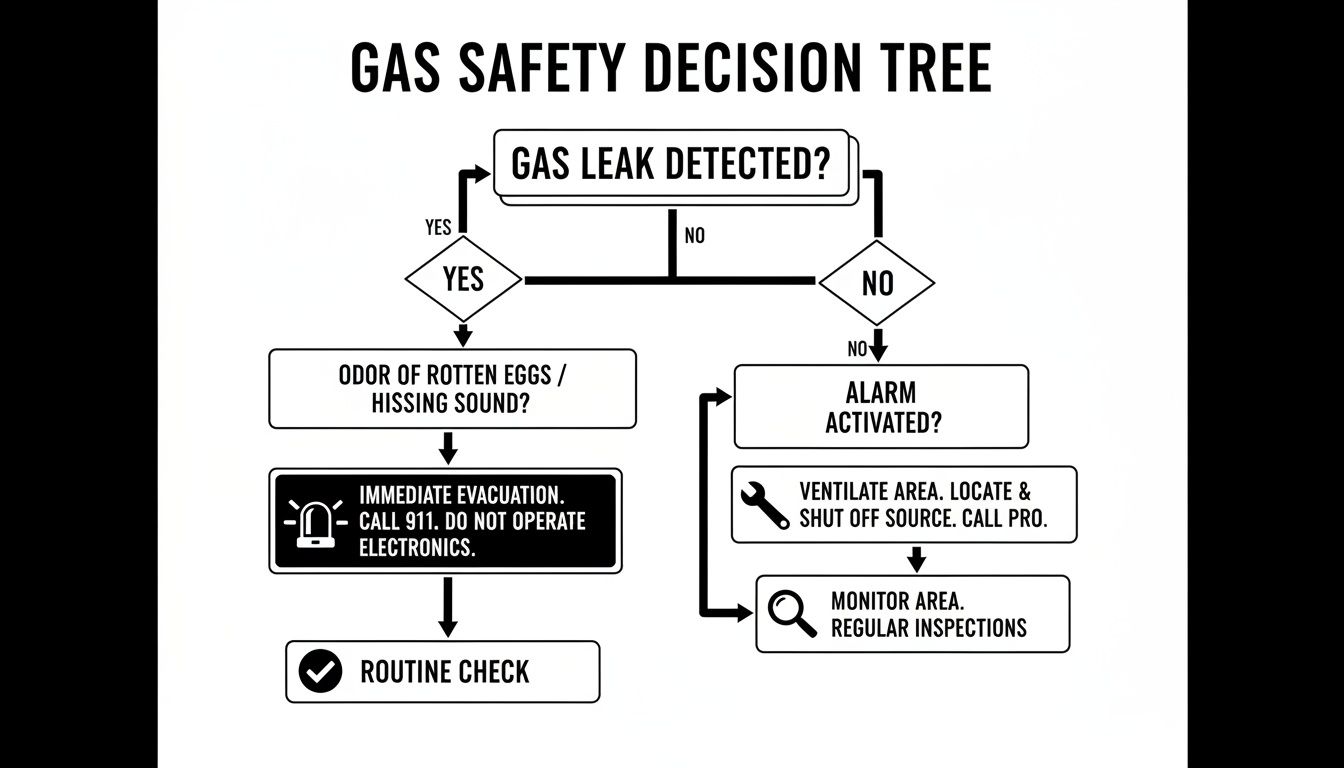
As you can see, if a leak happens, the lighter natural gas will rise and dissipate. But heavier LP gas sinks, pooling on the floor and creating a very different kind of hazard that requires specific safety protocols.
Real-World Recommendations for Washington Businesses
Let's break this down for a few Seattle-area scenarios:
- Seattle Coffee Shop: Most of your gear is probably electric, but you’ve got a gas-powered panini press or a small range. Natural gas is perfect. The low, steady demand makes it a super easy and cheap way to power that extra equipment alongside your main Seattle coffee shop refrigerator.
- Mobile Food Truck: It’s LP gas, no question. You need that intense heat for griddles and fryers, and you need it in a compact, mobile package that can power your entire kitchen on wheels.
- High-Volume Restaurant: Any large restaurant with multiple ranges, ovens, and sandwich prep tables will see the biggest benefit from the sheer reliability and lower per-unit cost of natural gas.
From an environmental standpoint, LP gas is proving to be a versatile choice for Washington's dynamic food scene. LPG, which is mostly propane pulled from natural gas processing, actually puts out way less CO2 than other fossil fuels and powers over a billion homes worldwide. While natural gas is cleaner than oil, its total reliance on pipelines just doesn't work for the growing number of mobile businesses in our market. You can learn more about the global LPG market on Mordor Intelligence to see the trends.
Common Questions Answered
When you're deciding between LP and natural gas, a few key questions always come up. For restaurant operators, getting straight answers is crucial for making a decision that’s safe, efficient, and good for the bottom line. Here are the most common things we get asked by foodservice pros across Washington.
Can I Convert Any Gas Appliance From Natural Gas to LP?
While most modern commercial gas equipment is built to be convertible, you can't just assume it is. It's not a universal guarantee. Before you buy anything, you have to check with the manufacturer to make sure a specific conversion kit is available for your exact model, whether it’s a high-output deep fryer or a simple six-burner range.
The conversion itself is a precise job. It requires a certified technician to swap out the orifices and install the right pressure regulator. Trying to DIY a conversion on your expensive Seattle bar equipment is a terrible idea—it's incredibly dangerous, instantly voids the warranty, and is guaranteed to fail a safety inspection. This is one of those times when calling a pro is non-negotiable.
Is Natural Gas Always Cheaper Than Propane for a Restaurant?
Looking strictly at the cost per BTU, natural gas from a utility line is almost always going to be cheaper than propane. The convenience of being hooked up to the grid makes it a great choice for powering everything from your cooktops to the water heater connected to a commercial freezer's defrost system.
However, the real cost depends entirely on where your restaurant is located and what infrastructure is already there. If your business is in a rural spot without access to a gas main, the thousands of dollars it would take to extend a line could easily make propane the smarter financial choice. And for a food truck that relies on a compact under counter freezer and griddle, propane isn't just an option—it's the only practical solution.
The biggest safety difference comes down to gas density. Natural gas is lighter than air, so it rises and dissipates during a leak. Propane is heavier than air and will sink, pooling in low-lying areas and creating a serious ignition hazard.
What Are the Main Safety Differences I Should Know?
That density difference changes everything about your safety setup. If your kitchen uses natural gas, your gas detectors need to be installed up high, near the ceiling, to catch the rising gas. On the other hand, a kitchen running on LP gas needs detectors placed low to the ground to pick up on any pooling propane.
Getting this right is absolutely critical for passing Washington state fire code inspections and keeping your staff and customers safe.
Do I Need Different Equipment for LP Gas vs. Natural Gas?
You don't need totally different appliances, but the equipment must be configured for the specific gas you’re using. An appliance built for natural gas, like a pizza prep table with an integrated oven, won't run safely or efficiently on LP gas without a proper conversion. The internal parts, especially the pressure regulator and orifices, have to be changed out by a technician to match the fuel's properties. Always, always confirm compatibility before you buy.
At Seattle Restaurant Equipment, we do more than just sell boxes. We help you find the right gas-powered appliances and make sure they’re perfectly set up for your fuel source, whether you're outfitting a downtown restaurant or a new food truck. Find the reliable, commercial-grade equipment your kitchen needs by visiting us at https://seattlerestaurantequipment.com.